From the Newsletter
Bigger Pie, Thinner Slice, Better Customers
AI is creating far more questions than search ever handled, and each answer names only a few businesses. Which few depends on what the AI knows about the person asking, and on what it can find about you.

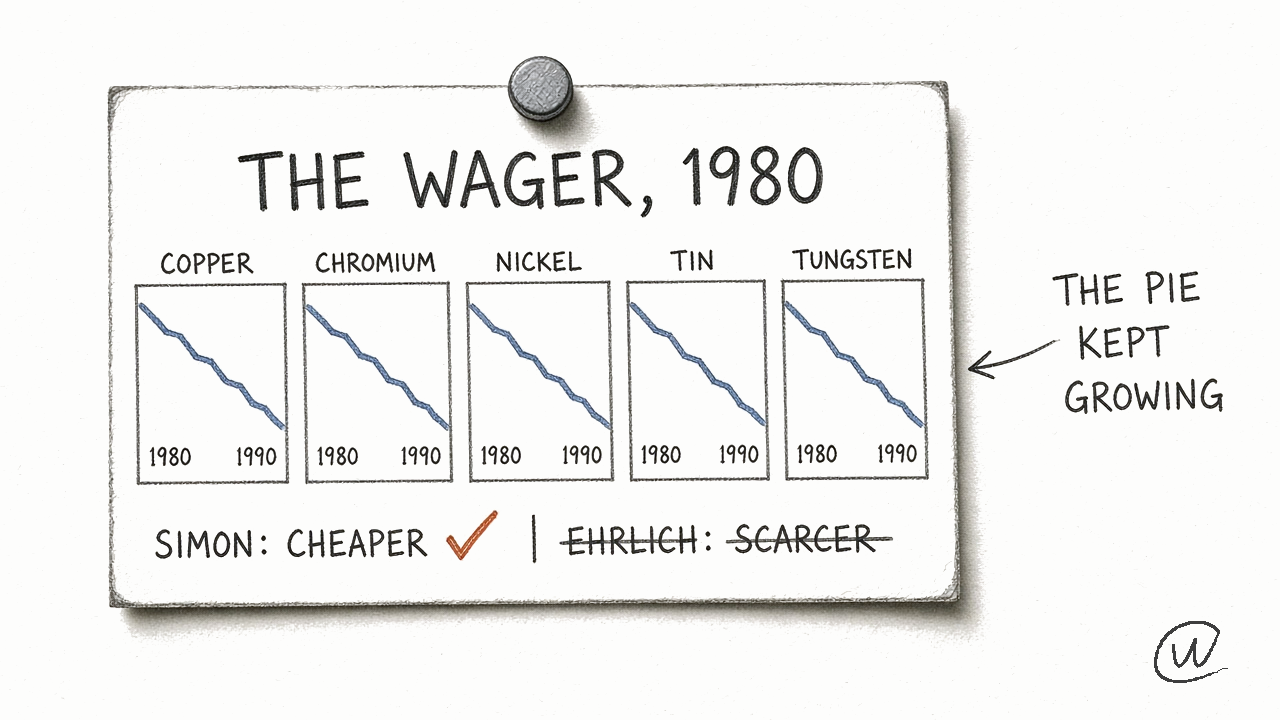
In 1980, the biologist Paul Ehrlich and the economist Julian Simon made a bet.
Ehrlich had been famous since The Population Bomb in 1968, and he expected a growing world to run short of raw materials. Simon expected the opposite. In his view, when something gets scarce the price goes up, and people respond by using less, looking for new supply, inventing substitutes and recycling. Eventually the price ends up lower than where it started.
Simon offered to stake up to $10,000 on that idea. Ehrlich and two colleagues, John Holdren and John Harte, took him up on it for $1,000. They picked five metals (chromium, copper, nickel, tin and tungsten), put $200 on each, and gave it ten years, adjusted for inflation.
By 1990 all five were cheaper. The basket had fallen about 36% in real terms, and Ehrlich mailed Simon a check for $576.07.
I'd be overselling it if I stopped there.
Economists still argue about whether Simon was right or lucky. When Our World in Data replayed the bet decade by decade back to 1900, it found "Simon and Ehrlich would both have won around half the time."
A 2010 study in Ecological Economics by Katherine Kiel, Victor Matheson and Kevin Golembiewski, "Luck or skill? An examination of the Ehrlich–Simon bet", found Ehrlich would have won 61.2% of ten-year windows in inflation-adjusted terms. Gale Pooley and Marian Tupy, who are both affiliated with the Cato Institute, measured prices in the hours of work it takes to buy them and found Simon would have won 54.2%.
Simon conceded the point himself. "Commentators said that a single bet proves little, and they are right. Hence I offered to repeat the wager, but there were no takers," he wrote later.
The long view is kinder to him. The world now produces 40 times as much copper a year and 250 times as much nickel as it did in 1900, and Our World in Data says the long-term price story is "more in line with Simon's worldview".
His book The Ultimate Resource (1981) explains why he kept betting on abundance. In the preface to the second edition he put it this way.
"The main fuel to speed the world's progress is our stock of knowledge, and the brake is our lack of imagination. The ultimate resource is people--skilled, spirited, and hopeful people--who will exert their wills and imaginations for their own benefit as well as in a spirit of faith and social concern."
Swap metals for questions, and that first sentence describes what is happening to search. The fuel is knowledge. The brake is whatever we leave out.
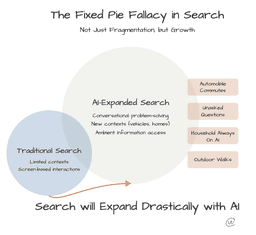
In July 2025 I wrote Search Fragmentation Grows the Pie. Analysts were watching Google lose share to ChatGPT, Claude and Perplexity and treating it like a fight over a fixed pie. I argued AI was adding questions that never would have been typed into a search box.
Fifteen months later, Google's own numbers say the pie got bigger.
In April, Sundar Pichai told investors that "queries are at an all time high." In July he called it "an expansionary moment," and Alphabet's earnings release said "Our popular AI features are driving Search query growth." AI Mode passed 1 billion monthly users, and Google says it is "driving an incremental increase in Search queries overall."
ChatGPT kept growing at the same time. It reached 1.2 billion weekly users at the end of September.
In February 2024, Gartner predicted "By 2026, traditional search engine volume will drop 25%." It's 2026, and Google is reporting record queries.
The questions changed shape, too. Google says the average AI Mode search is "triple the length of a traditional Search query," and more than 1 in 6 U.S. searches now use voice or images. Those are exactly the questions that typing used to discourage.
And one question no longer means one search. Google describes AI Mode breaking a question into subtopics and "issuing a multitude of queries simultaneously on your behalf." Its Deep Search "can issue hundreds of searches". Every one of those is another chance for your business to be included or left out.
A bigger pie hasn't meant more traffic for the businesses in it.
Rand Fishkin's own research shows this. SparkToro and Similarweb found that "In the first four months of 2026, a whopping 68.01% of Google searches ended without a click." In 2024 it was 60.45%. Ten years ago it was about 45%.
So some of this is a long trend. SparkToro ties the recent jump to AI Overviews, which it says cut click-through by nearly 60% when they appear.
Ahrefs looked at 300,000 keywords and found that an AI Overview goes with a 58% lower click-through rate for the top-ranking page. In their words, "For every 100 clicks you could historically earn for a top-ranking page, Google now 'keeps' 58."
Pew Research Center tracked the browsing of 900 U.S. adults and found they clicked a traditional result in 8% of visits when an AI summary appeared, against 15% when it didn't. Longer searches were far more likely to get the summary. Just 8% of one- or two-word searches got one, compared with 53% of searches with 10 words or more.
That ties the two halves together. The longer, more conversational questions growing the pie are the same ones most likely to be answered on the spot.
Local answers are even tighter. BrightLocal ran more than 200,000 local prompts and found ChatGPT names 4.1 businesses per answer on average, Google AI Mode 3.5 and AI Overviews 2.5. Google Maps mentioned a tracked business in 66% of searches. The AI surfaces managed 32 to 38%.
Ten blue links turned into a shortlist of three or four.
Getting on that shortlist is most of the game. Seer Interactive found that brands cited inside an AI Overview get "+120% more organic clicks per impression versus when you are not cited," while brands left out saw click-through fall 67% over 2025. Seer is careful to add, "We cannot claim causation. Higher-authority brands are also more likely to be cited."
The lists aren't only getting shorter, either. Parse found Google AI Mode's median answer grew from 4 named brands to 6 between June and August. But "The extra brand slots are mostly going to brands already in each market's pool, not to new entrants."
So the pie grows, each answer still seats only a handful of businesses, and the seats go to the ones the AI already knows.
Rand recently argued on LinkedIn that marketers are finally investing in PR, YouTube, Reddit, LinkedIn articles and other distribution only because it might influence AI. His estimate is that "AI influences maybe, at the outside, 30%, perhaps up to 40% of your buyer journeys. And that's if you're in a very heavy-AI-use sector. For most consumer journeys, and plenty in B2B, it's under 10%."
That's his estimate, and I'm not going to argue the range.
My issue is with the unit. Having a conversation is a different act from running a search, so a count of searches and a count of conversations can't really be compared.
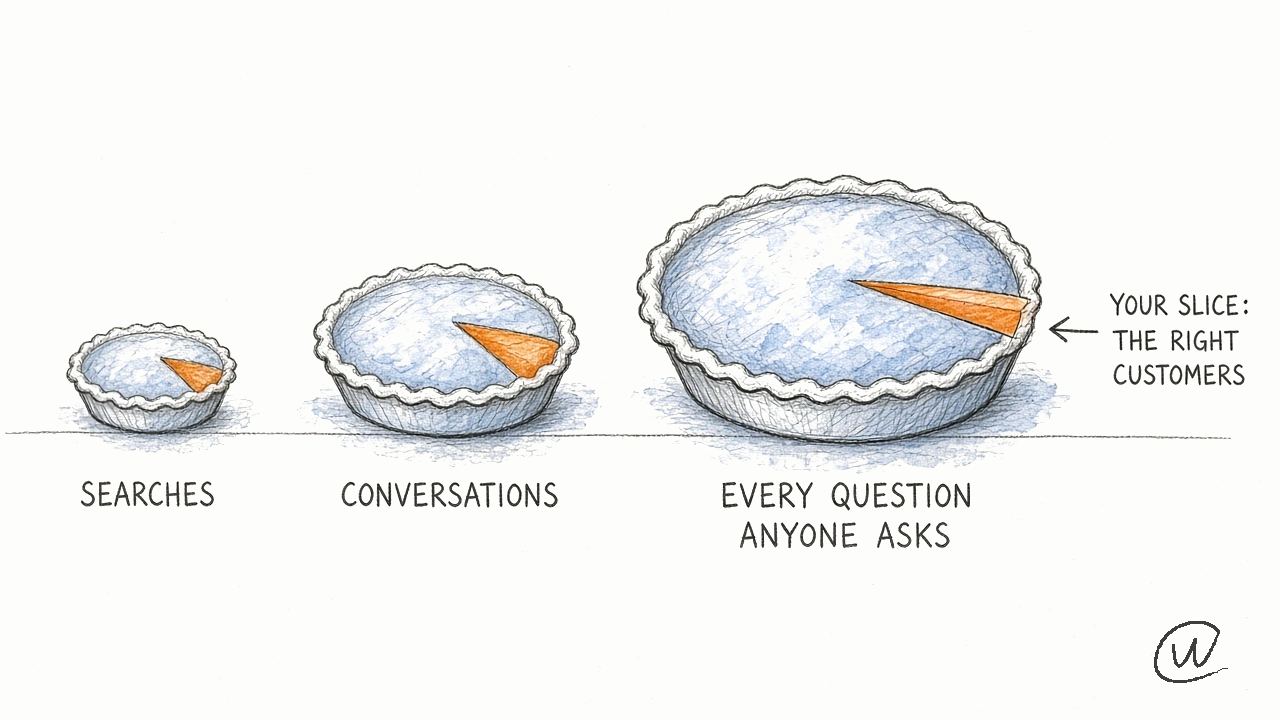
The usage numbers behind this debate mostly come from clickstream panels, which track the sites a sample of people visit on their computers. In SparkToro and Datos data, AI tools made up 3.2% of desktop searches. Rand's framing there is generous to AI. Even if you "assume every prompt is a search-equivalent," he wrote, Google dwarfs them.
I think the assumption is the problem.
A prompt carries what you said five minutes ago, and with memory, what you told the AI five months ago. Google's chief business officer, Philipp Schindler, described the change on the company's April earnings call. "People no longer search in fragments; they search conversationally and share more context." One of those conversations can fan out into many searches behind the scenes.
The same panel data also can't see the AI inside Google. Rand says so himself, writing that "Most AI Search and AI Answers happen on Google." AI Overviews have more than 2.5 billion monthly users.
And the line between the two is about to blur.
I think it's highly likely Google moves more to a conversational interface than classic search by the end of this year or early next year. They're losing a ton of context to their competition by sticking with the search bar, and they've already started changing how the search bar behaves. AI Mode was one step. Personal Intelligence, an opt-in feature that Google says "selects recommendations just for you, right from the start," was another.
Once Google's front door is a conversation, counting searches against conversations won't tell anyone much.
On October 12 I'm giving the keynote in Marbella at the conference of SIINDA, a European non-profit association that connects local search, digital marketing and technology companies from around the world. I'm bringing back a game I first used at SIINDA in 2021.
Guess Who.
If you never played it, each player gets a board of faces. You take turns asking yes-or-no questions and flipping down everyone who doesn't fit, and the first person to name the mystery face wins. There's a best first question, and a smart path after it.
That's how classic search worked. You asked, the engine knocked out what didn't match, and one of the survivors came out on top. Fixed rules, a right move, game over. It was a finite game.
In 2021 I told that room it was all going to change. AI search is an infinite game, to borrow the idea James Carse laid out in his 1986 book Finite and Infinite Games. As I wrote in When Search is No Longer a Finite Game, the point of an infinite game is to keep playing.
What I've had to revisit is the timing. With context and memory, the board changes before the question even arrives.
Say I tell an AI I want to work on my health this year. A bunch of businesses fall off my board, and they may never show up for me again. That doesn't happen in classic search.
Then I mention I went to the University of Florida, and the board changes again. It might skip a guy who does gutters because he went to a rival college. It's funny, but I have friends who literally won't hire a lawn service, gutter cleaner or mechanic who roots for the wrong team. Every person weights context differently, and the AI picks up on those clues even when you'd never think they matter.
Then it remembers I'm a left-handed beginner golfer, and that I'm headed to Spain. By the time I ask whether I can get lessons there, most of the board is already face down.
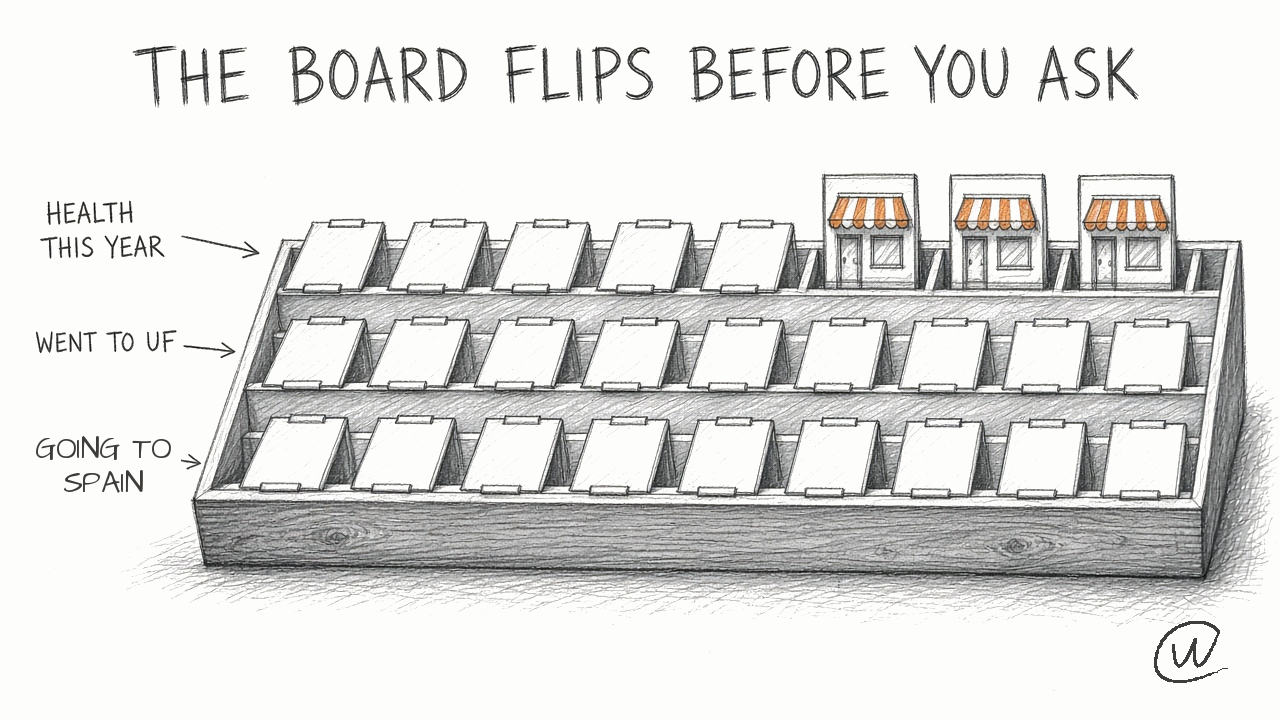
So when the question finally comes, best has already been customized. That's why I keep telling audiences that best will never mean one thing ever again. You can be the U.S. News & World Report pick in your category, and nobody will care if you aren't the best for them.
The research is starting to measure this. A May preprint from researchers at an AI-visibility company told the models who was asking and found that "mid-market brands swap up to 75% of the recommendation set as the persona changes," while category leaders stayed about 80% consistent.
A UK study of logged-in history, posted online as a preprint that hasn't been peer reviewed, found the brand set shifted 16 points on ChatGPT and 33 points on Gemini. Claude showed no detected difference, and most of the core list held.
Parse found that two phrasings of the same buyer question shared just 11.7% of named brands, and that "Adding situational detail steers the engine harder than syntax does."
Category leaders get named almost no matter who's asking. Everyone else has to match the person's context, and the AI can only match what it knows.
So yes, your share is shrinking. I don't think that's so bad.
If you've provided every fact you can think of about why your business is right for a given audience and purpose, and some people still aren't seeing you, many of those people weren't a good fit anyway.
Anyone who has been in business for a while knows the joyful understanding that comes with that. Not every customer is a good customer for you.
In that July 2025 post I joked that if I tell an assistant I'm vegetarian, well... no more steakhouse ads. A steakhouse that falls off a vegetarian's board hasn't lost much.
The trouble is the other kind of shrinking. If the AI drops you because you aren't a fit, fine. If it drops you because it never knew you were a fit, you just lost the customers you actually wanted.
A disclosure first. I'm the Chief Data Officer at Yext, and several studies in this section are Yext research. Where independent work exists, I've leaned on it.
BrightLocal studied almost 2 million local AI citations and found Google Business Profile was cited for 94.17% of the businesses it tracked. "Around 93% of the domains cited were individual business websites." Reddit was 1.79% of citations.
A Yext study of 6.8 million AI citations landed in the same place, with 86% coming from "sources brands already control, such as websites and listings." I'm quoted in that release.
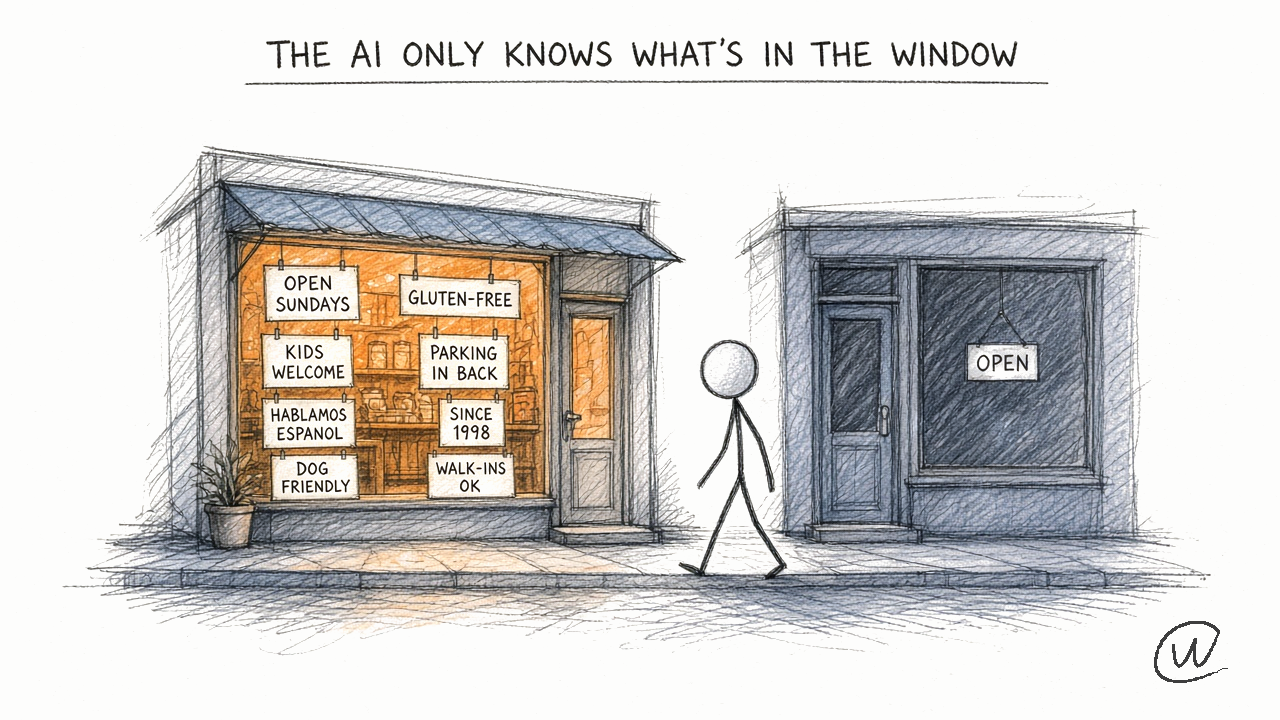
So most of what an AI says about a local business comes from the business.
When the facts are missing, the AI answers anyway. A Yext study of 1.76 million AI answers found walk-ins came up in 35.95% of answers, yet only 0.66% of the providers offered that field had marked "Accepts walk-ins" as yes. Breakfast was marked by 45.27% of restaurants and mentioned in 68.37% of answers. Yext is clear that it didn't measure what happens after a business fills a field in.
Another Yext study looked at nearly 492,000 local cases where four AI engines answered the same question. They agreed on the top business only 4% of the time. The businesses all four agreed on had 95% profile completeness against 80% for the typical field, and 91% had their own website among the cited pages. The highest-rated business on a list ranked first only 40% of the time, and Yext notes "The study is not claiming that one field alone causes selection."
Rand's point about distribution shows up here too, and the data is with him. Ahrefs studied 75,000 brands and found YouTube mentions had the strongest correlation with AI visibility (about 0.737), with branded web mentions close behind. The number of pages on a site barely registered (about 0.194). The places your audience spends time seem to be where the AI does its reading, too.
I hate to use the term, but I've been calling all of this knowledge maxing. "The only way you'll be considered on the other side of a conversation that you have no knowledge of is by knowledge maxing everything about your business."
It's the same fuel Simon wrote about, the stock of knowledge, except now each business has to add its own.
I've been putting it more bluntly to my team as we build the talk. The only way you're going to win is by putting "every freaking fact you have about your business, who you are, what you do into Yext."
On stage, I'll give the room five things. "You can add more data, more content, more distribution, more updates, and easier interactions."
- More data. Fill in every attribute, especially the ones that feel too small to matter, like walk-ins, breakfast, parking or the language spoken at the counter.
- More content. Yext found that "Intent queries landed on intent pages more often than on local pages." If you never published the page for a specific need, the AI has nothing of yours to cite.
- More distribution. Your own website and listings first, then the places your audience already spends time, YouTube included.
- More updates. Yext found locations on 50 or more live platforms got 150% more customer actions the next month than locations on 1 to 20, and more update days went with more actions too. That's a correlation, and Yext notes that brand demand, industry and location size may also play a part.
- Easier interactions. In 2025 I wrote that "Brands must supply structured offers that AI can call at the moment of need." Make it easy for a person, or an agent working for one, to book, call or order.
Get More Where This Came From
One letter a week, mostly. AI frameworks and data strategy for people who have to make the call.