From the Newsletter
Search Fragmentation Grows the Pie
Browser Fragmentation is a New Accelerant and Opportunity

The conventional wisdom about search fragmentation contains a blind spot. We've seen this many times before when a market undergoes a significant innovation or restructuring.
Market analysts tracking Google's declining share of search queries interpret this as redistribution within a fixed market (or pie). They measure ChatGPT's growing usage, Claude's growth, and Perplexity's expanding query volume and conclude that Google is losing ground. This is a mistake.
And this perspective completely misunderstands what's happening.
The Fixed Pie Fallacy
Economist Julian Simon spent decades challenging the "fixed pie" assumption in resource economics. In The Ultimate Resource (1981), Simon argued that apparent scarcity often masks untapped abundance. When pie-fixated thinking dominates, we miss the mechanisms that expand total availability.
The same fallacy distorts our understanding of search fragmentation. When Google's search impression volume plateaus or declines, analysts assume the total search market is contracting. They see billions of queries moving to ChatGPT, Gemini, Grok, and Perplexity and frame this as redistribution.
But search isn't a zero-sum game.
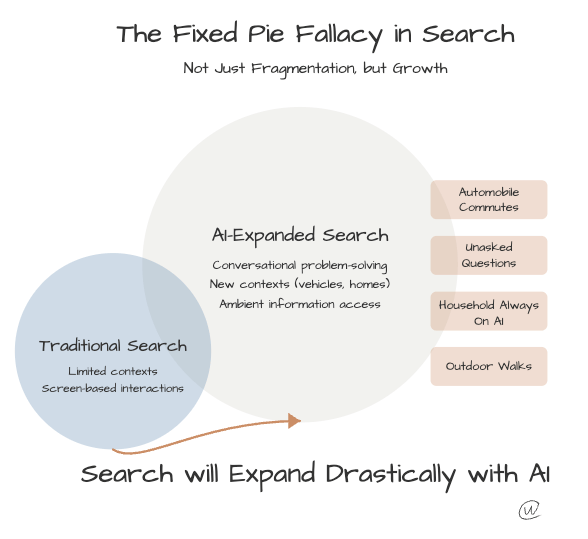
What's actually happening is expansion. AI-driven search surfaces billions of queries that were never practical through traditional keyword interfaces. These new queries come from places where typing was impossible or inefficient, like voice interactions in vehicles, quick clarifications through wearables, ambient questions in smart homes, and specialized inquiries within workplace RAG tools.
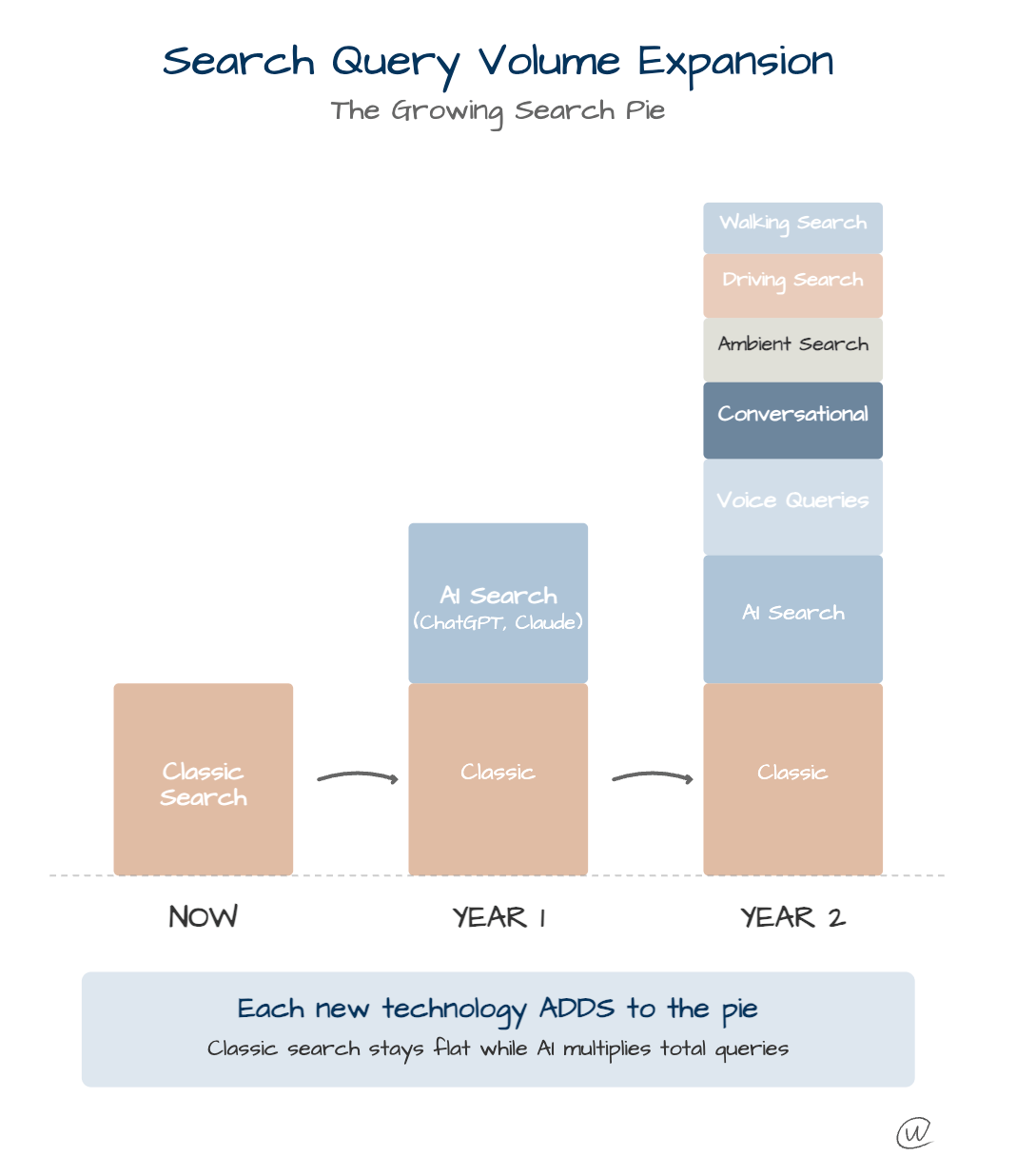
There will be so much more Search.
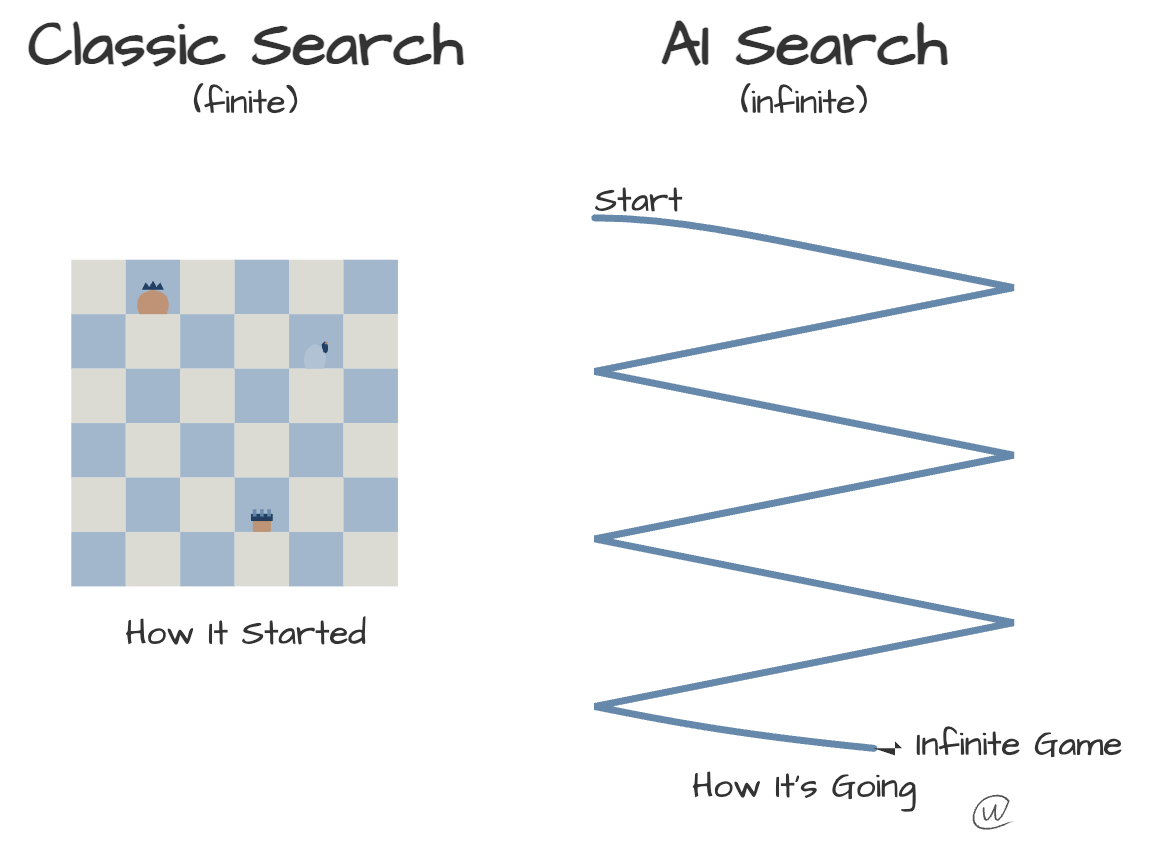
As detailed in my earlier analysis of the infinite game nature of search, the total addressable market for information queries is close to unlimited. The real limit has always been interface friction.
Three Independent Fragmentations
Search is fragmenting in three separate ways at the same time. The three are connected, but each one works through its own mechanism and expands the market in its own way.
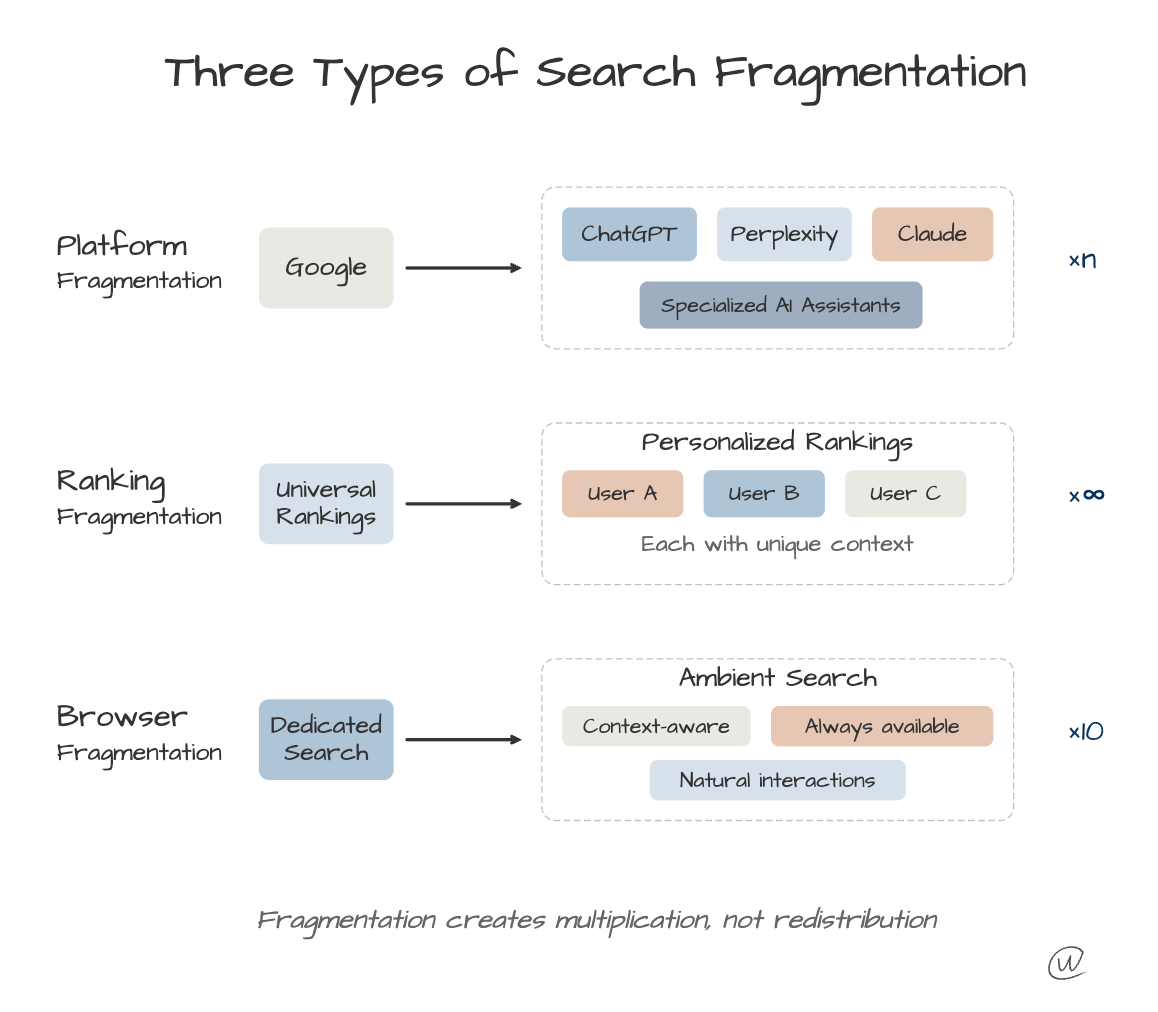
This is a combinatorial explosion of Search.
Platform Fragmentation
Users no longer default to a single search engine. Instead, they maintain a portfolio of specialized models at the ready.
Morning news updates might come through Perplexity. Creative brainstorming sessions flow through Claude. Technical troubleshooting runs through ChatGPT. Domain-specific questions route to specialized AI assistants. Workplace queries hit internal RAG systems.
This diversification adds query volume rather than simply redistributing it. Each platform optimizes for different intents and contexts.
The same person who searches "restaurants near me" on Google might also ask Claude for recipe modifications and query their company's internal assistant about dietary policies. All three of those queries add to the total.
The multiplication effect intensifies as each platform develops unique capabilities. Gemini's multimodal processing surfaces visual queries that never existed in text-only environments. Grok's real-time data integration enables time-sensitive questions that traditional search couldn't handle effectively. ChatGPT's reasoning handles complex analytical queries that would have required multiple traditional searches.
Ranking Fragmentation
Memory-enabled systems alter how results get ordered. Instead of universal authority signals determining rankings, personal context shapes every response. The same query now yields millions of different rank orders, one per user profile.
This goes further than the personalization we're used to. AI systems with persistent memory adjust rankings based on past behavior, and then they keep going.
They rebuild what counts as relevant for each individual. As I explored in my analysis of AI memory features, these systems create personalized knowledge graphs that evolve with each interaction.
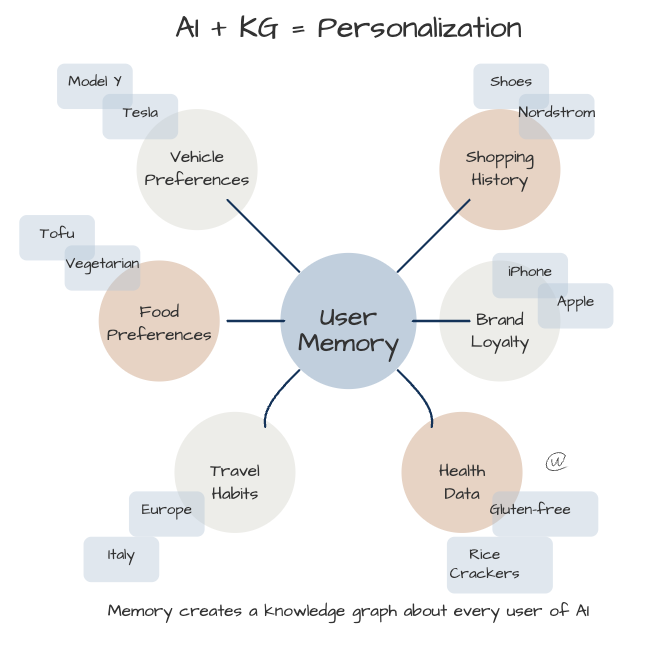
A query about "best project management tools" might surface completely different results for a startup founder and a Fortune 500 operations manager. The tools on the market are the same. What changes is how well the AI understands each person's constraints and past preferences. This personalization multiplies the effective search surface area exponentially.
Browser Fragmentation
The newest shift is in where search starts. Traditional browsers separate search from browsing by using dedicated search engine homepages (or the top navigation bar, known as the Omnibox).
AI-native browsers, on the other hand, embed search directly into the browsing experience and produce an agentic extension of the web.
Perplexity's Comet browser is a good example. Rather than going to a search engine, users interact with AI capabilities throughout their browsing session. Questions emerge naturally from what they're reading and watching, without a deliberate trip to a search box.
OpenAI's anticipated browser release will likely accelerate this trend. When search becomes ambient rather than intentional, query volume multiplies dramatically. Users ask questions they never would have typed into a traditional search box.

Context-aware browsers reduce the friction between curiosity and inquiry. Instead of switching tabs or apps to search, users can immediately query whatever they're viewing or thinking about. Casual wondering turns into a searchable query.
Strategic Implications for Businesses
The multiplication of search surfaces demands new approaches to visibility and measurement. Traditional SEO metrics become inadequate when queries fragment across platforms, rankings, and browsers.
Measurement Reset
Impression-based KPIs lose relevance when the same query produces different results for different users across various platforms. Track solved tasks or assisted decisions instead. Focus on query completion rates rather than click-through rates. Monitor how effectively your content answers questions rather than how often it appears in results.Data Strategy
Brands must supply structured offers that AI can call at the moment of need. This replaces ad auctions with real-time eligibility systems. Instead of bidding for keyword placement, businesses need to ensure their information is accessible when AI systems evaluate options for users.The shift requires rethinking content architecture. Rather than optimizing pages for search engines, optimize data for AI consumption. Create machine-readable specifications, pricing, availability, and capabilities that AI can access instantly.
Experience Design
Optimize for inclusion in personal memory graphs rather than universal top-ten lists. This means creating memorable, contextually relevant interactions that AI systems will recall when appropriate. Instead of pursuing broad visibility, focus on deep relevance for specific user contexts.
As I detailed in my analysis of the expanding search pie, this approach aligns with the shift from push-based discovery to pull-based assistance.
Resistance and Challenges
Several forces will slow or complicate search fragmentation.
Incumbent ad models rely heavily on repeat queries. When AI systems remember previous interactions and provide increasingly complete answers, users ask fewer follow-up questions. This reduces the query loops that drive advertising revenue, creating economic pressure to limit memory capabilities.
Google avoided making search that personal for years. I always thought it was because personal context would limit control over ad budgets. If I tell an assistant I'm vegetarian, well...
No more steakhouse ads, right?
Context and memory work against the ad model. I cover more of that when I write about AI assistants replacing ads with offers.
Privacy concerns will shape the amount of history an assistant retains, influencing the depth of ranking fragmentation.
Users may opt for limited memory to protect their privacy, thereby reducing the personalization that drives query multiplication.
Regulatory scrutiny may slow the rollout of always-on context capture. Governments concerned about data collection and market concentration might limit the ambient search capabilities that create new query surfaces.
Probably the greatest challenge, though, is the incumbent model.
In 1998, a paper titled "The Anatomy of a Large-Scale Hypertextual Web Search Engine," by founders Sergey Brin and Larry Page, posited that advertising could present a real problem. They put it plainly.
We expect that advertising funded search engines will be inherently biased towards the advertisers and away from the needs of the consumers.
Sergey Brin and Larry Page
However biased it may be, the search engine created from this paper (you can find here), has become one of the most successful business models of all time. Breaking that incumbent model, along with the user behavior and market grip built around it, will be a massive challenge.
The Abundance Paradigm
Julian Simon's insight about resource abundance applies perfectly to information discovery. When we viewed search as scarce, limited by typing speed, query formulation skills, and interface friction, we built systems to ration it. Keyword bidding. Ten blue links. Winner-take-all rankings.
The fragmentation reveals that abundance was always there, waiting for interfaces good enough to reach it.
Google's search market share dipped below 90% for the first time since 2015 because people are now searching everywhere. ChatGPT alone processes over 1 billion queries daily, queries that never would have existed in keyword-based search.

The businesses that do well in this transition will stop defending yesterday's metrics and start planning for a world where asking one more question costs almost nothing.
Three immediate actions for companies
Instrument for Multiplication
Stop measuring the share of searches. Start measuring problems solved across all platforms where your audience seeks answers.Design for Memory
Position #1 matters less now. Your content is competing to become part of personal AI knowledge graphs that persist across sessions.Prepare for Ambient Discovery
When browsers become active agents, your information needs to be discoverable through a person's context and intent, along with the keywords they type.
The search pie is multiplying.
Multiple pies are being baked simultaneously, each one larger than the last.
Human curiosity was always there. The poverty of our interfaces held it back.
Looking Back
Looking back from September 2026.
The pie is not only growing. It's also splitting up into billions of individual pies, and each of those is growing on its own.
My own search behavior has changed and increased, particularly now that AI can keep an ongoing check running, like a cron job, looking for more things later or inside the applications I use every day. The searching keeps expanding.
And it's becoming completely custom and contextual to every user.


