Quick Take
The Expanding Search Pie: How AI Will Transform Information Discovery
Beyond Fragmentation: Why AI Will Create Explosive Growth in Search

The conversation about AI and search has been missing something.
I think we've been measuring adoption wrong.
The standard narrative says we're fighting over slices of a fixed search market. Google defends its territory while Claude, Perplexity and others carve out small pieces of the existing pie. I don't buy it.
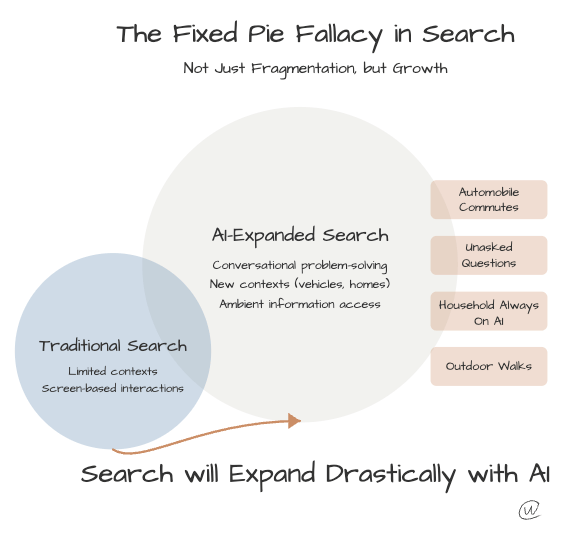
What we're witnessing is expansion.
The Fixed Pie Fallacy in Search
Most analysts see AI as redistributing existing search traffic. They're wrong.
This reflects what economist Julian Simon called the "fixed pie fallacy" (Simon, 1981). Simon argued that population growth increases our "stock of useful knowledge." The same principle applies to AI's impact on search.
The assumption that search volume is finite limits our understanding. Traditional search only captures a fraction of our information needs.
Think about how many questions go unasked because typing a query feels like too much work.
Consider how many complex problems never reach a search engine because we know it can't handle a request with that many moving parts.
I see this in my own use. Because AI has context, I talk to it about home projects, business ideas, writing projects, family scheduling, tax law, politics, you name it. Each one of those could be a search. Realistically, though, I'm no longer the one who has to compile, compute and synthesize all of that data. That alone changes how much I ask.
The unasked questions are incredibly easy to ask now. I even took a photo of my barbecue grill starter because I didn't know how to fix it. The AI guessed the circuit breaker on the first try.
Every day, billions of potential searches never happen.

AI will take some pieces of the current search market. More importantly, it's creating a new and much larger market for information discovery.
New Contexts Will Drive Search Expansion
AI will create Search opportunities in contexts where traditional search was impossible or impractical.
Your 40-minute commute becomes productive when your car has conversational AI that can answer your questions and also take action based on what you need.
Your smart home gets far more useful when devices can hold a Claude-like conversation and stop responding with "I don't know that."
Education changes when AI can guide learning through natural conversation instead of keyword matching.
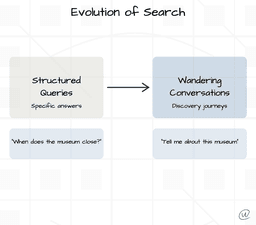
The move from "searching for information" to "conversational problem-solving" changes what search is for.
I expect the growth from these new contexts to be exponential.

Companies fighting over today's search market are fighting over the old pie. The bigger opportunity is in search contexts that don't exist yet.
The Business Impact of an Expanded Search Pie
For businesses, this is a big deal. Companies positioned for the expansion will thrive.
Those focused solely on capturing Google's market share are playing the wrong game.
Success depends on seeing AI search as a different market, with its own user behaviors and business models.
When search becomes ambient and conversational, usage patterns change dramatically. People ask different questions. They expect different outcomes.
The value moves from "finding information" to "solving problems through conversation."
That opens room for specialized AI search experiences built for particular contexts and needs.
Preparing for the AI Search Expansion
Smart companies will focus on creating value in new search contexts and leave the head-on fight with established players alone.
Start by looking hard at four things in your industry.
The search needs that traditional search engines can't address.
How conversational AI could change information discovery for your customers.
The unique data or expertise you could contribute to specialized search experiences.
The overlooked opportunities in always-on, ambient search contexts.
The companies that work these out will define the next decade of search.

The Overlooked Obstacles
Not everyone sees this expansion coming. Many analysts remain fixated on market share battles between Google and new AI search tools.
A few things keep that view narrow.
Our measurement systems track existing search behavior and miss the potential searches that never happen.
Industry analysts focus on competition within established markets, and market creation gets far less attention.
The words we use, like "search engine," "query" and "results," frame our thinking around traditional models.
Getting past these limits means accepting that much of the future search market doesn't exist yet.
It will emerge as AI makes information discovery possible in new contexts.
What "Always-On" AI Search Looks Like
Imagine walking through your day with an AI companion that knows your context and anticipates your information needs.
Your morning commute includes catching up on industry news without looking at a screen.
A question about dinner triggers recipe suggestions and a check of your pantry inventory and dietary preferences.
At work, hard questions get answers pitched to your expertise and what you already know.
Your smart home responds to casual wonderings that would never have become formal search queries.
"I wonder when that movie is playing" becomes a conversation about showtimes and reviews that ends with tickets purchased.
"The lawn looks long" triggers your AI to schedule the robotic mower.
Each of these is search activity that wouldn't exist in traditional search.
Add all of it up and search multiplies.
Action Steps for Businesses
Here's where I'd start if your business wants to grow with the expanding search pie.
Identify opportunities for AI-enabled search in your specific domain.
Invest in conversational AI capabilities that address unmet search needs.
Focus on creating value in contexts where traditional search falls short.
Build data assets that enable specialized search experiences.
Develop metrics that capture the expanded definition of search activity.
The winners will be the companies that imagine and build entirely new search contexts.
Once search is conversational and continuous, the question for any business gets very practical.
Which of your customers' problems could new forms of information discovery solve?
The answer will shape your position in the AI-driven future of search.
The search pie is growing beyond recognition.
That leaves plenty of room for more than one winner.
Looking Back
Looking back from September 2026.
Since I first wrote this, the commute I described has shown up for real. People are literally sitting in their Teslas talking to Grok Bot.
I've also watched search change in another way. Search used to happen at one time. Now it can run through time.
You can have AI search for the best deal or opportunity indefinitely. Before, catching something like that the moment it became available online took sheer luck or utterly persistent attempts.
This ties closely to turning search into an infinite game, which I've touched on in other posts.