From the Newsletter
Bigger Models Can't Fix What Nobody Wrote Down
Everyone's racing to build smarter AI, and the missing piece is still in your people's heads.

I spent this week in New York at Envision with a room full of partners, clients and a lot of our team.
We launched Scout there as a multiplayer agent harness, which lets marketing teams, partners and agents work from the same shared context. Mike Walrath, our CEO, called his keynote "a love letter to marketers."
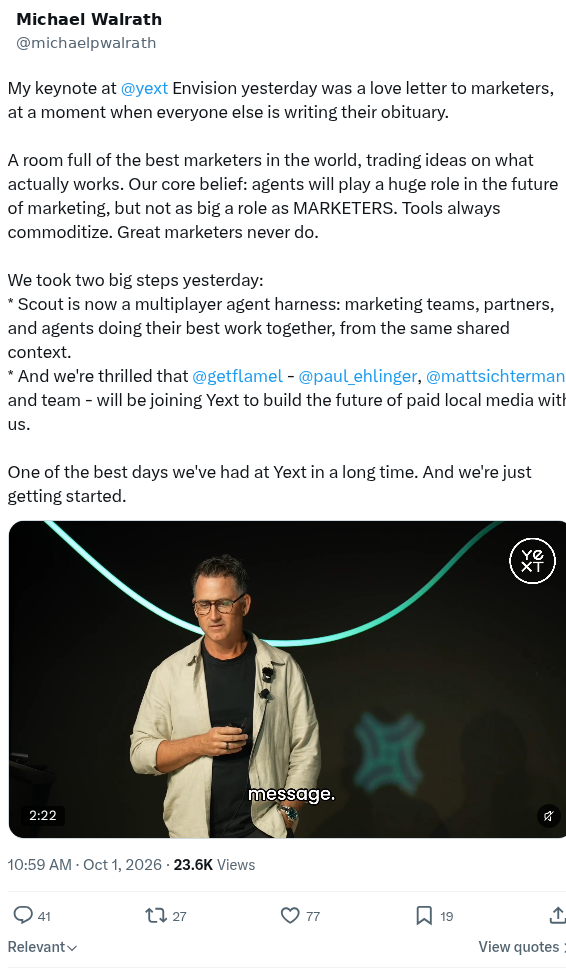
What surprised me was how well the marketers I spent time with already understand the technology. For them, the work now is gathering context, and doing it efficiently.
That reminded me how much better the models keep getting at holding onto what you give them.
When I went back through the week's news, most of it was about how much more AI can hold and do, and very little was about where the context comes from.
Google says Gemini 4 Argon is built to "sustain deep reasoning across complex, long-horizon workflows."
Google also raised how much Argon can write in a single run, to 1M tokens from 64K, so it can stay on a long job much longer. It's rolling out first to trusted cyber defenders, so it isn't broadly available yet.
The same week, Starburst CEO Justin Borgman told the Superintelligence newsletter about something he says agents can't do. His example is revenue, which can mean the number reported under generally accepted accounting principles (GAAP) or annual recurring revenue (ARR).
"A human can clarify what revenue means, GAAP versus ARR. An agent can't. It picks a definition and runs."
I have friends who work at Starburst, and he's built a hell of a company. He goes on to say the business context has to be available when the agent runs the query, and I agree with him there.
Where I think he's getting it fundamentally wrong is the idea that an agent can't tell the difference. It absolutely can, and if it doesn't know which one you mean, it can ask a follow-up question or someone can tell it once.
If anything, humans are the ones blurring that line. Plenty of companies talk about ARR as if it were the GAAP revenue on their audited books, and that habit is where the confusion starts.
A lot of very smart people still build their argument on what AI can't do, and those claims keep getting walked back.
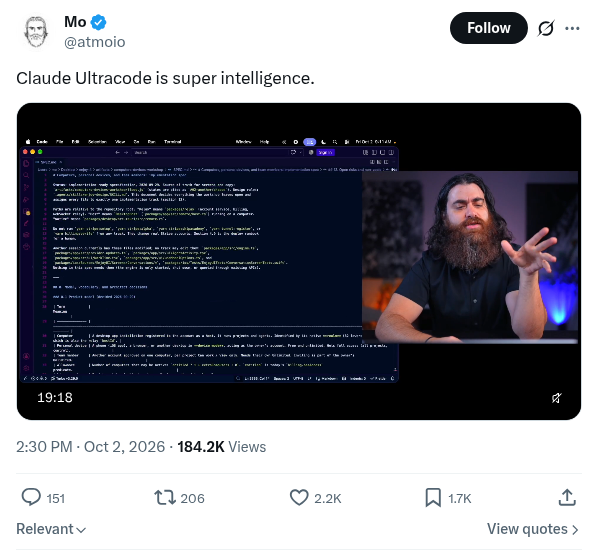
My favorite example is a 19-minute coding demo that Mo (@atmoio) posted with a single line, "Claude Ultracode is super intelligence."
The agent can make the distinction. What it needs is context, like which revenue number a given team actually reports on.
A model that can work through a longer job still needs somebody to give it that context first.
At DevDay, OpenAI introduced dots, which it calls "always-on agents built to handle everything." Meta expanded Muse so small businesses can connect the tools they already run on.
And Ethan Mollick, writing about both in The Dot and the Swarm, admits he changed his mind about how hard it would be to manage agents. "It turns out that organizing work is just one more thing AI can learn to do."
If AI can organize the work itself, managing a group of agents gets a lot easier and cheaper.
I didn't see anything this week that made a team's judgment or its context any easier to come by, and the agents still depend on both.
Mollick also says the more important thing about these agents is what you no longer have to tell them. I think that only holds when the context already lives somewhere the agent can reach.
NVIDIA released an open agent safety platform and borrowed a lesson from the early web to explain it. The internet got safe, they argue, when "the browser stopped trusting the code in the web pages explicitly."
Meta built a version of the same idea into Muse, promising that "nothing publishes, sends, or spends without your approval."
Line those stories up and most of the week was about capacity, meaning models that can take on longer jobs, agents that run all the time and in groups, and tighter limits on what those agents are allowed to do.
That's capacity on the machine side. Each of us has our own private capacity too.
It's what we know, what we've noticed, what we've figured out doing the job, and an agent can't use any of it until it gets out of our heads.
That was the point of my talk at Envision. As more of the context ends up inside platforms we don't control, real-time data and more of our own knowledge are the best answer I know of.
I pointed the room to the research we've published.
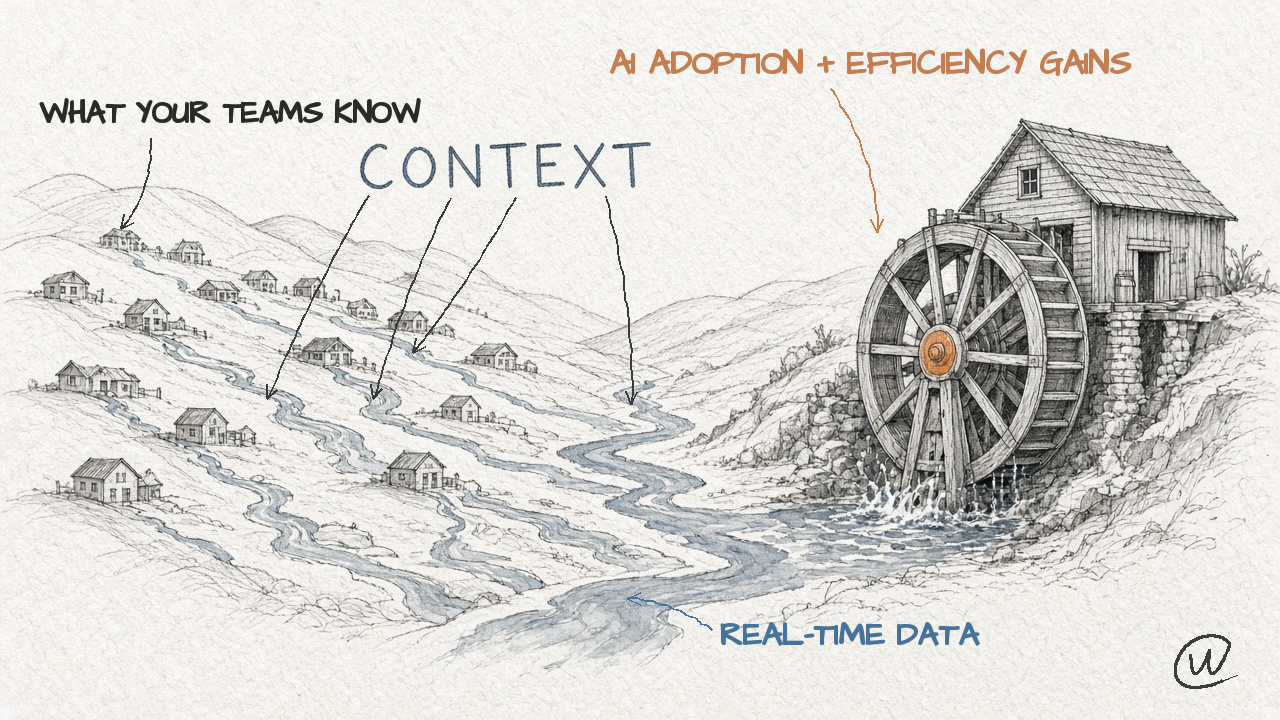
Scale makes this harder. A business with tens of thousands of locations around the world has its knowledge spread across a lot of people in a lot of places.
Context comes off every one of those people like a small stream.
One stream doesn't move much. When they all run together, they can turn something as big as search.
The work is getting what your own teams know into a place agents can use. That's what we built Scout to do, and I think every platform will end up having to solve the same problem.
I wrote back in May that AI agents need real-time data. Memory and context will keep getting better, and that only helps if what goes into them is current.
I'm most excited about what this means for consumers.
People are going to search, compare and buy through agents in ways that don't exist yet, and every one of those experiences runs on the context those marketers in New York were already working to gather.
Put all of that context together and it turns a massive engine.
That changes how search works, how customers get from a question to a purchase, and how quickly people take to these tools.
Get More Where This Came From
One letter a week, mostly. AI frameworks and data strategy for people who have to make the call.