From the Newsletter
The Price of Our Buying Mistakes Is About to Change

Earlier today, while I was boarding a flight, I quickly downloaded a book from the Orphan X series by Gregg Hurwitz (@GreggHurwitz). I love these books. I've watched him on several podcasts, and he's brilliant.
Unfortunately, the edition I grabbed was Einsamer Wolf, the German audiobook narrated by Stefan Lehnen.
Despite my affinity for Germany and my current travel there, I can't speak German and I can't read it. I'd spent an Audible credit on a book I couldn't understand.
My AI assistant noticed the receipt and flagged it for me. I approved the return, the assistant completed it, and a few minutes later the credit was back in my account.
It's kind of incredible that my AI now catches my mistakes and gets them fixed once I say yes.
There's been a trend to expose waste and fraud in the United States government, which I wholeheartedly support, and I'm thrilled to see that spending under scrutiny like never before.
What I find fascinating is turning the same lens on ourselves as individual consumers.
Making mistakes is a classic symptom of being a consumer. We buy things we never meant to buy. We think we're buying one thing and end up with something else, whether it's the wrong edition, the wrong size or the wrong plan.
If we added up every purchase we didn't intend, and every time we thought we were getting one thing and got another, I'm pretty sure a lifetime of those mistakes would have paid for an upgrade on almost every product and service we use.
I think AI is going to help us a lot with this. It also creates a conundrum for many businesses whose model depends on not sharing every detail of what they sell, and that benefit when people simply don't fight to get their money back.
My first instinct was to call this information arbitrage. Strictly speaking, arbitrage means profiting from a price gap between equivalent things, like buying in one market and selling for more in another.
What I'm describing is closer to information asymmetry, the term economists use when one side of a deal knows something relevant that the other side doesn't. It has a few close relatives, and my audiobook is a handy way to tell them apart.
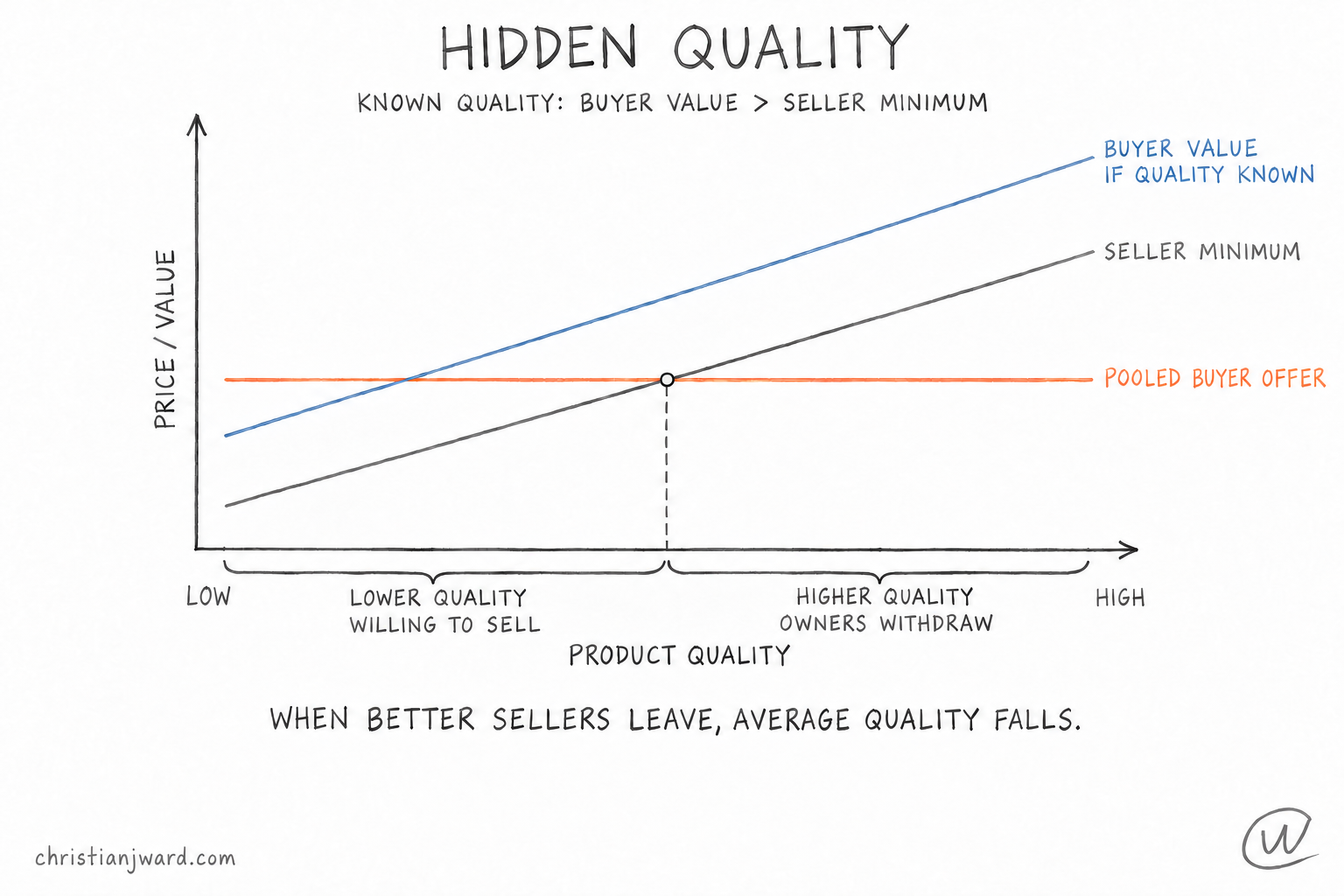
The classic paper on asymmetry is George Akerlof's 1970 The Market for “Lemons”. A used-car seller knows whether the car is a lemon, and the buyer can't tell.
So buyers offer a price that reflects average quality, owners of good cars won't sell at that price, and the average quality of what's left falls. Akerlof pointed to guarantees and reputation as the institutions that push back.
My audiobook wasn't a lemon. I just picked the wrong edition.
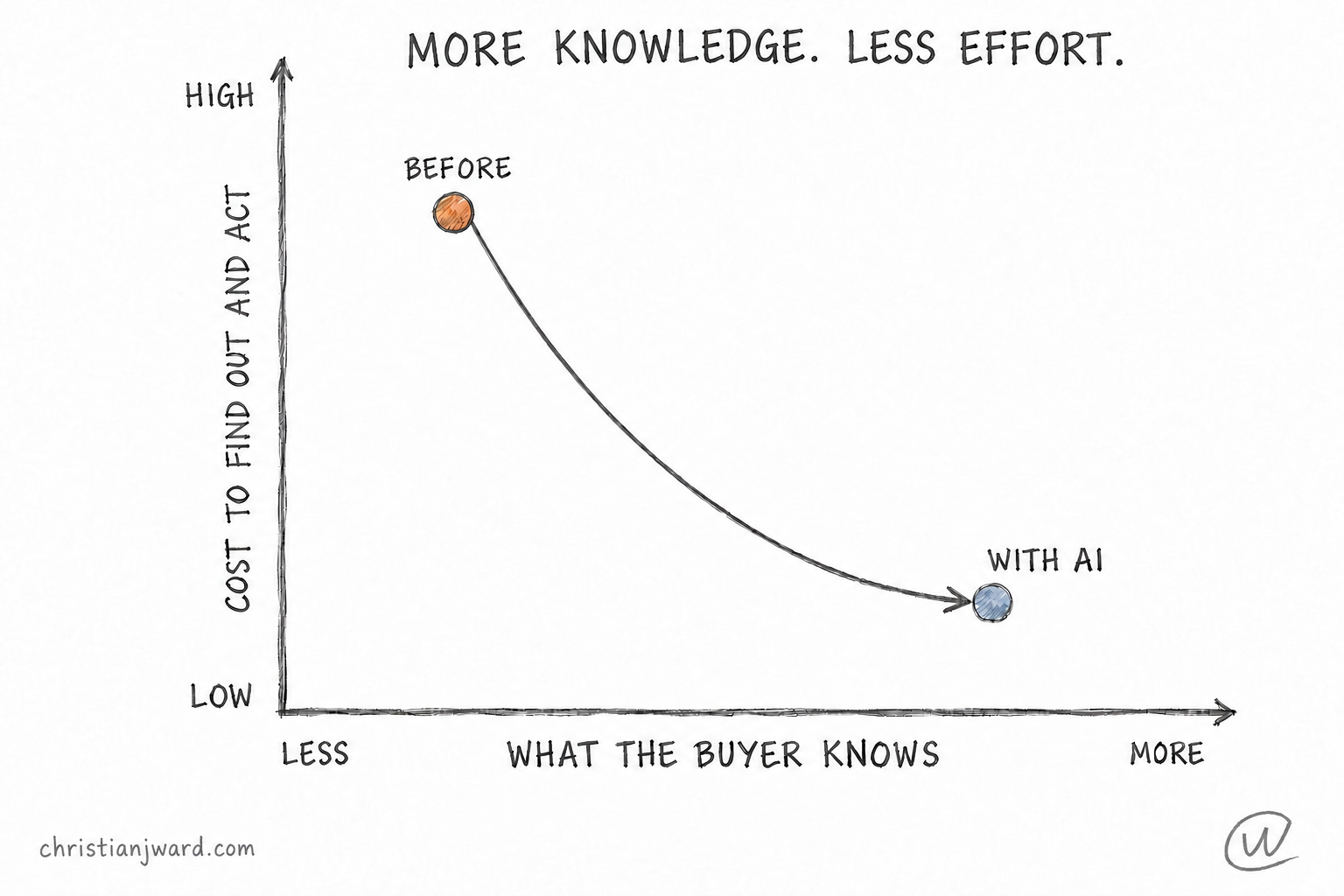
That's a different mechanism. Checking details costs time and attention, and people sensibly stop checking once one more look seems to cost more than it could save.
A quick download while boarding a flight is about as little checking as a purchase gets. A detail can be available and still never make it into the decision.
Fixing a mistake is a third thing. Once you know you bought the wrong thing, you have to find the receipt, find the return option, check whether you're still inside the window and decide the whole effort is worth your time. Plenty of money stays where it landed because of those steps.
Then there's fit, which I'll come back to with sneakers. Sometimes an honest seller and a careful buyer still can't know whether a product suits this particular person.
These mechanisms overlap, and they all leave the buyer holding something they didn't want. Many business models do well inside that overlap, some because customers don't see every detail and some because customers rarely come back for their money.
I think the gap between what's knowable and what actually reaches the decision gets significantly diminished as AI takes on both the checking and the doing.
I see AI opening two doors here.
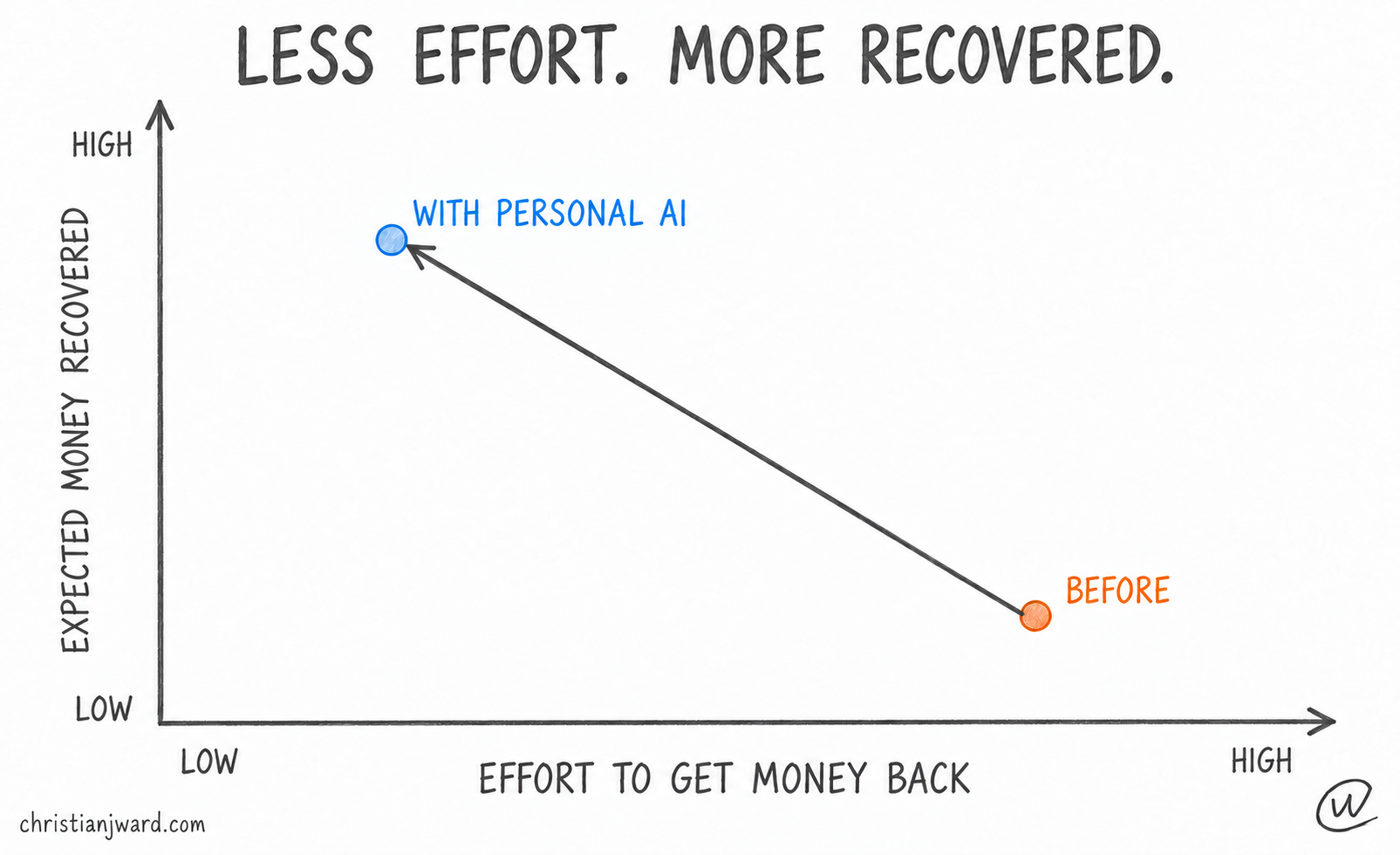
The first door is recovery, and my audiobook is about as simple as it gets.
Thanks to Audible (@audible_com) for giving me the credit back right away, even though choosing the German edition was my mistake.
The effort of acting on a mistake is worth real money to sellers.
In Selling Subscriptions, a 2025 American Economic Review paper, Liran Einav, Ben Klopack and Neale Mahoney looked at the months when a subscriber's payment card gets replaced, which forces an active decision to keep paying. Cancellations run much higher in those months.
In their study of subscriptions, the researchers estimated that cancellation frictions roughly double seller revenue on average, holding the initial subscribers fixed.
That's a lot of value sitting in the gap between knowing and acting. I think personal assistants will close much of that gap wherever a legitimate remedy already exists. Keeping track of receipts, renewal dates and return windows is exactly the tedious work an assistant can take on.
The second door is prevention. Here the AI helps you avoid the bad decision before you've made it.
Sneakers are my example. If all of the available data is out there, then all the marketing and branding in the world won't blind me to the fact that a particular pair isn't the right product for me and my horribly formed feet.
Patrick Collison argues, in a post about agents in the economy, that personal agents will act as “a kind of structural subsidy for product quality.” I hope he's right.
Fit is a separate question, though. A shoe can be well made, well reviewed and loved by plenty of other people and still be wrong for my feet. What works depends on the person, and on some things you only learn by wearing them.
Steven Matthews and Nicola Persico drew this line in a 2007 working paper, Information Acquisition and Refunds for Returns. They separate a product's common quality from a buyer's personal fit, which can be uncertain even when seller and buyer are both being honest.
You can learn about fit before you buy, or you can try the thing and send it back, and which route makes sense depends on how accurate and how costly each one is.
Returns are a legitimate way to learn. They're also expensive, because the buyer carries the hassle and the seller has to deal with whatever comes back.
My audiobook was a small fit problem. Nothing was wrong with Einsamer Wolf. It just wasn't for someone who doesn't speak German.
Prevention needs two kinds of information working together.
The product side has to be detailed and true, with language, edition, dimensions, materials, compatibility, total price and return terms captured in a structured form an AI can actually read.
The personal side has to know me. An assistant that knows I don't speak German could flag a German edition before I buy it. A catalog doesn't know my feet, though, and my assistant doesn't know what a manufacturer left off the spec sheet.
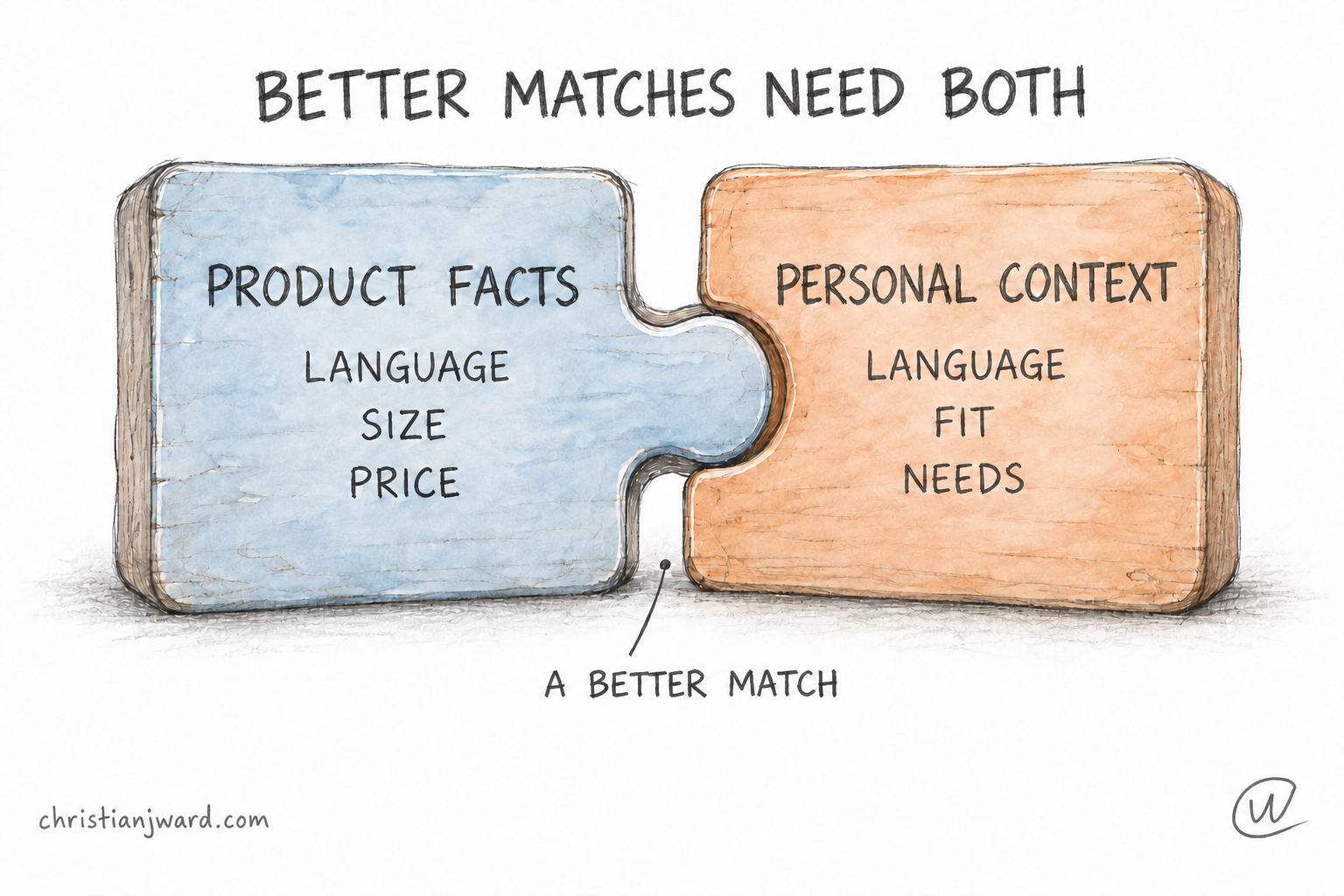
As that structured information gets captured and handed to AI alongside personal context, I think AI will completely change the customer journey around what is best.
That idea was the centerpiece of my talk at Envision, Yext's conference, and I wrote about the real-time business data behind it in a recent post.
It's also what I'll be talking about in my keynote at SIINDA's conference in Marbella on October 12, in a session called “Search is Now a Decision System.”
I wrote earlier this week about best becoming personal. This piece follows that idea into the money we lose getting there.
Marketing and branding still have work to do. They tell me a product exists and give me a reason to look. What I expect them to lose is the power to carry me past a mismatch the data already shows.
For a company whose model depends on customers not noticing or not bothering, this is a real conundrum. I'd expect some sellers to make their offers harder for agents to compare, and some of that will work for a while.
I still think it's a worse bet than it used to be, because an agent that reads the fine print and compares the full cost doesn't get bored halfway through.
The more durable advantage goes to companies that publish truthful, detailed, structured information about what they sell and keep it current, including who a product is for and who it isn't for.
That's what an agent will use to match products to people. When the match is right, I'd expect fewer avoidable returns, fewer support tickets and fewer customers who feel tricked.
Easy recovery belongs on the same list. A business that makes a fair remedy simple is betting the customer comes back. I'm thanking Audible in a blog post, so the bet is working on at least one customer.
All of this assumes the agent works for me.
Collison is plain about that in the same post. He writes that much of his argument hinges on personal agents being on the consumer's side, and that while he suspects that will be the winning strategy, whether it actually turns out that way raises a lot of other questions.
Who pays the agent, and who does it answer to?
If an assistant earns commissions, ranks sponsored products higher or favors its own platform, the value I'm describing flows somewhere else. In my case the assistant asked first and acted only after I approved, which is how I want it to work.
My forecast is that information asymmetry gets significantly diminished in the AI age. What's falling is the cost of knowing what's already out there and the cost of acting on it, both at the same time.
An assistant that carries my context into both is going to change how I decide what's best for me.
Get More Where This Came From
One letter a week, mostly. AI frameworks and data strategy for people who have to make the call.