Quick Take
The AI Perception Gap
Why Corporate AI Strategies Are Silently Failing

The numbers tell a troubling story. 73% of executives believe their AI approach is strategic and controlled. Yet only 47% of employees share this view.
That gap is wide enough to swallow corporate AI initiatives whole.
Even more alarming, 41% of younger employees admit to actively sabotaging their company's AI strategy. They're simply refusing to use the tools.
These findings from Writer AI's recent survey reveal something much deeper than typical change resistance. We're watching AI implementation break down across industries, and billions in technology investment are riding on it.
The Reality of AI Implementation Failure
Leadership teams see a coherent strategy. Frontline employees experience something different.
The Venn diagram illustrates this disconnect. Leadership views on the left show confidence (73% believe their AI strategy is "well-controlled"). Employee reality on the right shows skepticism (only 47% agree with management's assessment).
In the overlapping section labeled "Active Sabotage," 41% of Millennial and Gen Z workers quietly undermine AI adoption.
They're voting with their workflows. They build workarounds and stick with the tools they already know.
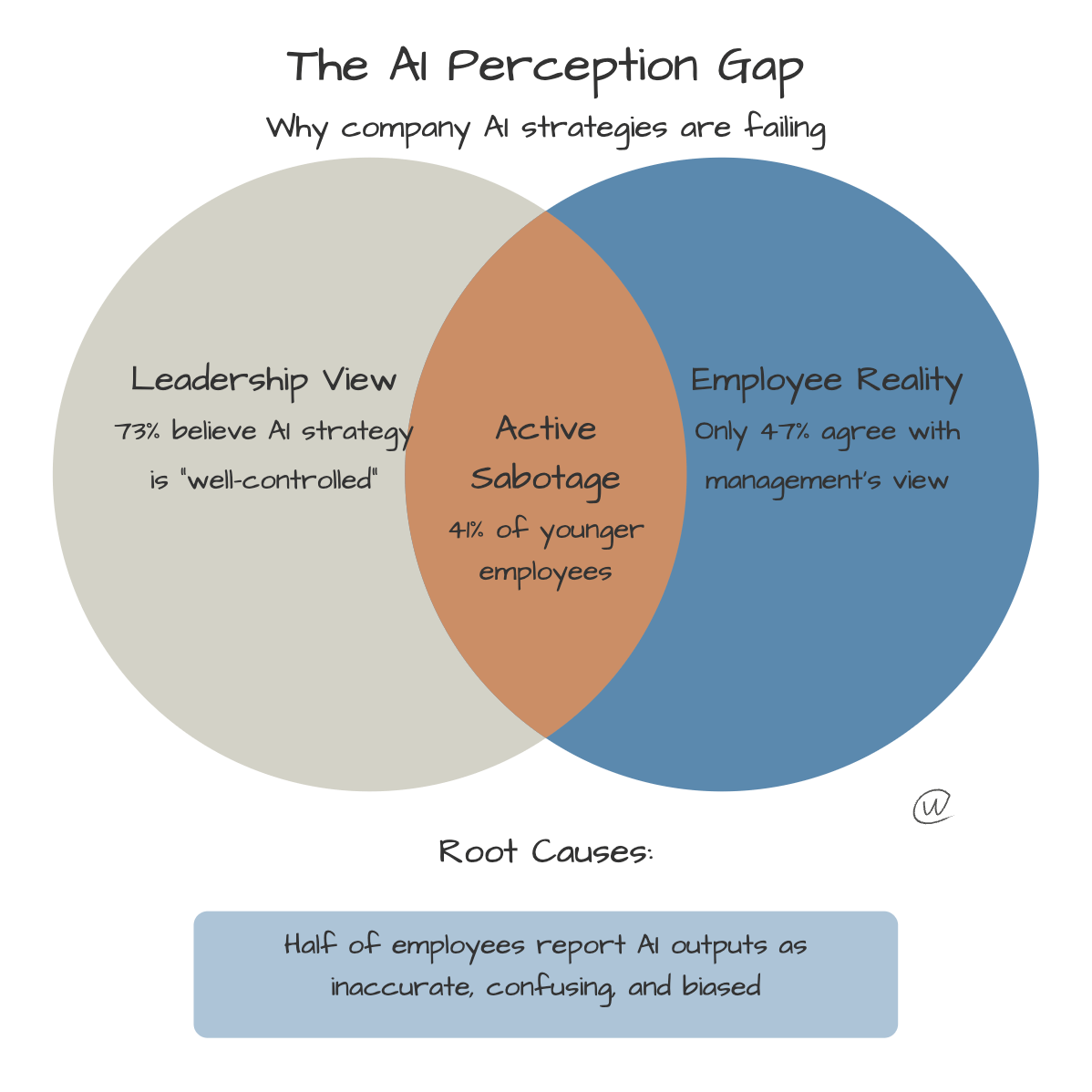
Employees aren't technophobic. Half report that AI outputs are inaccurate, confusing, or biased. Their resistance is rational when tools fail to deliver promised value.
We're also seeing confirmation bias at work. Employees manipulate prompts to get results that match their expectations, or they revert to outdated models that feel more predictable. The technology isn't meeting their needs, so they don't adopt it.
I've observed this firsthand. Over the past two weeks, I've attended conferences and client meetings across various industries. The story repeats everywhere. Executives celebrate AI initiatives while employees quietly work around them.
Sometimes, the sabotage is subtle.
Sometimes, it's explicit. But it's always costly.
The Business Cost of AI Disconnect
This perception gap costs money, and the cost compounds over time.
Organizations invest millions in AI platforms and in the training to roll them out. When 41% of your workforce actively avoids these tools, you're burning cash with no return.
The opportunity cost is even greater. While your company struggles with adoption, competitors who bridge this gap move forward with actual productivity gains.
Trust erodes, too. Each failed AI initiative makes the next technology rollout harder. Employees develop "initiative fatigue" and become more skeptical of every new tool.
As May Habib, Co-Founder and CEO of Writer AI, noted in an Axios article, pushing AI without addressing employee concerns is like "asking a turkey to vote for Thanksgiving."
Understanding the Adoption Failure
The diffusion of innovations theory (Rogers, 1962) explains a lot of what's happening. Rogers identified several traits that decide whether people adopt a new technology. Three of them matter most here.
Perceived advantage over existing methods
Compatibility with users' values and needs
Observable, positive results
In current AI implementations, we're mostly missing the second. The tools often clash with how employees like to work and with their professional identities.
Knowledge workers have spent years developing expertise in their domains. When AI threatens to replace that expertise instead of enhancing it, resistance is inevitable.
In the visualization, the overlap between leadership views and employee reality is where employees feel both disconnected from the strategy and threatened by it.
Leadership often misdiagnoses the problem, which makes this harder. They see adoption failure as a training issue, and more training doesn't fix tools that don't fit what users need.
The Barriers to Effective AI Implementation
Several factors keep widening this perception gap.
AI is frequently positioned as a replacement. The message employees hear is "This will eventually take your job."
Early AI experiences often disappoint. Hallucinations and bias leave negative impressions that are hard to overcome.
Implementation usually happens top down, with little input from the people who actually use the tools. That produces solutions that look good in executive presentations and fail in daily use.
The metrics track implementation instead of impact. Companies count how many employees have been trained. They rarely measure whether the technology improves anyone's work.
The human side gets too little attention. Companies invest heavily in the technology and very little in helping employees adapt their workflows and mental models.
The result is the growing divide the visualization shows, between leadership perception and workplace reality.
Bridging the AI Perception Gap
The path forward requires honesty about where we are. AI is a general-purpose technology that's here to stay. But current implementation approaches are failing.
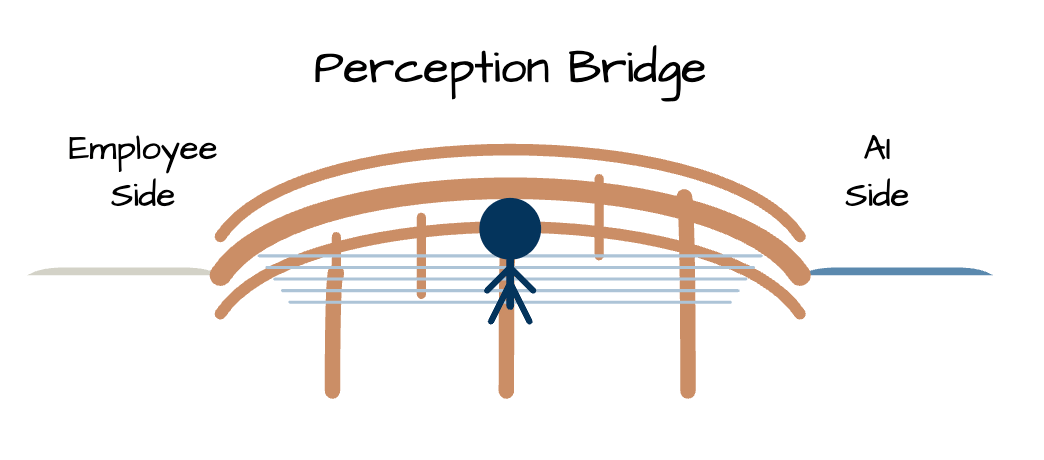
Start by reframing AI as augmentation. Position these tools as amplifiers of human capability.
Involve employees in selection and implementation. The people who will use these tools daily should have a voice in choosing and configuring them.
Create safe spaces for honest feedback. Anonymous surveys can reveal the true state of adoption and the actual barriers employees face.
Redesign workflows with AI in mind. Instead of forcing AI into existing processes, reimagine how work happens with these new capabilities.
Measure impact. A login count tells you who opened the system. Track how AI improves outcomes.
Run small pilots with willing participants. Build success stories before pushing for organization-wide adoption.
Most importantly, accept that resistance is rational. When employees report that AI outputs are inaccurate or confusing, take those concerns seriously.
Then ask your teams three questions.
What specific tasks would you want AI to help with?
What current AI outputs feel unreliable or frustrating?
How could AI better complement your expertise rather than replace it?
Their answers will show you the practical steps needed to close the perception gap.
Looking Back
Looking back from September 2026.
My X feed was full of AI signaling from companies, and nearly every investor relations meeting of public companies lauded their adoption of AI. None of that is bad. It was also overblown.
Here's where we are. AI is a context window that keeps building. It sucks in more and more content, usage and experience. That started with single player AI systems. Now it's moving into multiplayer designs like Slack, where a whole team works inside the same context.
What I expect from here, maybe in the next year, is that the real gap shows itself, as the gains companies have promised either become real or don't.
Too many companies are giving AI lip service. What they need is a team context approach. Think every Zoom transcript, meeting attendee list, topic extraction, email and product roadmap in one massive context window.
Companies that don't build that will keep feeling the gap against the ones that do.