From the Newsletter
You're Already Behind
Why your rivals are scaling faster with AI tools you’ve never heard of

Complacency is the most dangerous thing in business, and right behind it is not understanding what's already possible.
Right now, there is a significant gap between what AI can do and what most people believe it can do. This information asymmetry will determine which companies survive and which entrepreneurs build the successful businesses that come next.
And the gap is widening every day.
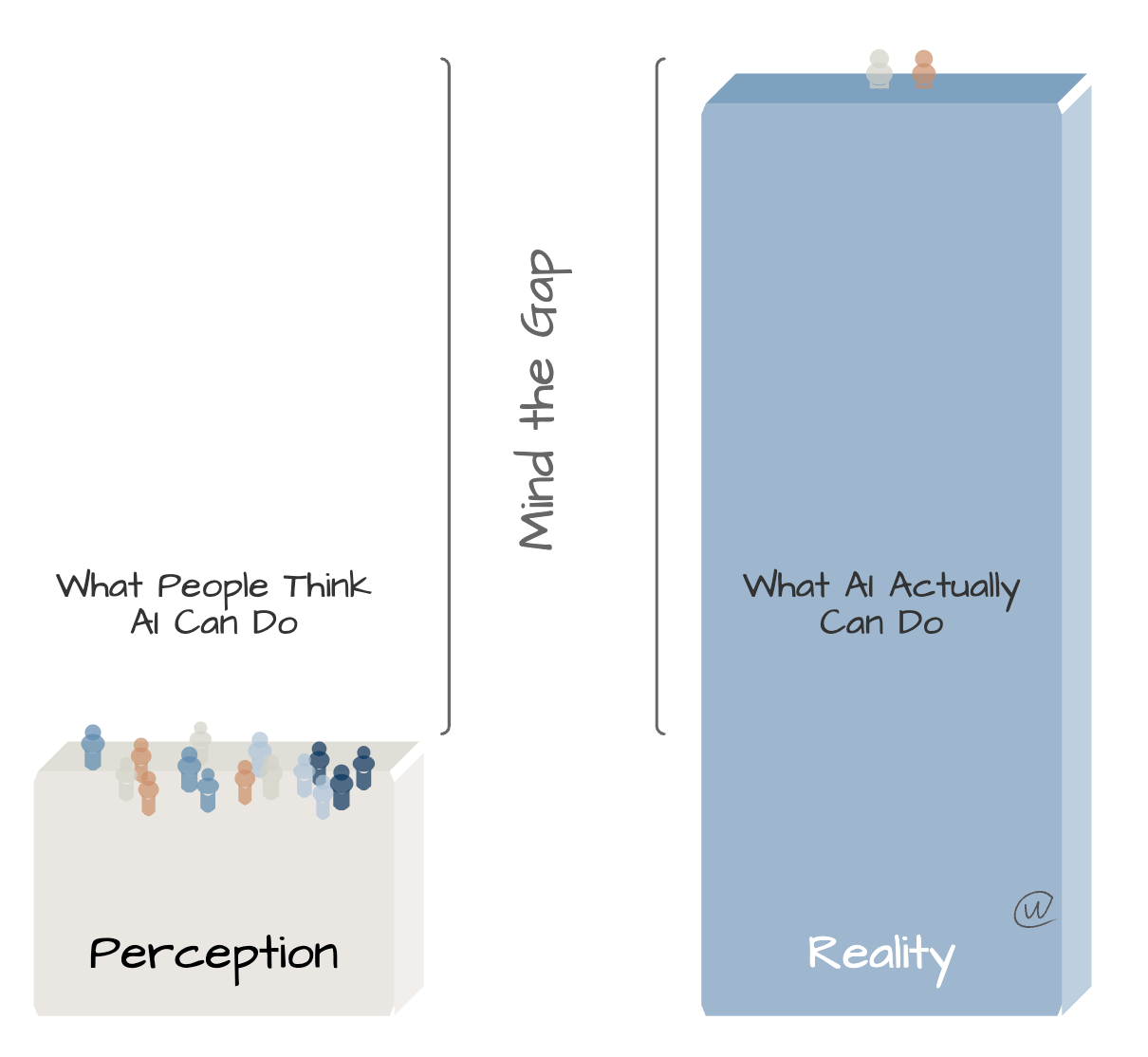
Repeat after me, “AI will never be able to…” [Now stop saying that.]
Let's look at where this Agency Theory concept comes from and what it means going forward.
The Academic Foundation and Current Reality
Economists George Akerlof, Michael Spence, and Joseph Stiglitz first formalized the concept of information asymmetry in their Nobel Prize-winning work on markets with imperfect information. Akerlof's 1970 paper "The Market for Lemons" demonstrated how quality uncertainty creates market failures.
The concept directly connects to agency theory. Developed by Michael Jensen and William Meckling in 1976, agency theory examines relationships where one party acts on behalf of another. The principal-agent problem emerges when the agent has different incentives or information from the principal.
We're witnessing an entirely new form of agency now. Agentic AI systems act on our behalf with unprecedented capability (Ashoori, 2025).
These systems respond to prompts, and they also anticipate and adapt to changing conditions. They execute tasks with many steps and make decisions with growing autonomy.
The problem is that the distribution and usage of Agentic AI remain catastrophically uneven.
William Gibson nailed it decades ago.
"The future is already here. It's just not very evenly distributed."
William Gibson
This quote has never felt more relevant than it does with AI right now.
The Reality That Changes Everything
Saanya Ojha from Bain Capital Ventures captured this perfectly in her recent LinkedIn post.
"The most surreal part of this AI moment isn't the tech - it's the lag. The lag between what most people think is possible and what is already possible. I talk to friends across medicine, law, media - thoughtful, accomplished people - who speculate about what AI might do one day. The only issue is that the 'one day' came and went 2 weeks ago at a demo day."
Saanya Ojha
Let me read that one part back again… “The only issue?… That "one day" happened two weeks ago at a demo day.”
I feel like I see this almost every day. The demo days are outpacing my actual days.
I also hear her point outside of work. Once people learn what I do, the conversation often turns to how behind they feel. They come from completely different circumstances, and they share the same sense of not understanding what is happening.
That's really important, because it means the gap reaches well past work. There is a big gap in our personal lives too.
She also warned about where this leads.
"There is a growing divide between those building the future and those about to be blindsided by it. We won't get a warning label before reality starts to look like fiction."
Saanya Ojha
People are debating possibilities while others are already building the future. The tech accelerates while awareness crawls. Policy lags, and public conversation moves at a snail's pace.
Even imagination falls short of current reality.
Here's how Satya Nadella put it.
"The application layer is collapsing into agents."
Satya Nadella
That means the apps you use every day can go obsolete overnight.
Eric Schmidt predicts we'll see breakthrough "super-programmers" and "AI mathematicians" within two years. Software development becomes less constrained by physical limitations. Just code and feedback loops running millions of iterations in minutes.
According to recent IBM and Morning Consult research, 99% of developers are exploring or developing AI agents (IBM, 2025).
Meanwhile, most executives are still asking basic questions about ChatGPT.
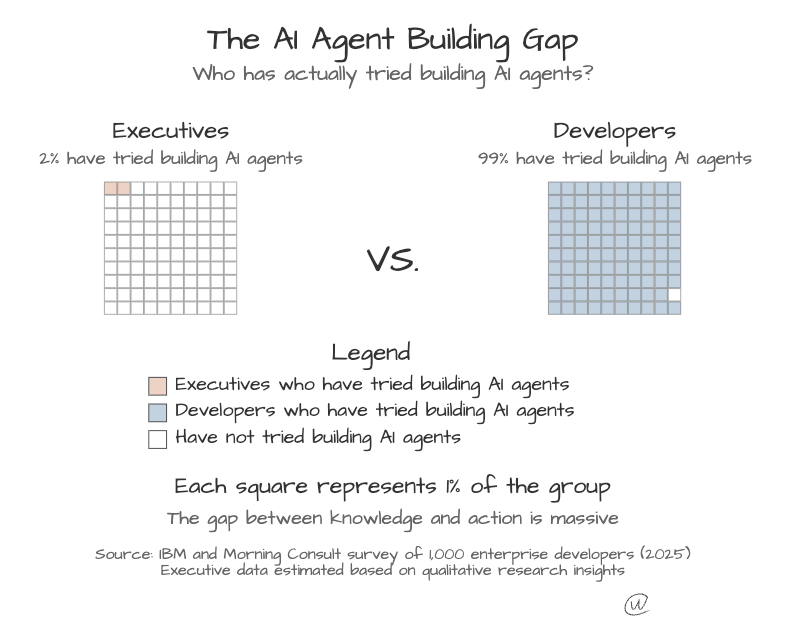
Trust me, you’re probably on the Left.
Your Action Plan Before It's Too Late
Step 1. Audit Your Current AI Understanding
Test yourself.
Can you name three AI capabilities that became available in the last month?
If not, you're already behind.
Step 2. Set Up Information Pipelines
Follow the builders and subscribe to their demo days. Join the Discord communities where people ship actual products.
Step 3. Start Small, But Start Now
Start by hooking up an agent to your personal calendar or email (such as through Anthropic’s Claude 4.0 model). You can build personally to inform yourself professionally.
It also starts closing the personal gap I mentioned earlier.
Step 4. Build Your Agentic Workflow
Identify one process in your work that involves multiple steps. Build an AI agent to handle it. Start with something simple. Learn the mechanics.
Reflection Questions
Picture your industry if every competitor had AI agents handling their routine work.
Which of your current advantages disappear when AI democratizes expertise?
Then look for the new opportunities that open up when barriers to entry collapse.
Last month, I covered how you can scale your AI usage.
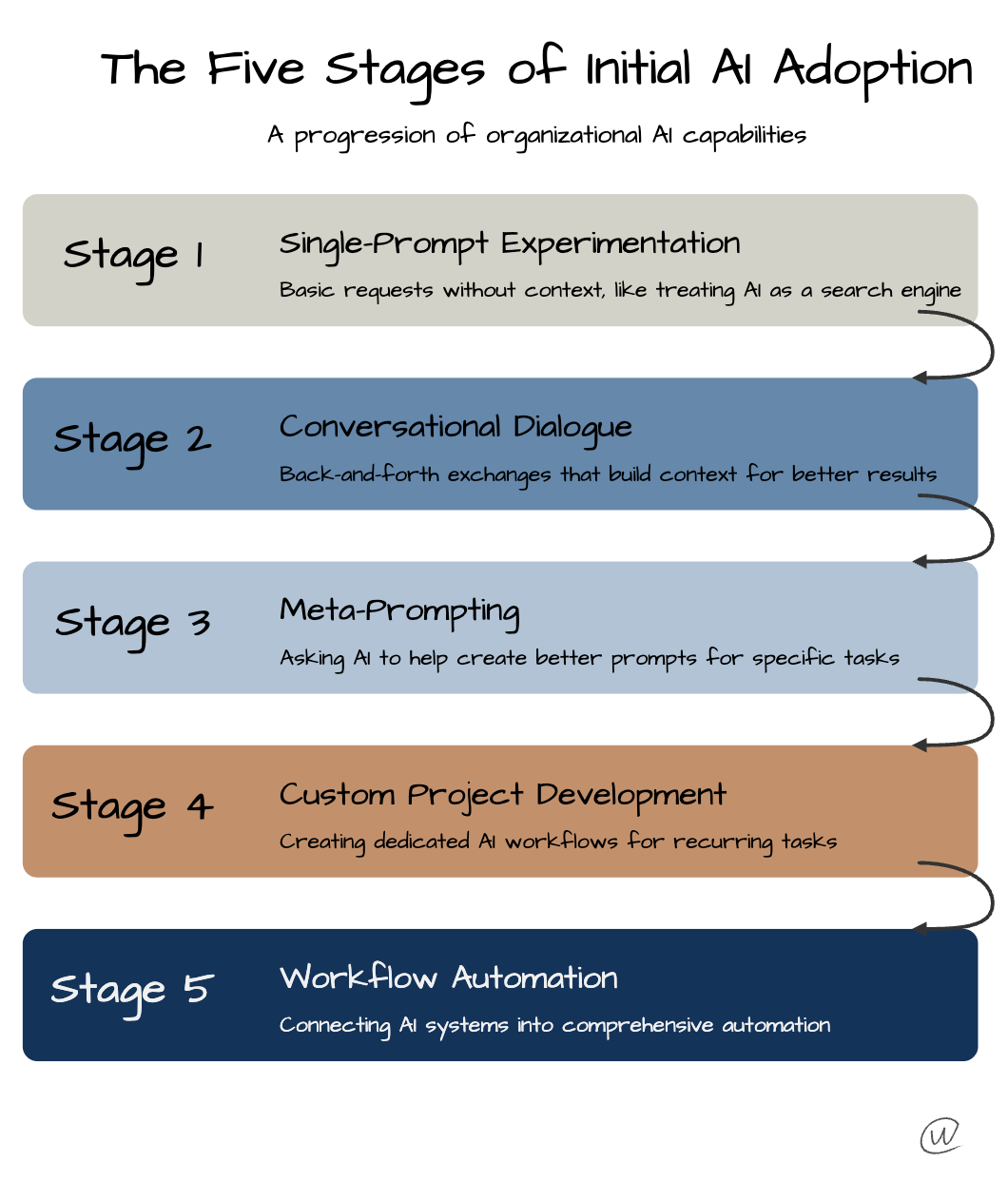
The Barriers That Keep Most People Stuck
The biggest obstacle I see is psychological. People resist believing what's already possible.
Most people wait for permission from authorities or institutions. They want official validation before accepting new realities.
By the time a consensus forms, the opportunity will have vanished.
There's also the comfort trap. Current systems work well enough.
Why change something that generates steady income?
That thinking worked when things moved slower. It breaks down when change is exponential.
Legal and regulatory uncertainty creates another barrier (TechInformed, 2025). People want clear rules before acting. But regulation follows innovation.
The Stakes Are Higher Than Most Realize
This is about survival in an economy that's changing fast.
Companies that miss this transition won't get a second chance. The speed of change makes it impossible to catch up.
Research indicates that the global AI agent market will grow from $5.1 billion in 2024 to $47.1 billion by 2030 (Alvarez & Marsal, 2025).
Power concentrates in the hands of those who recognize and act on current capabilities. Everyone else becomes dependent on their systems and platforms.
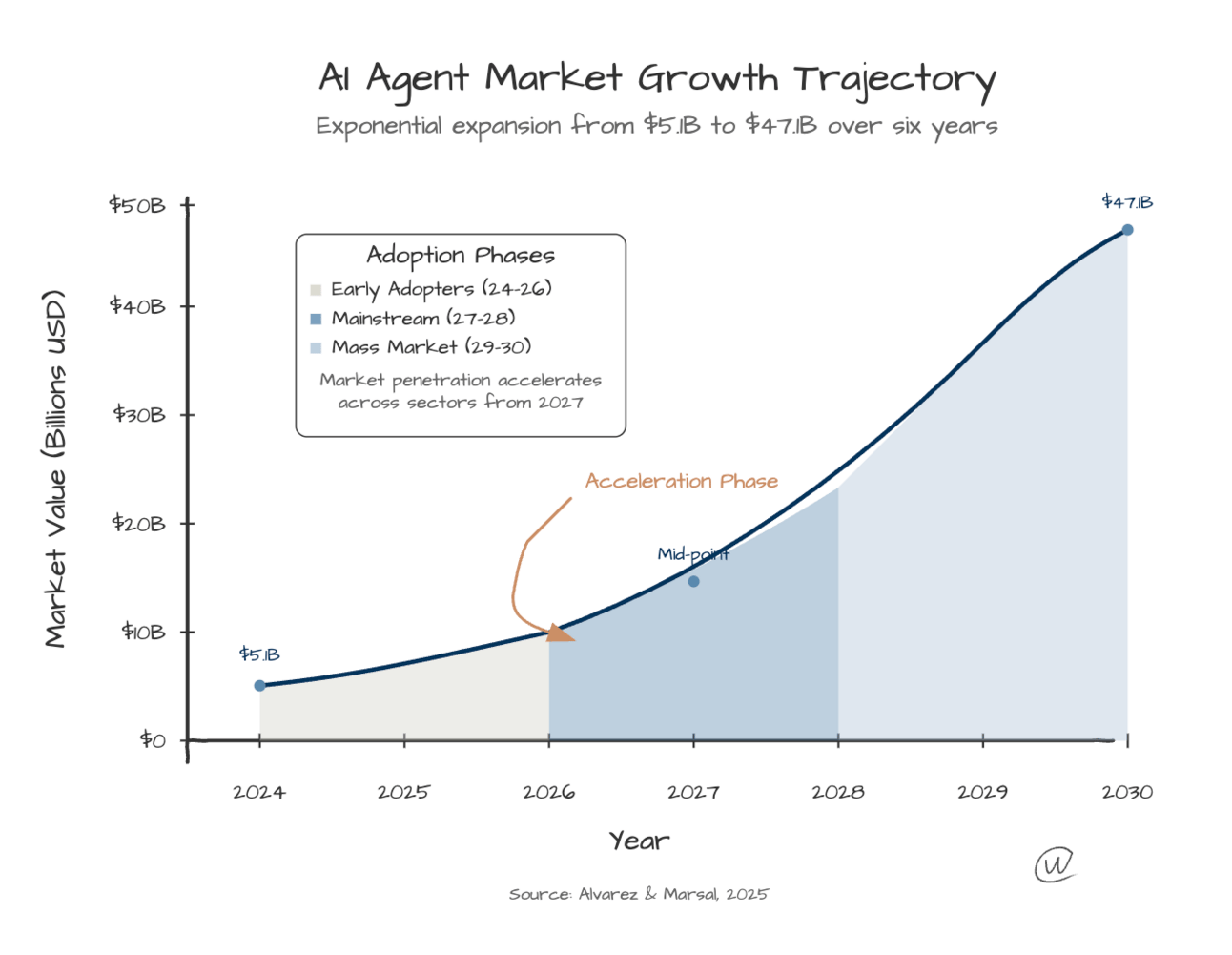
We are already in the acceleration phase.
What's at stake is agency itself, your ability to control your own economic destiny.
Saanya Ojha described the risk as
"waking up in a world built by and for a small subset of people who were paying attention."
Saanya Ojha
That world is being built right now.
The uneven distribution of understanding creates dangerous power imbalances. Those who master agentic AI systems will shape the rules for everyone else.
Your job is to notice what's already here.
Because you can't shape what you can't see, and you can't compete with what you don't understand.
Closing the information asymmetry starts with accepting that the future doesn't need our permission to arrive.
It just requires our attention.
Looking Back
Looking back from September 2026.
In my experience, many firms know they are behind. Heck, anyone on X can see that.
It's also hard to distinguish fact from hype, so I don't blame people who are being cynical. Just don't let the cynicism stop you from checking what's real.


