Quick Take
The AI Maturity Paradox
Why 99% of Organizations Are Still on the Journey

Only 1% of companies consider themselves "AI mature." That number shows an enormous gap between AI investment and actual organizational maturity.
The disconnect between enthusiasm and implementation isn't surprising. Most businesses recognize AI's potential value but struggle with practical integration. Let's look at why this happens and what you can do about it.
The State of Enterprise AI Adoption
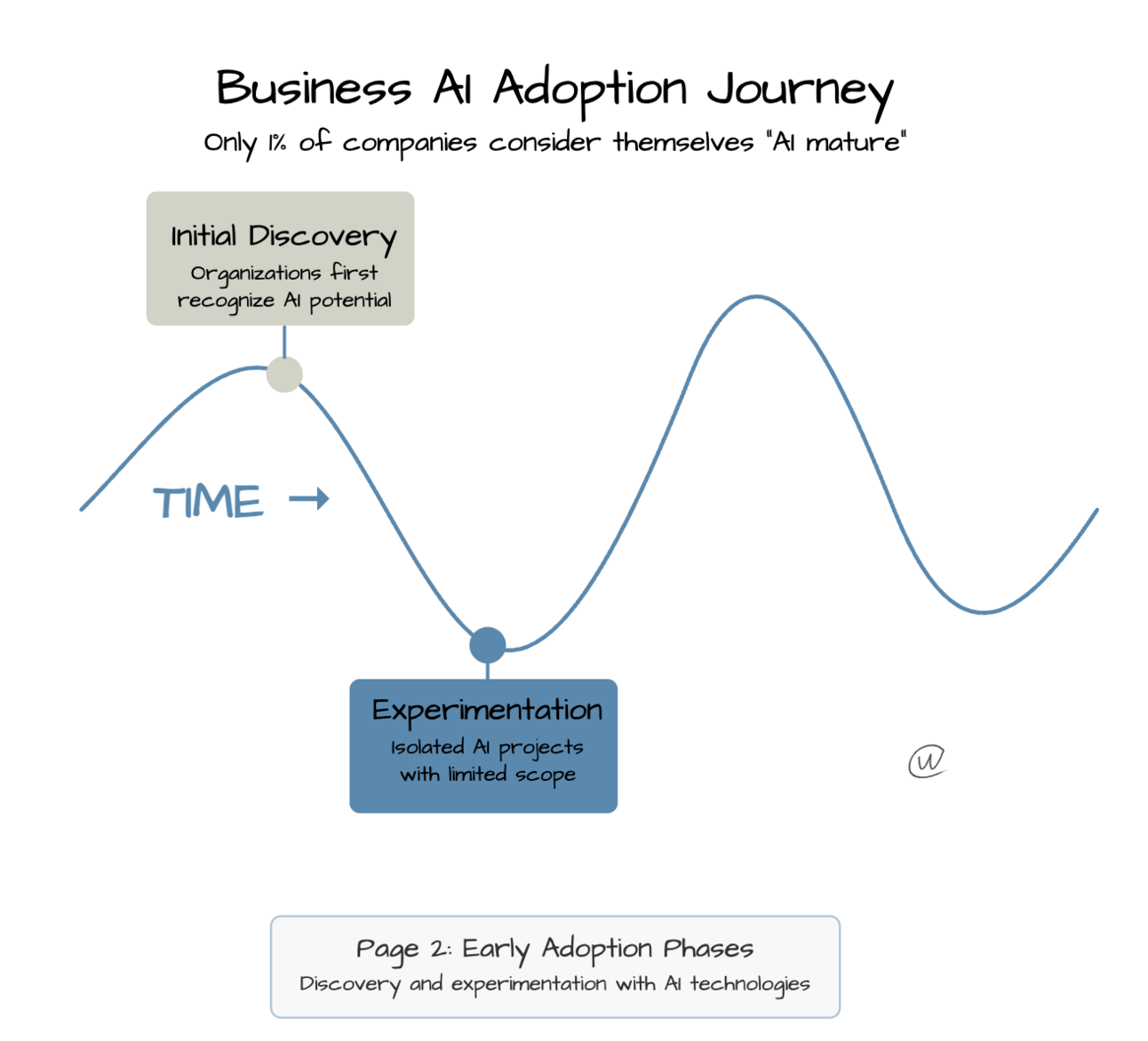
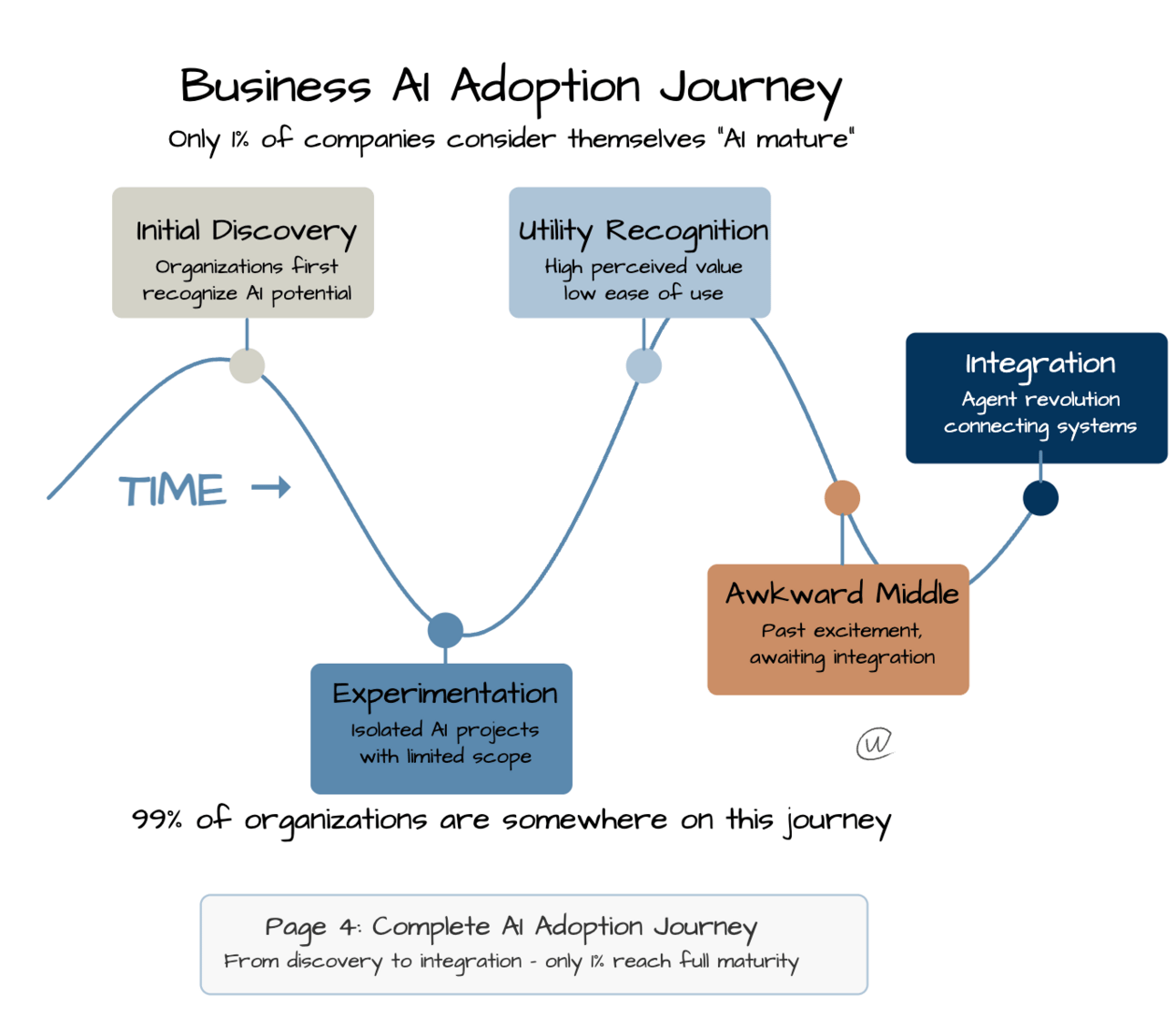
AI adoption follows a predictable pattern. It begins with initial discovery, when organizations recognize the potential. Next comes experimentation with isolated projects.
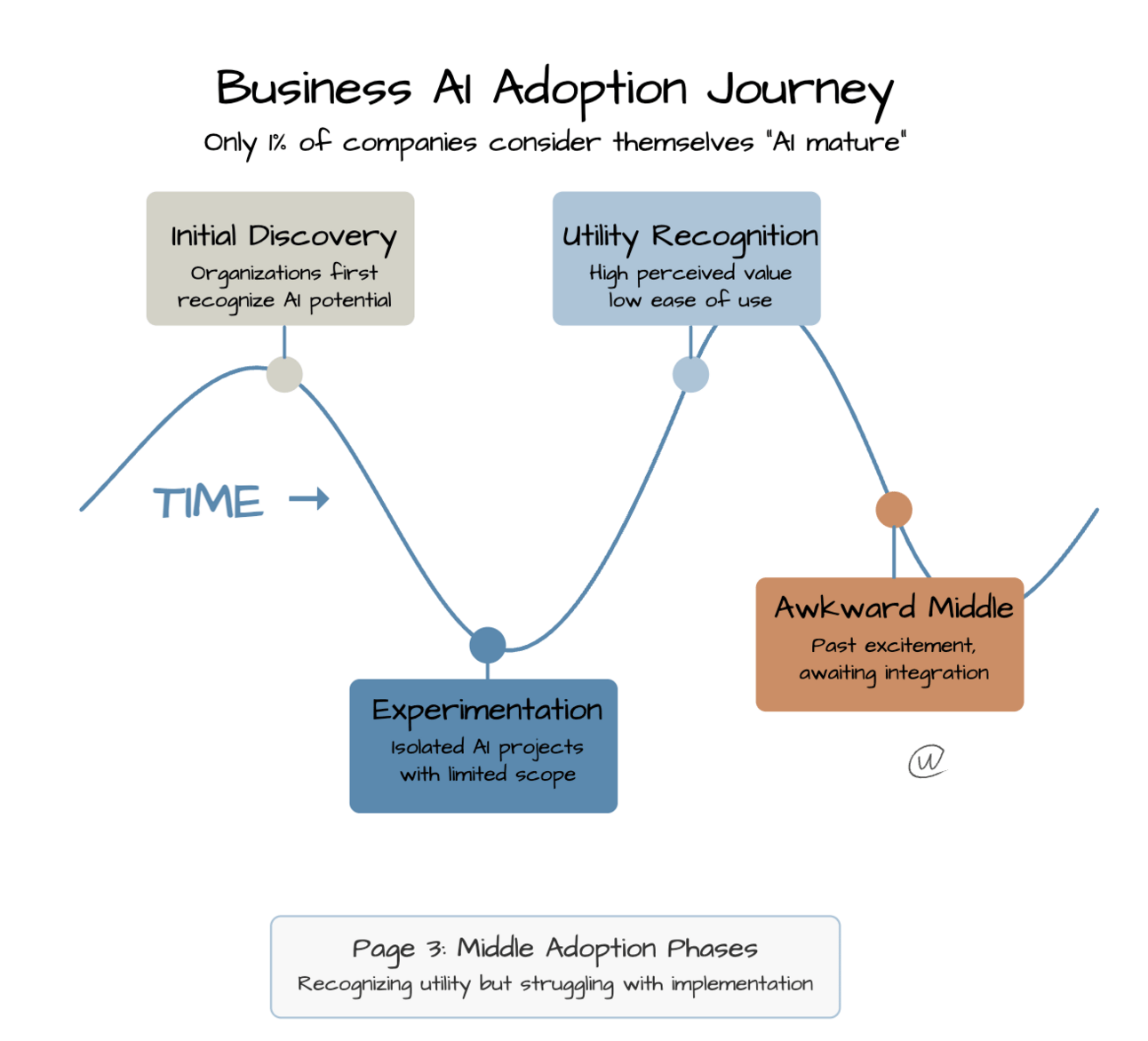
Then many hit the "awkward middle." That's the uncomfortable phase after the excitement fades but before the benefits show up across the whole company.
According to McKinsey's January 2025 report, a mere 1% of companies consider themselves "AI mature." The other 99% are spread across the rest of the adoption timeline.
That creates an enormous opportunity. Companies that solve the integration challenge gain a real competitive advantage.
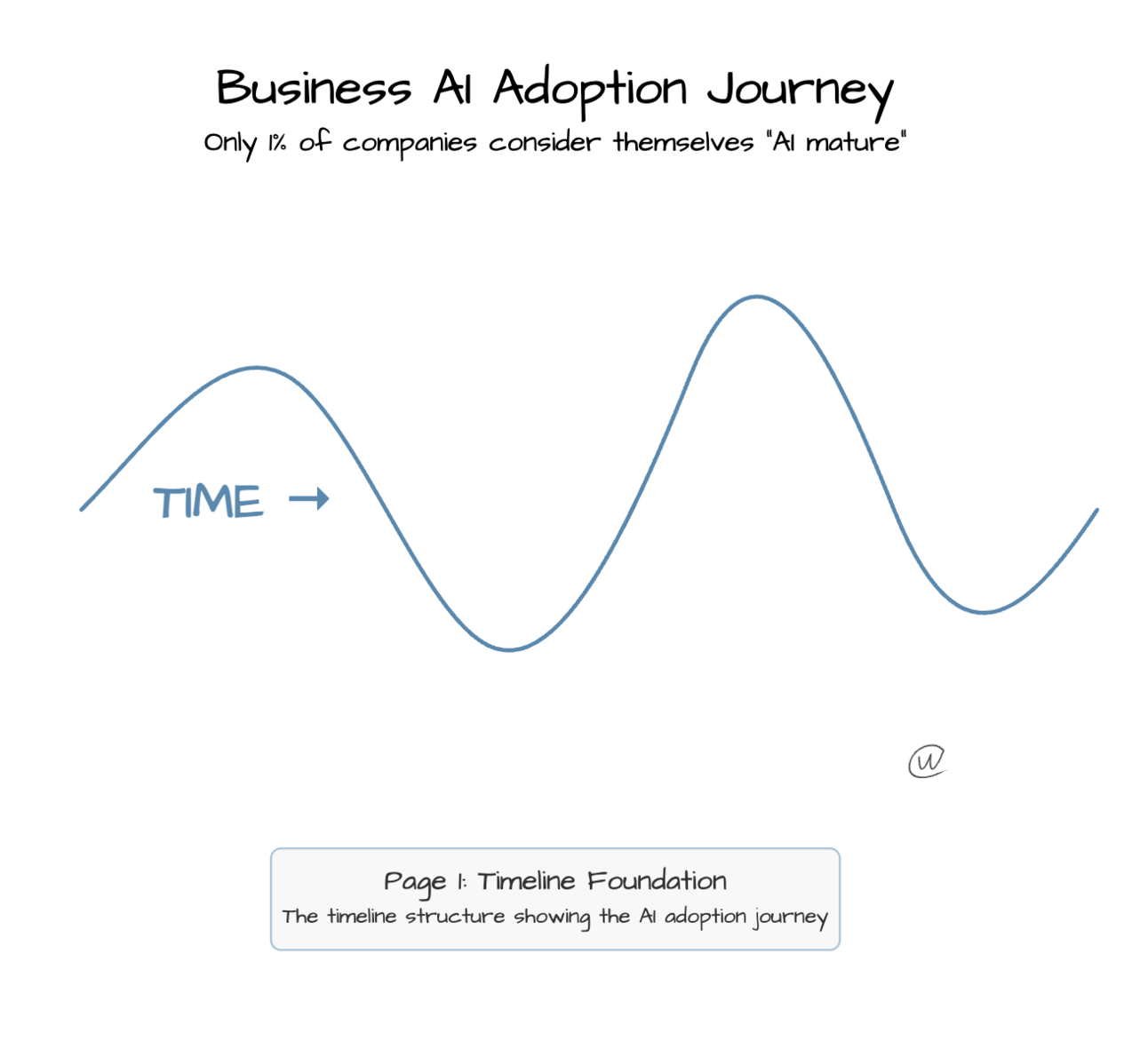
Look at the diagram I've created tracking how businesses adopt AI. It shows the path most organizations follow from initial discovery all the way to full integration. Notice how the curve dips after the initial excitement before climbing again toward mature implementation.
The visual captures five distinct phases that nearly every organization experiences.
The Technology Acceptance Framework
Davis's Technology Acceptance Model (1989) is a useful way to understand what's happening. The model identifies two factors that decide whether people adopt a technology.
The first is perceived utility, meaning whether people believe the technology provides value.
The second is perceived ease of use, meaning whether people can use it without excessive effort.
For AI, the first factor is rarely an issue. Most business leaders recognize AI's potential value. The problem lies with the second factor.
AI systems remain hard to implement across enterprise applications. Each isolated solution works well inside its own boundaries but struggles to connect with other systems.
That creates friction that slows adoption. Organizations get stuck in the experimentation phase, with proofs of concept and limited deployments that never scale.
Barriers to Enterprise AI Integration
The hardest part usually sits in the connections between systems.
Most enterprises run dozens or hundreds of applications built over decades. Each one stores its data its own way and expects the work to flow through it in its own way.
AI benefits evaporate when information can't move smoothly between these systems. The value gets trapped in silos.
Many organizations try to solve this with manual processes. People serve as human bridges between systems that use AI, copying insights from one application to another.
While automation platforms like Make (formerly Integromat), N8N, and Zapier offer solutions, adoption of these tools remains low in enterprise settings. The automation mindset has yet to take hold in most organizations.
Part of the reason is that every team gets stuck at first, and each one for a different reason. The way things have been done is ingrained in everyone's own little world.
In marketing it might be video production, or editing, or social posting and content calendars. In engineering it's Jira, standups and code reviews. In UX and design it's the brand folder combined with affordance mandates.
All of these things have to be broken in order to really get the benefits of AI.
You have to be willing to step outside the box you've trained your whole life to be in.
Moving Beyond the Awkward Middle
How do you push past isolated experiments and get AI benefits across the whole company?
Start by figuring out where your organization sits on the adoption timeline. It might be initial discovery, experimentation, utility recognition or the awkward middle.
If you've gone through experimentation but haven't seen benefits across the company, you're likely in the awkward middle shown in my diagram. That's where most organizations find themselves right now.
The way out typically starts with personal projects.
People will happily build a marshmallow spaghetti tower at an offsite. They're completely unwilling to attempt the same approach in their comfortable day to day. A personal project is where some of that offsite willingness can start to carry over into real work.
Then focus on the connection points between systems. Look for places where AI insights can flow across applications without someone moving them by hand.
Build automation skills within your teams. Knowing how to connect systems through platforms like Make, N8N, and Zapier creates a lot of value.
Find the workflows that cross multiple systems and matter most to the business. Those are the openings for agentic AI systems that can work across application boundaries.
Consider how emerging AI agents might speed up your transition. They promise to connect applications that have been isolated until now.
Which of your AI initiatives have actually moved beyond experimentation?
Make a list of the systems that still need a person copying things between them. Many of those handoffs could be automated with tools that already exist.
Then look at the skills your team would need to get from isolated AI experiments to implementation across the enterprise, and start building them.
The Coming Agentic Revolution
The next wave of AI development focuses on autonomous agents that operate across system boundaries.
These agents promise to connect previously isolated applications automatically. They watch how people move between systems and learn to repeat those patterns.
This shift could dramatically accelerate AI adoption by removing the integration barrier. Organizations that prepare now will be in a much better position to use these capabilities.
And it's moving fast, right now.
Companies that build the skills and mindset for automating across systems today will have an easier time adopting agents tomorrow.
The 99% figure is also a big market opportunity. Whoever solves integration faster than their competitors gets the advantage.
The Timing of AI Maturity
The timeline for AI maturity depends mainly on how quickly organizations solve the integration challenge.
For most companies, this transition will happen over the next two to three years as agent technologies mature and the integration barriers fall.
Those who wait will be at a competitive disadvantage. The window for an early adoption advantage is closing fast.
Remember that only 1% of organizations currently consider themselves AI mature. That won't stay true for long.
The acceleration is coming.
Will your organization be ready?
Remember, roughly 99% of us are still working toward AI maturity.
You're not alone in the awkward middle.


