From the Newsletter
AI Is the Amplification of What You Already Are

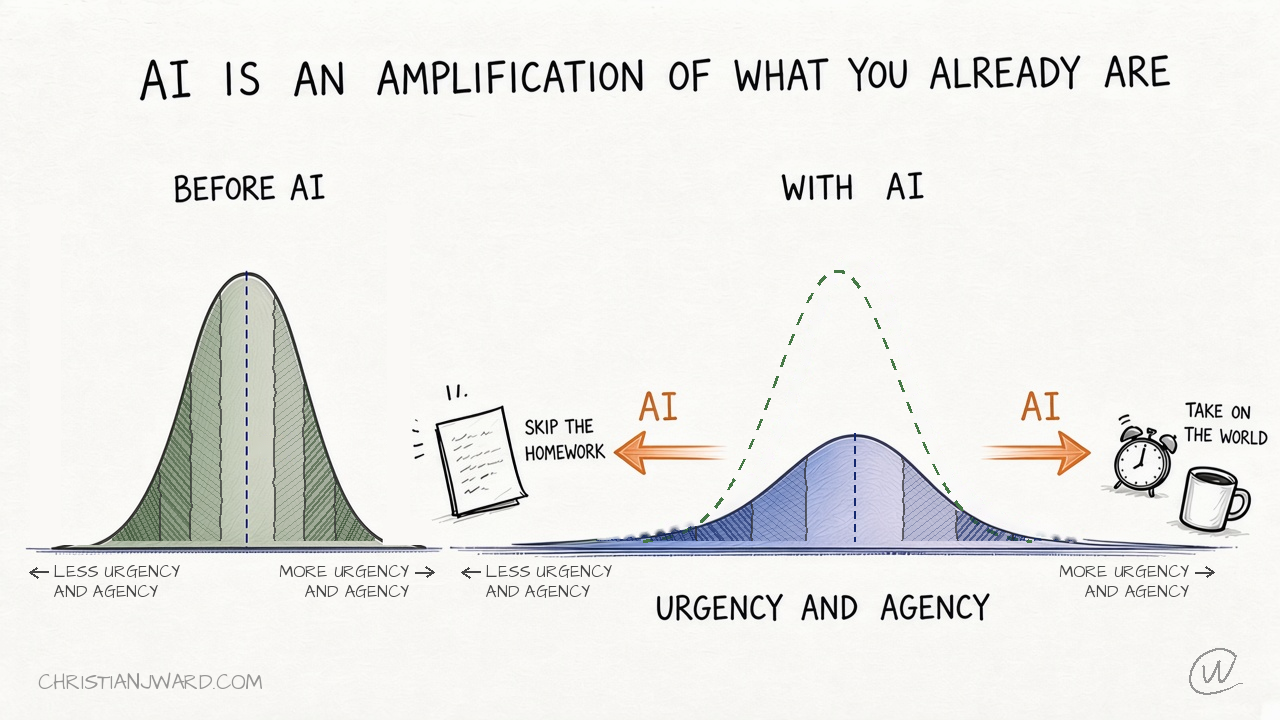
AI hands you more of whatever you walked in with.
THE QUESTION
I was a guest on Leadership Beyond Borders, the podcast hosted by Kimberli J. Lewis, with Stéphanie Vérilhac also on the episode. It airs around November 10.
We talked about what AI is doing to students, and I think it's the same thing behind the two camps I keep seeing in programming and engineering.
Kimberli knows I have three kids, from college to grammar school, and she asked me this.
"Do you think there's any kind of danger that this is going to make us lazy and think less? Or do you think that when you're using AI, you really do have to even think more?"
WHAT I TOLD HER
I think AI is the amplification of that which you already are.
For the very smart, high-agency individual, the person that wakes up with both urgency and agency, AI is making them better. It's making them more intelligent, with access to knowledge and access to action.
Then there's the student who woke up and decided it was going to be a video games and sit around the house day. They wanted the homework done, and they were going to cheat anyway. So they're going to cheat with AI too.
AI is an amplifier of the student, and generally of anyone.
In all fields and in all situations, you're going to see what looks like a normal distribution get pulled at both ends. It's going to pull people from the middle toward more of what they are.
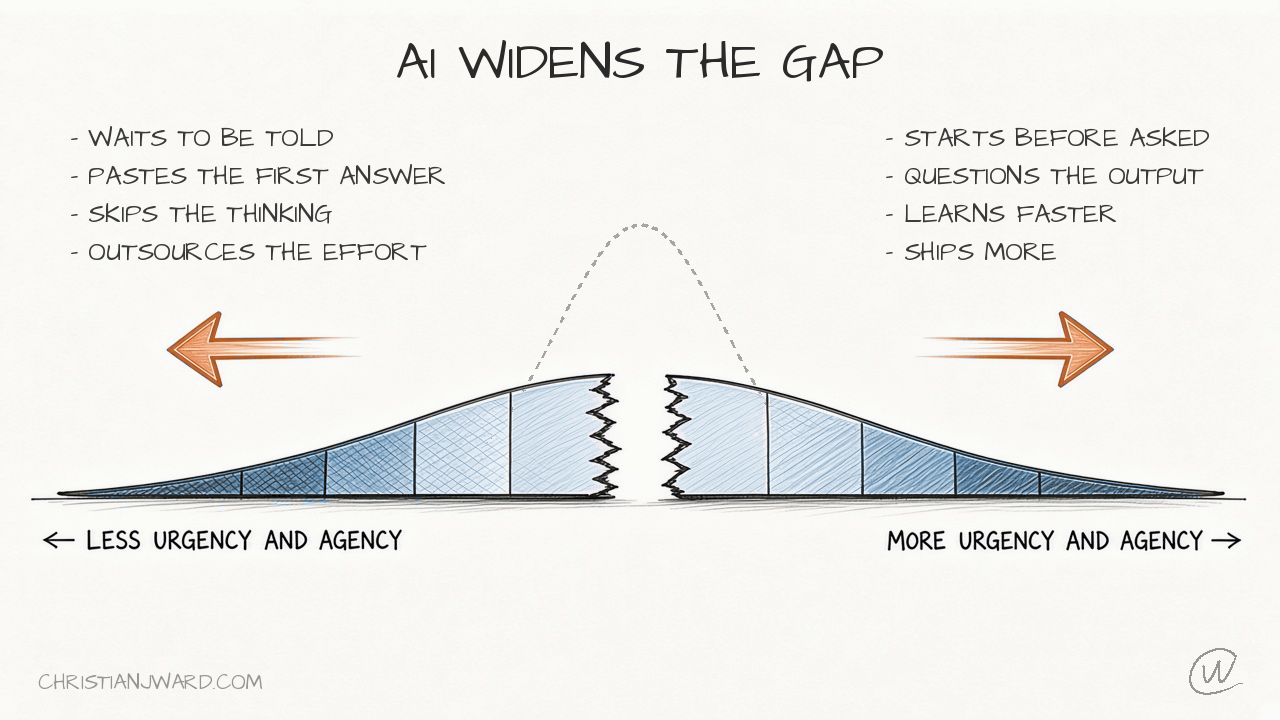
If you're leaning toward resting on your laurels and skipping the hard work, it's going to pull you in that direction. If you're leaning toward starting a company at the age of 18 and taking over the world with your thoughts and ideas and ambitions, it's going to pull you to give that a shot.
Hopefully that's not too depressing for everybody, but that is absolutely what I am seeing.
There's a study that kind of confirms what I'm seeing. It's about a year old, but it makes sense. Bastani and colleagues ran a field experiment published in PNAS, the Proceedings of the National Academy of Sciences, with nearly 1,000 high school math students. Once access was taken away, the students who had used a ChatGPT-like version of GPT-4, often as a crutch for answers, scored 17% worse on the exam than students who never had it, and a tutor version that gave hints largely eliminated that harm.
A TECHNOLOGY THAT ADOPTS US
We have never had a technology that adopted us, and that is what's happening. The AI is adopting us, which makes it infinitely easier to adopt it.
This is also the first technology that can explain how to best use itself.
I wish we could segment businesses on their savvy and their personal agency.
TWO CAMPS
Gergely Orosz (@GergelyOrosz) wrote that he is starting to sense a divide in the tech industry. One group is "People thriving on autonomy who are reinventing how they work and what tools they use with AI". The other is used to being told what to do, and he sees them getting frustrated with the lack of guidance from management and more bitter about AI.

Aaron Levie (@levie) wrote that "It’s almost incomprehensible how wide the distance is between someone who’s working at the frontier with AI and basically everyone else right now." He also wrote that the two lines keep growing farther apart.

Peter Diamandis (@PeterDiamandis) wrote that the real AI divide will be "curious versus afraid."

Peter Steinberger (@steipete) was reacting to a Proton AI manifesto that Joseph Cox of 404 Media obtained. Steinberger wrote "Bullish on Andy Yen and Proton. He gets it." He called "the loss of identity some engineers feel as AI redefines our jobs" difficult and wrote "I sympathize", and he added that Yen "runs a business and might has limited patience when we now had two years to process".

WHEN YOU DECIDE
I'm not sure the two camps are new.
I think the people embracing AI are the people who would embrace any new form of technology that could amplify them.
I also want to be optimistic here. At different times in my life I've had differing levels of urgency and agency. It's not an always on, always off thing.
I think what's fascinating about AI is the adoption cycle. With other technologies it was so long, let's say over a couple years or 10 years. With AI, the technology is changing so quickly that if tomorrow you decided you wanted higher agency and higher urgency in your career or your path, the AI you're going to adopt is so much better than the AI I've been trying to adopt for the last three years.
I think the positive news is the tool is there, and the tool gets sharper every single day. So when you do decide it's the right time for you, I think you're going to really be able to jumpstart something faster than ever before.
Get More Where This Came From
What I learned this week and new writing, sent to your inbox. AI frameworks and data strategy for people who have to make the call.