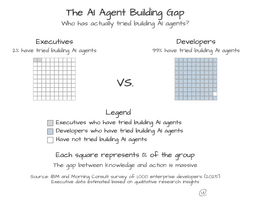
Quick Take
Red Pill or Blue Pill
The AI Adoption Choice That Will Define Your Career

The wake-up call is here, and the signs are unmistakable. AI is changing at warp speed.
Recent releases from major AI companies serve as clear signals. Claude now searches the web. Gemini 2.5 brings new capabilities. OpenAI's image creation tool reaches new heights. Each one alone would turn heads.
Put them together and the story is acceleration.
Try them. Give each one hours. A few minutes of testing tells you almost nothing about what these tools can do now.
The AI Revolution Is Here, Not Coming
Denial is no longer an option.
The simultaneous launch of Claude's web search, Gemini 2.5, and OpenAI's new image creation tool should be your wake-up call. It's a blaring alarm.
Most professionals casually experiment with new tech. They try a few prompts, form quick opinions, and move on. This approach fails with AI.
So many people, from engineers to novices, have this habit of saying "Yeah, I tried it…" and then they stop. They can't seem to understand how fast these things are improving.
The human brain struggles with geometric growth. We think linearly. AI grows exponentially. This creates a perception gap that benefits early adopters.
Smartphones and tablets changed how we communicate. AI reaches much further than that.
We're witnessing the emergence of a true general purpose technology (GPT). These rare innovations change how an entire society works. Electricity did this a century ago, and the internet did it more recently. AI will surpass both.
Was electricity overhyped?
Probably. It reshaped society anyway.

The diagram I've created illustrates this divide visually.
Understanding the Adoption Curve
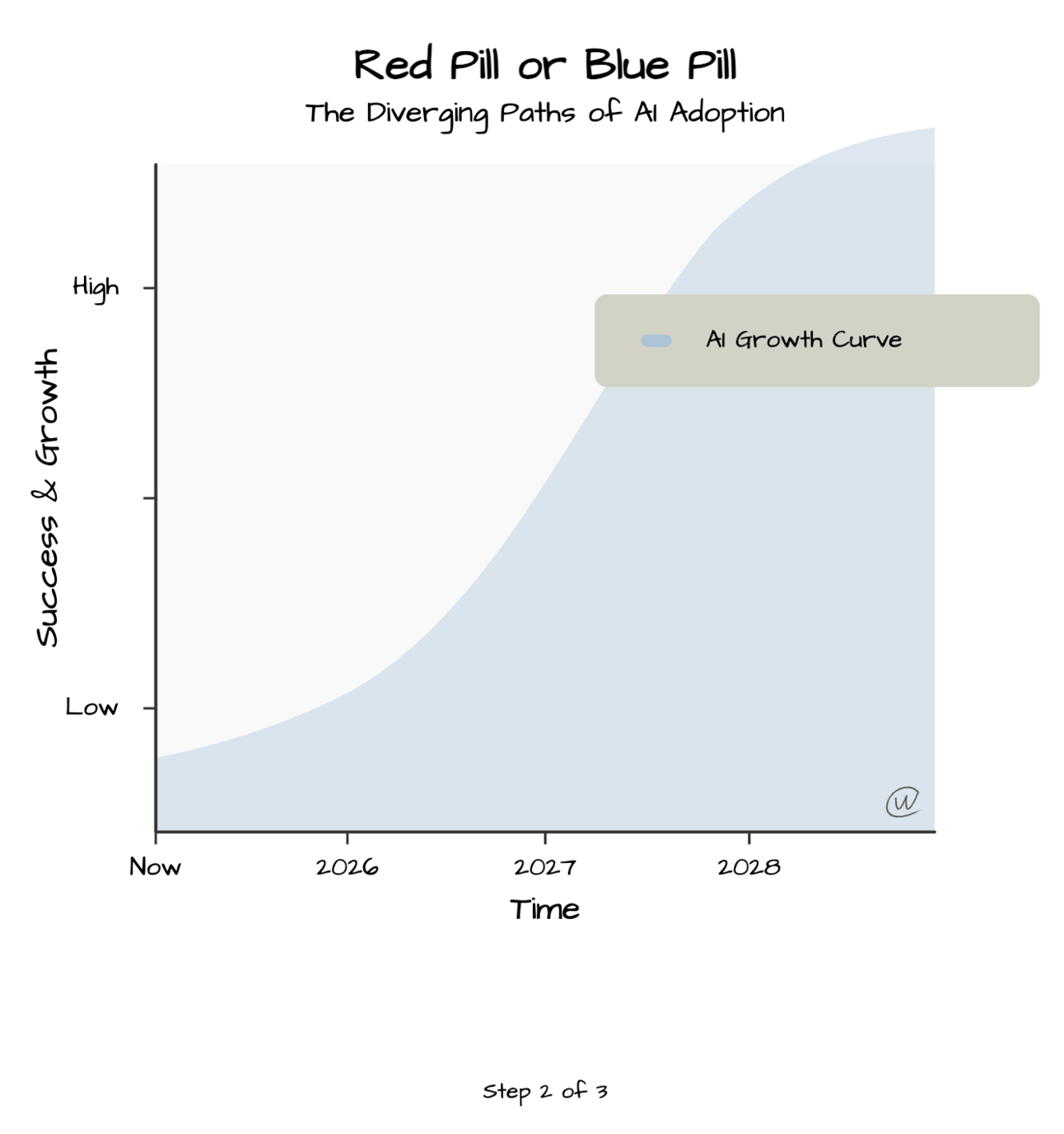
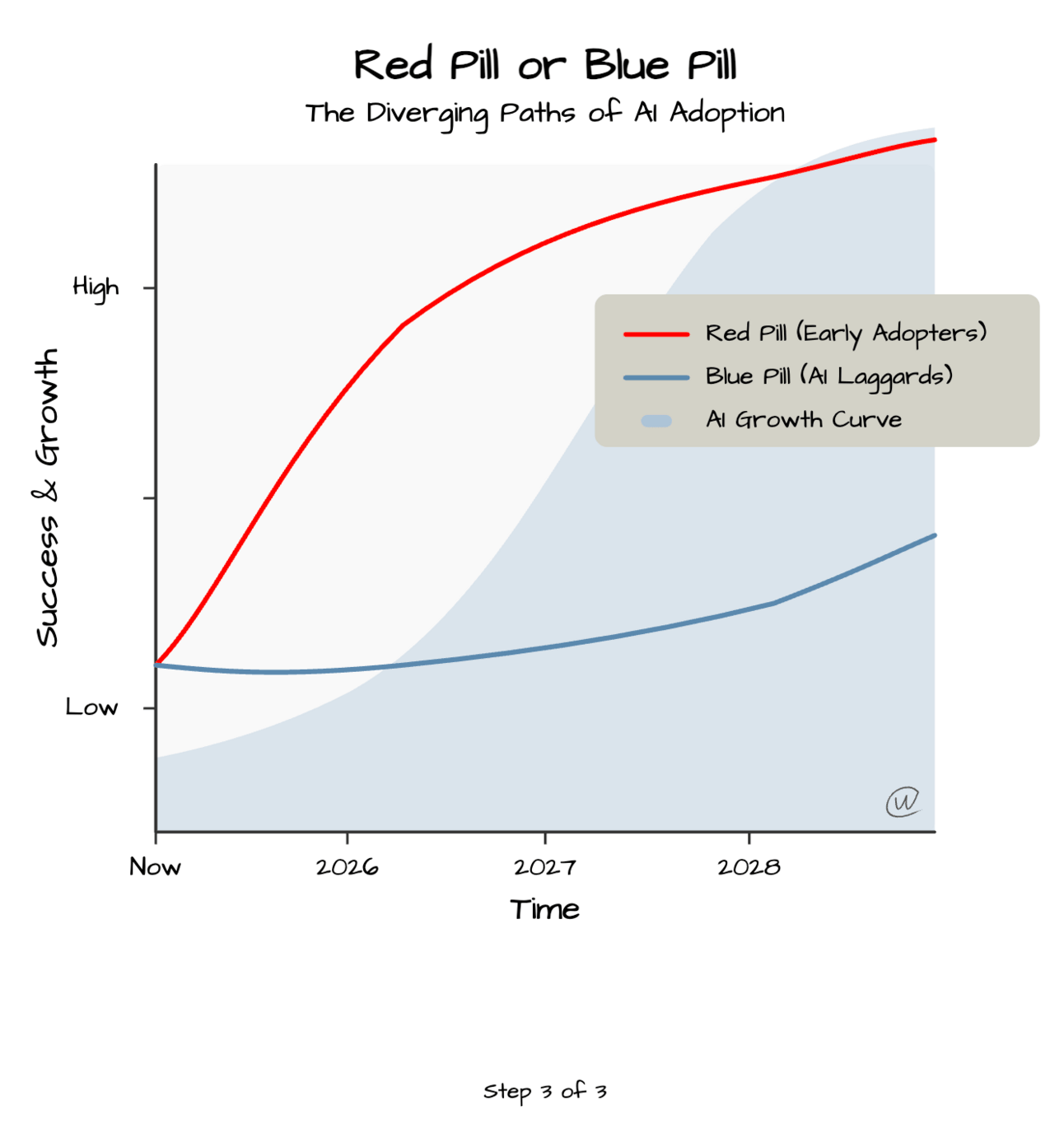
The diagram tracks success against time, showing two distinct paths.
The blue pill path shows minimal initial movement, remaining flat until late 2026, when the pressure to adopt becomes overwhelming. By then, the expertise gap proves nearly impossible to overcome.
The light blue background represents overall AI growth. Even laggards eventually adopt, but too late to capture the early advantages.
The red pill path represents early adoption. It starts climbing immediately, with gains accelerating through 2026 and 2027 as AI capabilities compound. Those on this path build expertise and working habits while others stand still.
What makes this visual particularly striking is the gap between the two lines. Early adopters build a lead that late adopters may never close.
Let me prove this point concretely.
Look at my drawing above. Then consider that I created it with OpenAI's new image tool. One attempt. One prompt.

This isn’t real. It’s just a prompt.
Five years ago, creating this visualization would have required design skills, specialized software, and hours of work. Today, it takes seconds with the right prompt.

Here’s the Prompt.
Pretty pictures are the easy example to point at. The same shift is coming to how we create and how we solve problems.
The Resistance Is Understandable But Costly
Many professionals remain skeptical about AI adoption. Their concerns often follow predictable patterns.
"I need to focus on my actual job, not learn new tech." This view misunderstands the situation. AI is becoming part of how you do that job well.
"The tools aren't reliable enough yet." This argument grows weaker every week as capabilities improve. Waiting for perfection means missing the entire advantage curve.
"My industry/role is different." Every industry said this about previous technologies. Banking would never go online. Retail would never move to e-commerce. Publishing would never go digital. All proved wrong.
"I'm too busy to learn new systems." This short term thinking creates long term disadvantages. The time you invest now pays exponential returns later.
These objections sound reasonable. They provide comfortable justification for inaction. That comfort comes at an enormous career cost.
The most dangerous misconception is that you can wait and catch up later. The diagram shows why this fails. The gap widens over time.
The Stakes Are Career-Defining
The career implications couldn't be clearer. Professionals will split into two groups. Early adopters will use AI to accelerate their careers. Late adopters will resist change until it overwhelms them.
The red line shows early adopters gaining exponential advantages starting now. The blue line reveals what happens to those who wait. Both groups eventually adopt, with dramatically different outcomes.
Early adopters gain compound advantages. They learn how to prompt effectively. They build workflows that hold up. They automate routine tasks. Most importantly, they spend the time they free up on the work AI can't handle.
This creates a virtuous cycle. More AI use leads to better AI skills, and better skills open better opportunities.
Late adopters face the opposite. Their skills gradually lose value, and their career options narrow instead of expanding.
By 2028, according to my projection, the gap becomes so wide that catching up becomes nearly impossible. By then, the early adopters are playing an entirely different game.
Is this guaranteed?
Nothing is. But the signals point clearly in this direction.
We've seen this pattern before with other technologies. Early digital adopters in journalism thrived. Late adopters struggled to find work. Early e-commerce adopters built empires. Late adopters closed stores.
Windows of opportunity open and close. This one won't stay open long.
Taking the Red Pill
I chose the Matrix reference on purpose. Like Neo, professionals face a defining choice between a comfortable illusion and an uncomfortable reality.
"This is your last chance. After this, there is no turning back. You take the blue pill—the story ends, you wake up in your bed and believe whatever you want to believe. You take the red pill, stay in Wonderland, and I show you how deep the rabbit hole goes."
Morpheus, The Matrix (1999).
This choice comes down to agency and perseverance. Here's how to take the red pill.
Commit real time to exploration. Set aside two hours per week at minimum. Use that time for deliberate practice with the major platforms, beyond casual play.
Start with the big three. Claude, GPT-4.5, and Gemini each have distinct strengths, so learn them all.
Build integration habits. Don't treat AI as a separate activity. Work it into your daily workflow, starting with simple tasks like email drafting, meeting summaries, and research.
Join communities of practice. Find others on the same path. Share prompts and workflows. Learning accelerates in groups.
Track your progress. Document your AI wins. Measure the time you save and the work you can now do that you couldn't before.
Teach others. Nothing reinforces learning like teaching. Share what you discover with colleagues.
Stay current. Set up alerts for major AI releases. Test new features immediately. Go back to the tools that let you down, because they may be different now.
The red pill path isn't always comfortable. It requires continuous learning, and it challenges established habits.
It forces you to recognize that skills once hard earned may no longer hold the same value.
But discomfort today prevents obsolescence tomorrow.
So ask yourself one thing...
Which curve will your career follow, the rising red line or the flat blue one?
The choice exists now. It won't always.
Looking Back
Looking back from September 2026.
I often write about adoption and people needing to try these tools, but this post is so important because it's about agency and perseverance.
One caution about reading my chart above, or any chart like it. The adoption curves themselves are shifting through time and changing shape as new models, utilities, tools, and capabilities come forth. That makes it very hard to compare one set with another.
So be very careful here. You cannot assume that because you tried something with AI 3 months ago (let alone 3 hours ago) that it can't be different now.