From the Newsletter
Traditional Websites Are Dying
The AI Takeover Framework

By dying, I mean websites as we know them today.
The traditional website is heading for a massive overhaul, and it's coming faster than most business leaders realize.
Websites have ballooned into sprawling digital properties, built mostly around SEO and centralized search funnels. Along the way, we created an internet that mixes what humans need with what machines need to know. That mismatch is about to get corrected.
The AI Takeover Matrix
A lot of people are worried about what AI is going to take over. After thinking about that worry for a while, I decided to focus only on websites and industries, and to work out what we actually expect to happen as you move from one sector to the next.
Then I added the consumer's side. I used two plain measures. The first is whether people enjoy doing the thing or not. The second is whether it's simple or complex.
There are plenty of other axes you could use. I try to break things down into very simple terms, especially when we're talking about something like AI adoption.
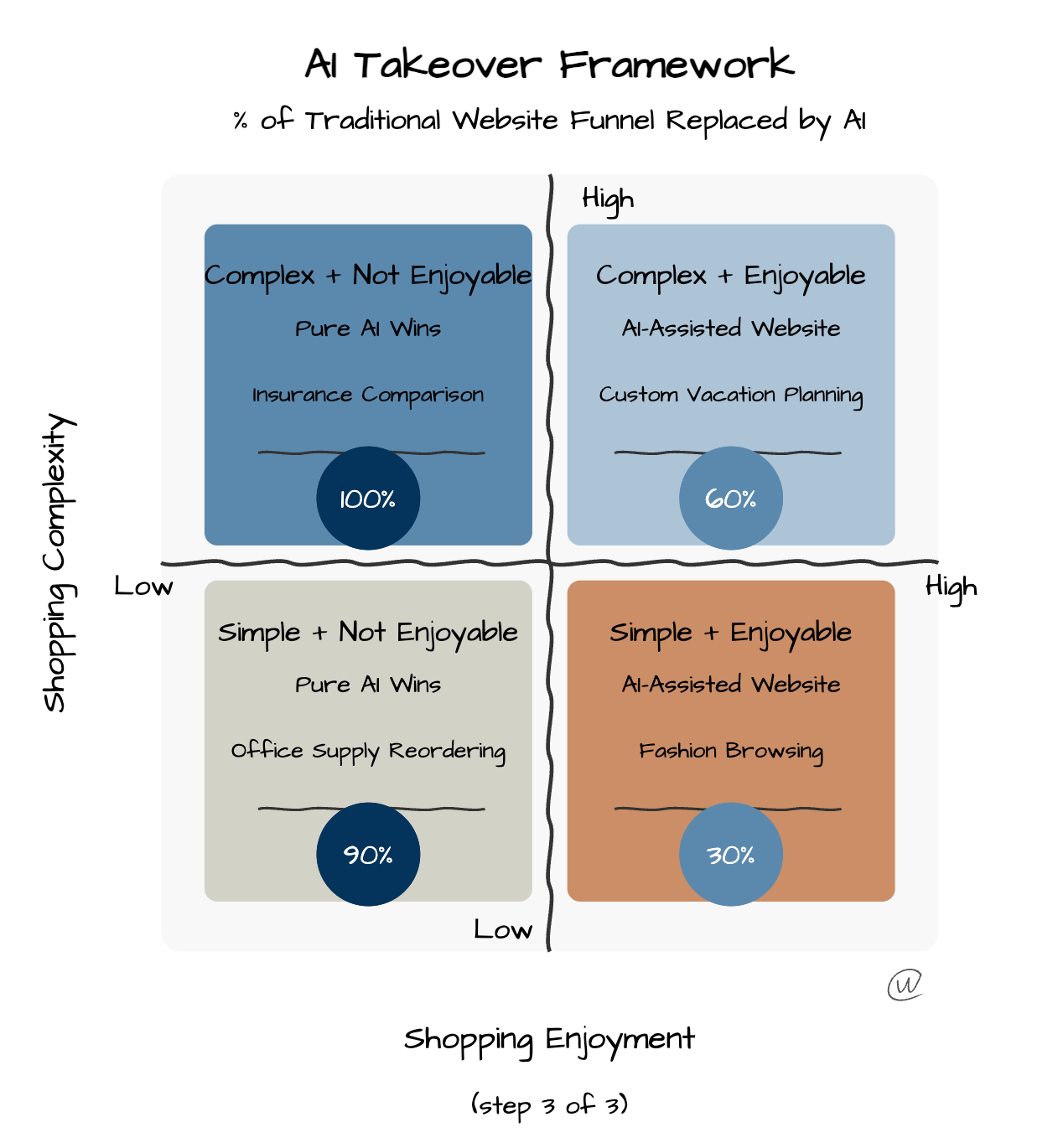
Put those two measures together and you get a matrix. It estimates how much of a traditional website's work AI will likely replace, based on shopping complexity and shopping enjoyment.
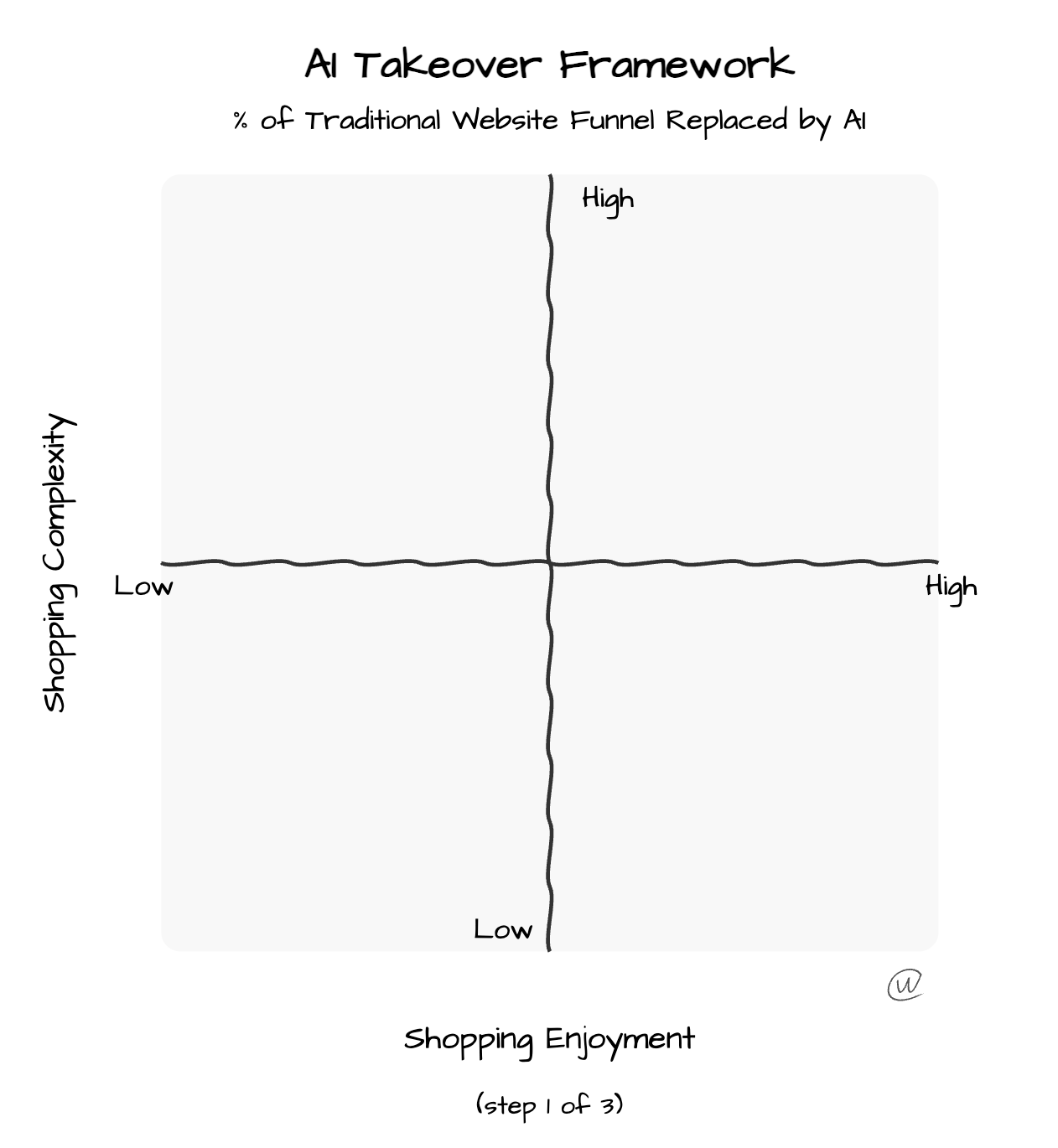
The matrix breaks into four quadrants.
Complex + Not Enjoyable (99.9% AI takeover). Insurance comparison shopping sits squarely here. Nobody, and I mean nobody, enjoys comparing insurance policies, yet we all have to do it. AI will handle nearly all of this process in the near future.
Complex + Enjoyable (60% AI takeover). Custom vacation planning stays partly driven by websites. People genuinely enjoy exploring destinations and picturing their options, and that emotional pull keeps the website valuable while AI handles the logistics and the comparisons. My theory is that the areas people really enjoy will keep a lot of engagement, even when they're complex.
Simple + Not Enjoyable (90% AI takeover). Office supply reordering offers zero joy. It's a pure transaction. AI already handles much of it, and that will speed up until traditional websites are almost irrelevant for these tasks.
Simple + Enjoyable (30% AI takeover). Fashion browsing keeps a real website presence because people value visual discovery and inspiration. They like browsing clothes and imagining how they'll look and feel in them.
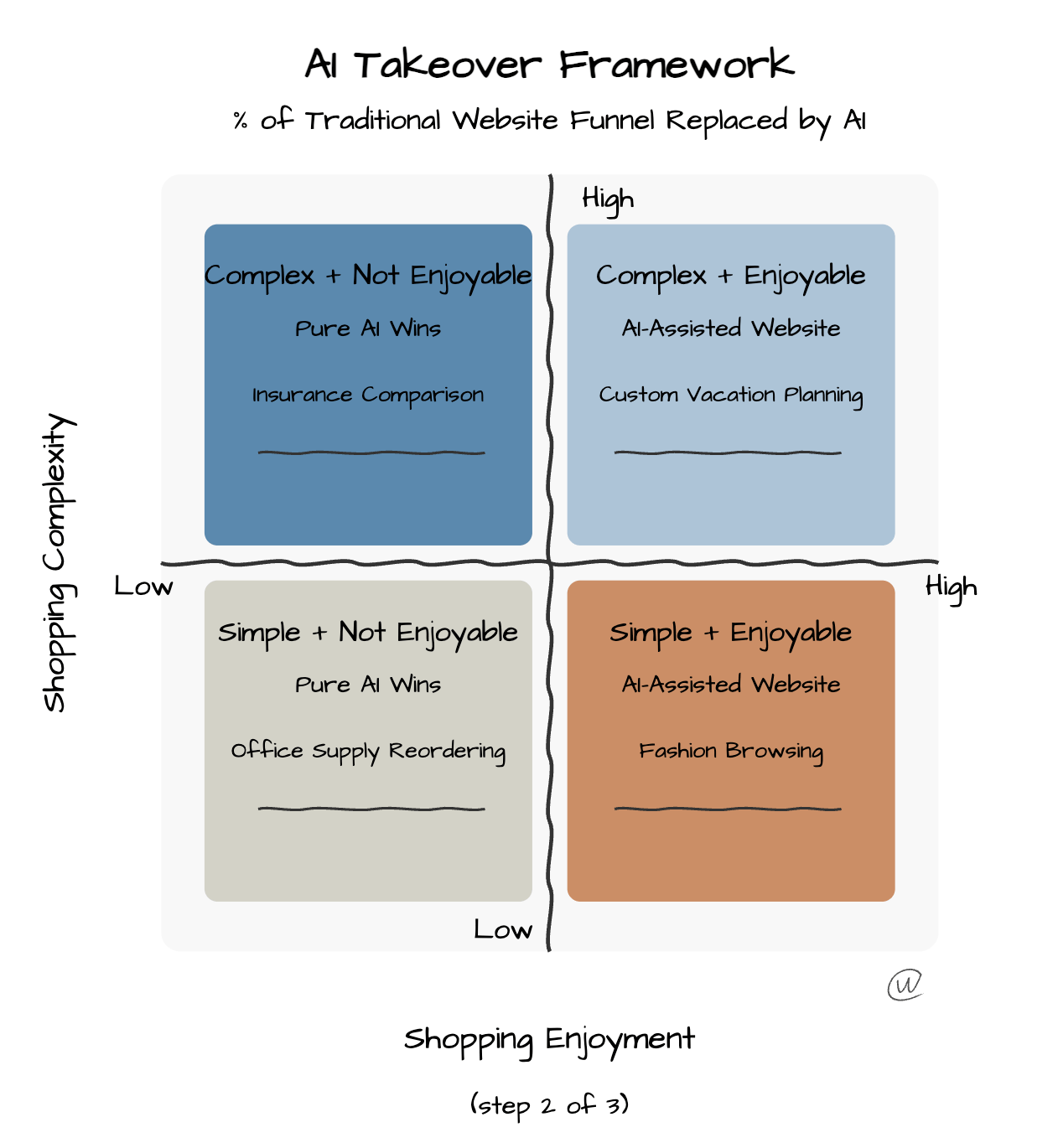
The diagram shows each quadrant with a percentage circle for its projected AI takeover rate. The spread is stark. Some sectors face nearly complete replacement, and others see much more modest change.
Bounded Rationality and the New Digital Experience
The matrix ties directly to Herbert Simon's idea of "bounded rationality" from 1955. Simon explained that people make decisions with a limited ability to process information. AI removes many of those bounds, and when the bounds move, behavior moves with them.
The bounds of your website will no longer exist, and neither will the bounds of your competitors' websites.
The walls between digital properties start to crumble once AI becomes the main interface between businesses and customers.
That matters because it changes how businesses reach customers in the first place. Companies that understand this and adapt will gain two real advantages, lower costs and a better customer experience.
Timeframe and Industry Variations
The timeline varies a lot by industry, but the direction is clear. Some sectors, like insurance and office supplies, are already in the middle of this shift. Others, like fashion retail, will change more gradually.
What holds across every industry is that traditional websites will increasingly give way to structured data formats built mainly for AI to read. That's why the debate around llms.txt matters so much. It's one of the early attempts to standardize how AI systems interact with business data.
For businesses in the "Complex + Not Enjoyable" quadrant, these changes are already underway. Everyone else has a bit more time, but not much.
What the New Website Looks Like
We built today's sprawling sites to rank on Google and funnel humans through conversion paths. The websites that come next will look very different. I expect four things to take their place.
Lean architectures that put data first
Structured content that AI can use directly
Smaller, more focused interfaces for humans
Direct API connections between business systems and AI platforms
That shift will likely save enormous resources and improve the customer journey at the same time. Think about the collective hours spent maintaining bloated websites, optimizing for search engines, and managing content that few humans ever read all the way through.
Most of that waste goes away.
Businesses can put their effort into resources that are genuinely useful, instead of SEO content farms. Customers get faster, more personal service without wading through navigation menus and content written mostly for algorithms.
Challenges to Adoption
Not every business will adapt quickly. The resistance will come from four places.
Legacy investments. Companies that spent heavily on traditional websites will hesitate to move away from them.
Industry regulations. Sectors with strict disclosure requirements may run into compliance problems with models that put AI first.
Technical debt. Organizations running on older systems will struggle to build the APIs and structured data that AI integration needs.
Trust. Some customers will resist dealing mainly through AI at first, especially for expensive purchases.
Those barriers will slow some sectors down. The cost savings and the better experience will still win out over time, and the sectors will differ mostly in how fast they get there.
Preparing Your Business
So what should business leaders do now?
Audit your current website. Use the matrix to find the parts of your funnel most exposed to AI disintermediation.
Invest in structured data. Start organizing your business information in formats AI can use.
Experiment with AI interfaces. Build and test AI customer interactions alongside your traditional website.
Focus on unique value. Put your energy into the parts of the customer experience AI can't replicate, like human connection, creativity, and emotional resonance.
Watch other industries. Pay attention to how companies in the high takeover quadrants adapt, and learn from what works for them and what fails.
Picture the conversation. Imagine a customer getting exactly what they need from your business by talking with an AI, without ever clicking through your website.
How would that change your digital strategy?
Traditional websites aren't dead yet. The change has started, though, and the businesses preparing now are getting ready for a world where AI becomes the main interface between companies and their customers.
Looking Back
Looking back from September 2026.
I wrote this in April 2025. I think the percentages are probably still correct.
What's changed is the speed. People themselves are going to need to visit websites less, and sooner.
With Grok Bot and other tools like it, it's very likely that AI will keep checking and updating data more and more on its own. That hasn't happened yet. I think we could get to a point, though, where most websites disappear unless browsing them is an experience people enjoy. That goes further than I went in 2025, when I expected websites to shrink and change.
It also puts the enjoyment side of the matrix in charge of which websites survive.
For most businesses, the job is simpler. They need to focus on knowledge maxing, putting more and more of their content and data into their systems. If AI is the one doing the checking, that knowledge is what it finds.