From the Newsletter
Why AI Will Disappear Faster Than We Think
How general purpose technologies quietly become invisible—and why AI will vanish even quicker

Remember when we marveled at electricity?
Of course you don't. That wonder disappeared generations ago.
The novelty fades, and what once felt like magic turns into infrastructure.
This pattern repeats with every general-purpose technology (GPT) that changes how the world works. First we're skeptical. Then we get excited. Eventually the integration is so complete that we stop noticing it entirely.
The Vanishing Act of Transformative Technologies
Electricity wasn't always invisible. People once gathered in town squares just to witness electric lights turning on. They dismissed it as a fad with no practical purpose.
Then it spread into everything.
Look around you. Count how many objects within arm's reach depend on electricity. Your screen, your lights, maybe your car, maybe even your toothbrush.
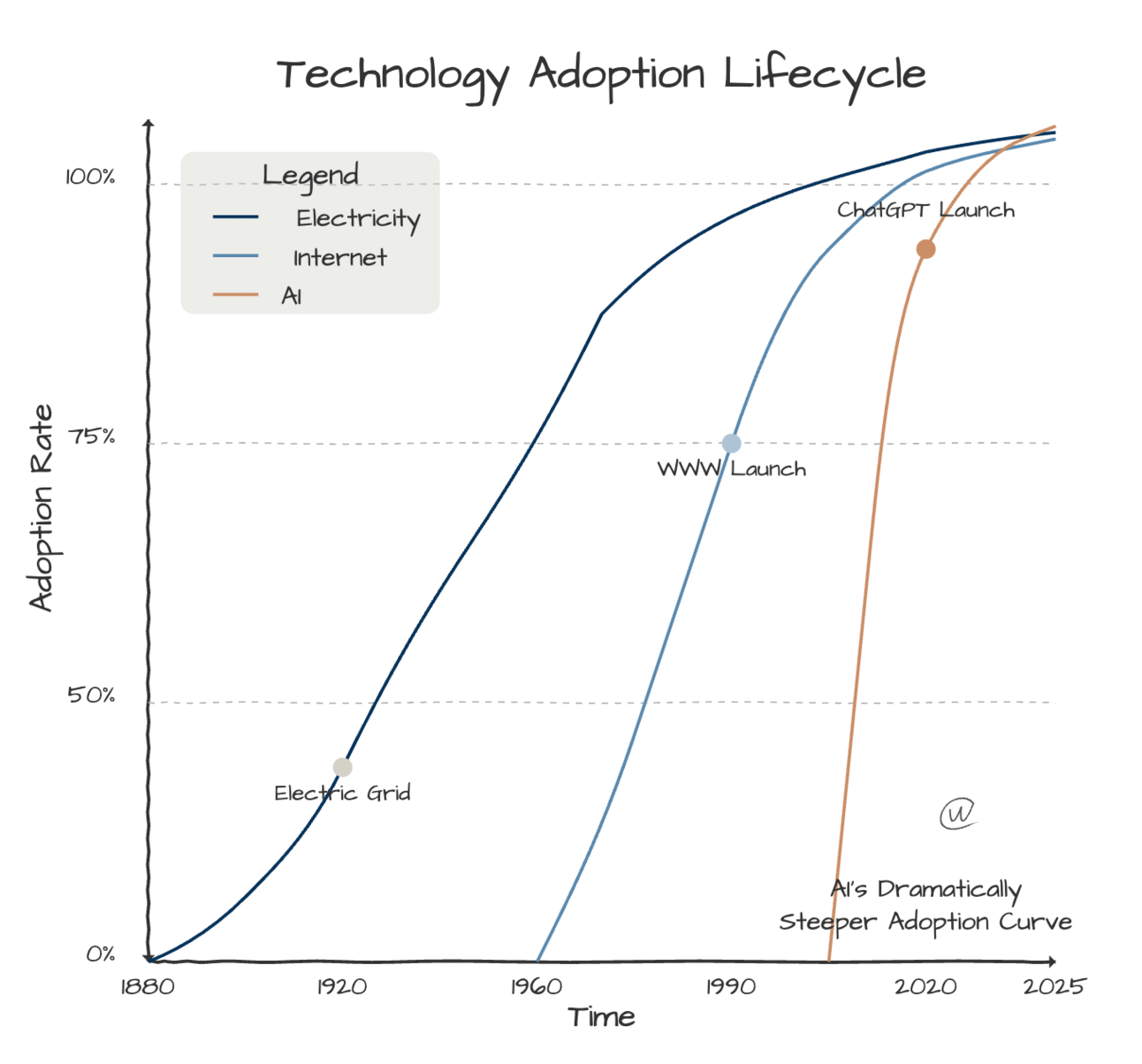
The Internet followed this same path. What began as a curiosity for academics and government researchers became the plumbing of our social and economic systems.
Think about something as simple as finding a restaurant for dinner. No more phone calls during business hours or flipping through physical directories. The entire experience was rebuilt from scratch.
AI is following the same trajectory as electricity and the Internet. It's just moving much faster.
The Accelerating Cycle of Adoption
General Purpose Technologies (GPTs) change everything they touch. Economists Bresnahan and Trajtenberg coined the term in 1995 to describe technologies that alter both economic and social structures across many sectors.
The adoption cycle for GPTs follows a predictable pattern. Skepticism gives way to experiments. Early adopters prove the value, and the mainstream follows. Eventually the technology is woven so deeply into daily life that it disappears.
AI differs from previous GPTs in three ways that matter.
First, it builds on infrastructure that already exists. Electricity needed physical grids. The Internet needed connectivity networks. AI runs on top of both.
Second, adoption is happening at unprecedented rates.
ChatGPT reached 100 million users in just two months. Electricity took decades to reach a similar level of penetration.
Third, and most important, AI adapts to humans. Every earlier GPT required humans to adapt to it.
That last difference changes the whole adoption equation.
The Human Interface Revolution
Previous GPTs asked a lot of us. Learning to use electricity meant understanding new concepts and new risks. The Internet demanded new skills and a whole new vocabulary.
AI inverts this relationship.
We no longer have to learn computer languages, because AI understands human language. Earlier technology made us work around its limits. AI adapts to our preferences.
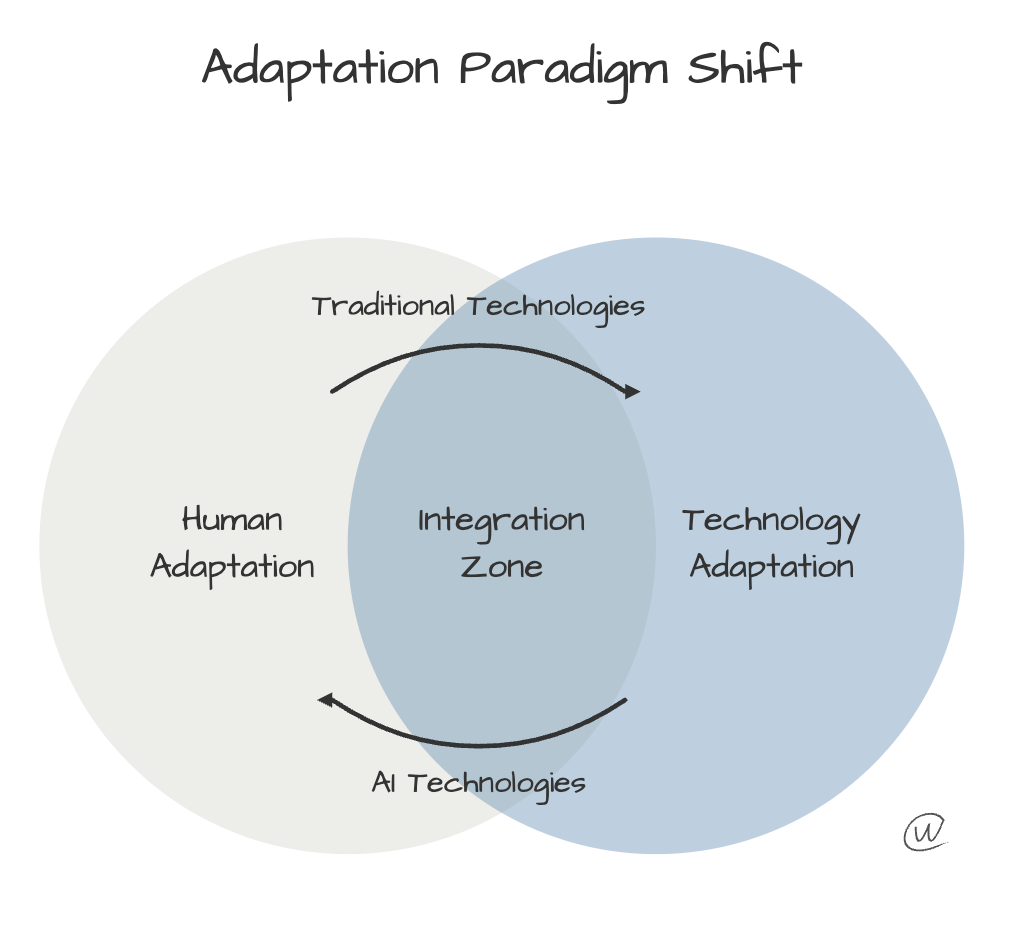
This shift toward technology adapting to humans is what speeds integration up so dramatically.
We already see this every day. AI systems improve through interaction. They learn how we communicate and what we prefer, and each interaction makes them a little more attuned to what we need.
This goes well beyond convenience. As AI works its way into existing systems, the technology itself becomes less visible, until we stop noticing it's there at all.
Preparing for the Invisible Future
In three years, we won't be talking about AI anymore. It will have succeeded so completely that it became invisible, just another utility powering our world.
How should we prepare?
Focus on capabilities. The technology matters less than what it makes possible.
What becomes possible when intelligence can be applied anywhere at negligible cost?
Look hard at the constraints in your business that exist only because human attention and cognition used to be expensive.
Ask better questions. As AI handles more complex tasks, the advantage goes to the people asking the sharpest questions.
Which questions, if answered, would change your business?
Consider which human skills become more valuable. As AI takes on routine cognitive tasks, the things only people can do carry a premium.
Which skills in your organization can't a machine replicate?
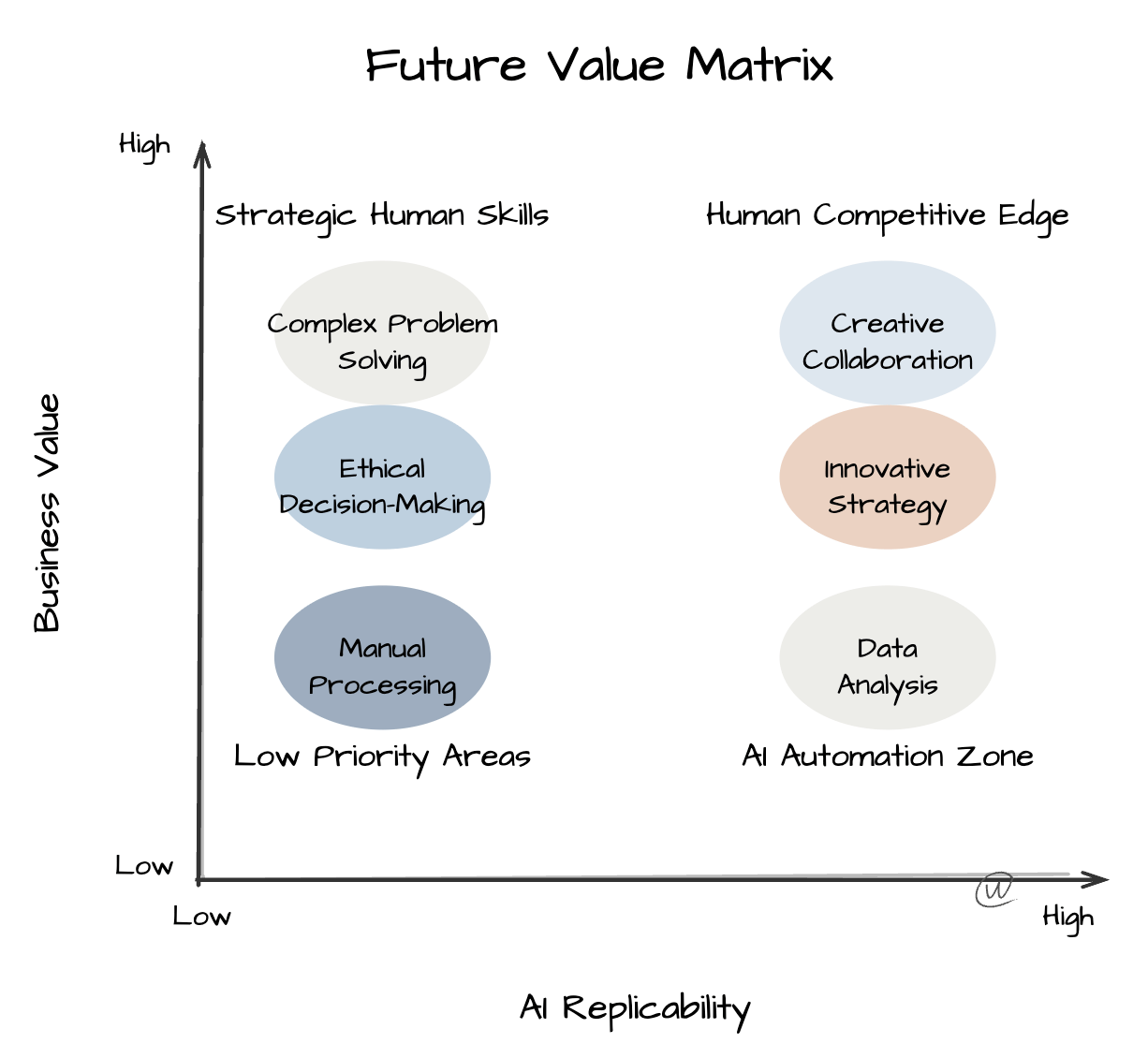
Watch for second-order effects. The biggest impacts often come from unexpected interactions between systems.
Where might AI open up entirely new approaches, beyond improving the processes you already run?
The Adoption Barriers
Even with all this speed, a few things could slow AI integration down.
Trust is still fragile. Businesses and individuals need confidence that AI will behave as expected before they hand it decisions that matter.
Regulatory frameworks lag behind what the technology can do. The rules for building and deploying AI are still uncertain, and that makes potential adopters hesitate.
Some work resists automation for good reasons. Tasks that call for moral judgment, creative inspiration, or human connection may keep people heavily involved even as AI gets more capable.
These barriers will likely slow the transition. I don't think any of them will stop it.
Amara's Law reminds us that "We tend to overestimate the effect of a technology in the short term and underestimate its effect in the long term."
AI feels overwhelming right now. The capabilities expand every day, and keeping pace feels impossible.
When we look back a decade from today, we'll struggle to recall how we managed without it.
We no longer marvel at light switches or video calls. AI will settle into the background right next to them.
Looking Back
Looking back from September 2026.
I don't know when it happened, but I no longer go to Google first. I go to ChatGPT, Claude, and increasingly Grok.
What I still can't believe, even as I say it, is that Google is my fourth choice. That includes Gemini, and I pay for the premium model! Gemini is an incredible model. Still, we now live in a world where Google isn't the start of every search and journey online.
That is almost unthinkable to me.
I also don't ask stunted searches anymore. I ask full, context rich questions, because I expect the results to be worth it.
AI hasn't disappeared into the background for consumers yet. I do see signs that traditional SaaS platforms are disappearing, though.
Since we launched our MCP, I already don't use our own company's interface for the vast majority of the data, research, and analysis I do. Nothing is wrong with our interface. It's just gone to me, because what can be done with Claude or Codex connected is so much better.
I can't tell you when I stopped going to Google first. It just happened, without my noticing.
That's how AI will disappear, too.


