Quick Take
Your Website is Too Heavy (AI Hates it)
How Structured Data Reduces Computational Costs by 90%

We talk endlessly about AI capabilities. Almost no one discusses what AI needs to work well.
Structured data is the foundational requirement that makes AI practical.
Why Structure Matters for AI Efficiency
Structure puts context around entities and ideas. It removes the ambiguity a machine would otherwise have to work out on its own.
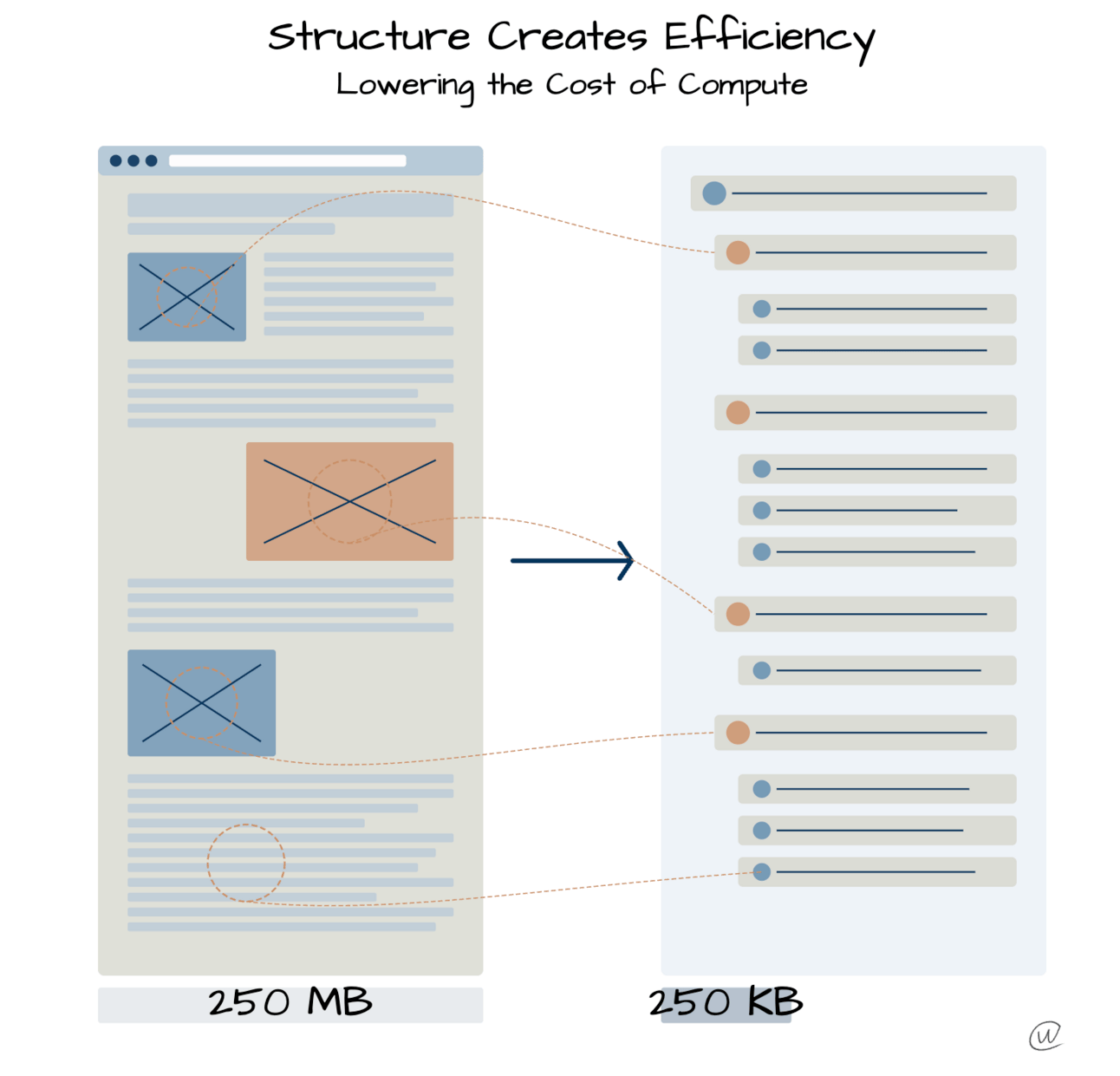
Without structure, machines waste enormous computing power trying to figure out the meaning that humans grasp immediately. The numbers tell the story. What takes 200 megabytes (my image is labeled wrong) in standard website content should only be 250kb in properly structured data.
Those numbers come from loading websites in the browser and noting how much memory the tab needed to run. Then I took the entire page, extracted as much structured data as I could, stored it as a markdown table and measured its size.
I did this on dozens of sites.
Take a simple word like "Washington" as part of a paragraph given to an AI system. Without structure, a machine sees multiple possibilities. It must guess.
Add structure and the guessing stops.
When "Washington" has a tag [Type: Person, Title: 1st US President], the machine instantly understands this refers to George Washington, the historical figure.
Add [Type: Place, Category: State, Country: USA] instead, and the machine knows this means the State of Washington on the West Coast.
Change to [Type: Place, Category: City, Role: US Capital], and the result is Washington, D.C., distinct from the state.
Tag it as [Type: Event, Category: Holiday, Official Name: Washington's Birthday], and the machine recognizes the federal holiday we know as Presidents' Day.
Apply [Type: Man-Made Object, Category: Monument, Location: Washington, D.C.], and you get specific identification of the Washington Monument.
A good system may still land on the right Washington without the tag. What matters is the cost of getting there. Working it out from the surrounding paragraph takes compute. A tagged entity from schema, or something similar, simply hands the machine the answer.
Structure eliminates computational waste. It prevents confusion.
Take One Page - Structure It in Markdown - And You’ll See
The diagram shows the difference. On the left, we see a typical web page at 200MB with unstructured content requiring significant processing. After proper structuring, the right shows the same information, just 250 KB of clean, tagged data points that machines can process efficiently.
Creating Machine-Efficient Data Structures
Think of structure as translation efficiency. While humans understand nuance through experience, machines need explicit relationship mapping and clear directions.
So much of the language on a page is there to let a human read it. That language is completely unnecessary for a system that's handed structure.
When proper nouns receive appropriate tags, you build a knowledge graph. Machines can move through it without exhausting computational resources.
The process isn't complicated. Start by identifying the key entities in your content and deciding what type each one is, whether that's a person, a place, an object, or a concept.
Add relevant attributes that distinguish one entity from another of the same type. The goal is zero ambiguity.
A person gets a role, an occupation, and a nationality.
A place gets its geographic category, its region, and what it's for.
A concept gets its field, how it's applied, and how it relates to other concepts.
The structure builds as connection points multiply. Each tagged entity becomes a node in an expanding knowledge graph.
The Business Impact of Structured Data
The ROI is substantial and measurable. Less compute to establish connections means faster processing at lower cost, and the outputs get more accurate.
Processing time drops dramatically when machines don't need to guess. An adequately structured dataset might process 10 to 100 times faster than unstructured content.
Cost savings follow directly. When a process that once required significant computing resources now runs efficiently, you save on infrastructure and energy.
Accuracy improves too. Eliminating ambiguity at the source prevents cascading errors.
None of this is new. It echoes the principles of the Semantic Web (Berners-Lee et al., 2001), which relies on structured data for machine comprehension.
But the stakes are higher now. AI systems are processing unprecedented volumes of information, and a page without structure makes them work out the meaning the expensive way.
The diagram shows it. Follow the dotted connection lines and you'll see clean, direct paths between structured elements, with no wasted processing and no guesswork.
Practical Steps Toward Data Efficiency
Start small. Identify the data points that matter most and create simple structural frameworks around them. Don't attempt to restructure everything at once.
Implement schema markup on web content. This invisible layer helps search engines and AI systems understand your content without changing what humans see.
Build consistent taxonomies across your organization. When everyone uses the same structural approach, machines process your collective information more efficiently.
Audit existing systems for structural gaps. Look for the places where machines work hardest to understand your data. Those areas need attention first.
Then work out which entities matter most in your domain and what attributes set them apart from others. Map how those entities relate to each other, and find where your systems struggle with ambiguity.
The answers become your roadmap. They point to where you'll get the biggest return on investment.
Obstacles to Structural Implementation
Despite clear benefits, structured data faces real resistance.
Legacy systems weren't built for structure. Retrofitting costs money now for benefits later. Plus, no one seems to want to do it in the IT department.
Standards remain inconsistent. Each department tags content differently, creating new problems. They should use a standard structure like Schema.org. Even that isn’t perfect.
People hate changing workflows. "What do you mean I need to tag everything?" kills initiatives before they start.
Short-term thinking dominates. Structure builds foundations for future returns, and it rarely delivers a quick win.
Awareness remains low. Many executives can't see what they're losing through inefficiency.
Companies pay for computing power when they need a better data design.
Are we structured enough for AI?
No. We're forcing machines to work too hard.
Organizations that structure early gain compounding advantages over time.