Quick Take
AI Is Reshaping Local Search: Why Distance No Longer Dominates
The Coming Revolution in How Businesses Compete for Visibility

Local search is changing. What once required physically moving your business might soon be solved by structuring your data.
Local Search Is Getting Smarter
Remember when moving your business was practically the only fix for poor local search rankings?
Those days are ending.
AI is changing how search engines process and prioritize local businesses. The rigid constraints of proximity-based ranking are loosening.
Most local searches don't actually require extreme proximity.
Unless you need coffee right now, does it really matter if a business is half a mile or a mile away?
Yet for years, distance from the query location (or mobile device location) has been one of the most important ranking factors. That created artificial barriers for otherwise excellent businesses.
DIAGRAM STEP 1
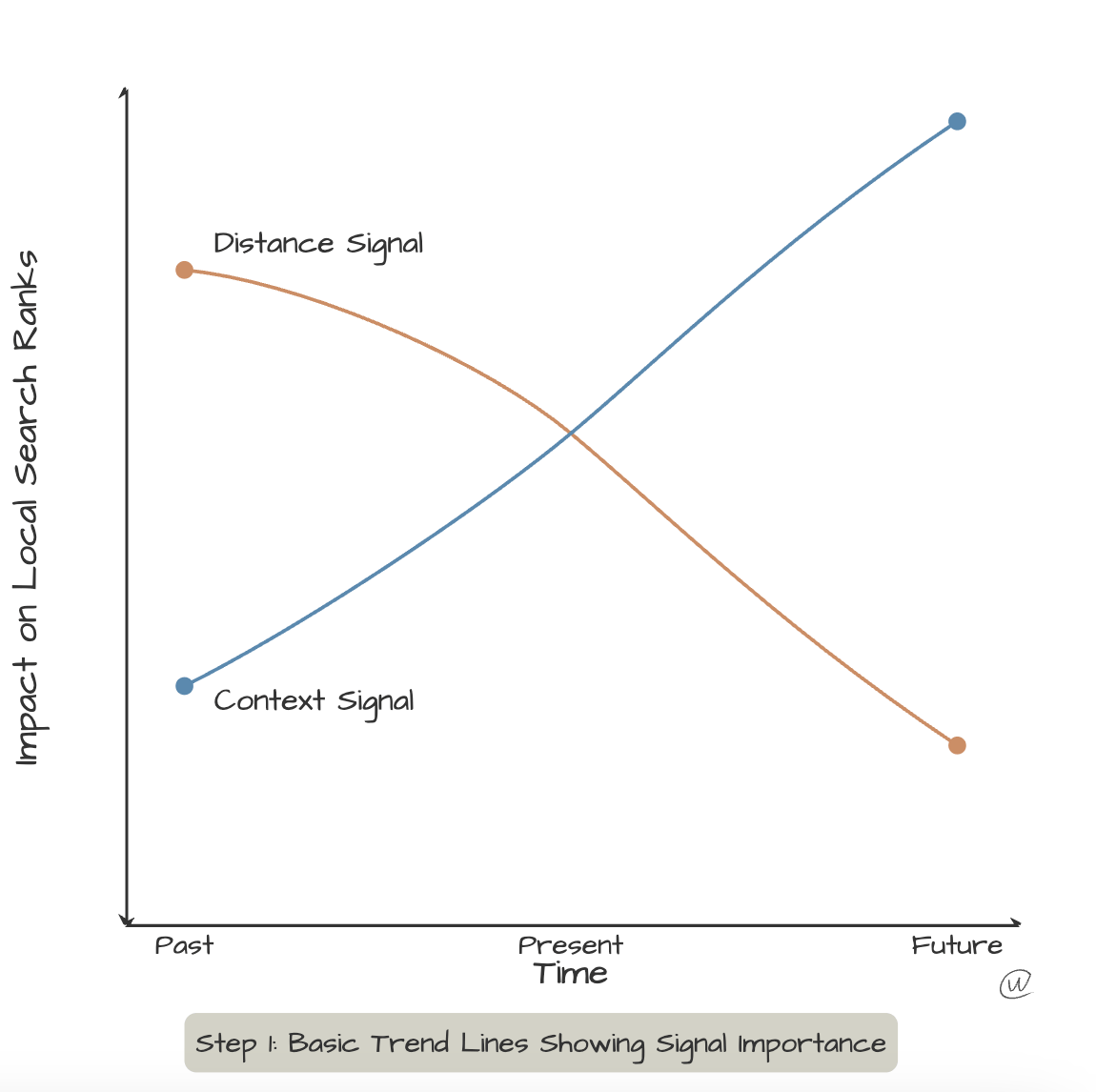
This all starts with Context becoming more important over time.
The visualization shows how the weight of different signals in local search rankings shifts. The blue line is context signals growing in importance, and the orange line is distance signals losing relevance.
Proximity's long run at the top is giving way. Context is becoming king.
Memory Features Are Changing Search Fundamentals
Google adding memory to Gemini Pro is a major shift for search. It follows OpenAI adding memory features to ChatGPT over a year ago.
The two approaches are quite different. ChatGPT passively picks up recurring preferences from your conversations. Gemini Pro offers on-demand recall of all your past interactions, using its large context window.
The big change shows up when you project these memory features forward to their logical conclusion and look at what they do to local search.
For years, proximity has ruled local rankings. Our client data consistently confirms this pattern. Stand in front of any coffee shop and search "coffee," and proximity-based results appear automatically.
But this makes little sense for specialized searches. When I ask an AI to recommend a patent attorney or research the ideal vehicle for my specific needs, physical distance should become secondary to my conversation history and needs.
I think the first time I chose a new business with AI was a vet for our dog, Jack. We had a lot of questions, and it was just so much easier to use AI in that case.
DIAGRAM STEP 2
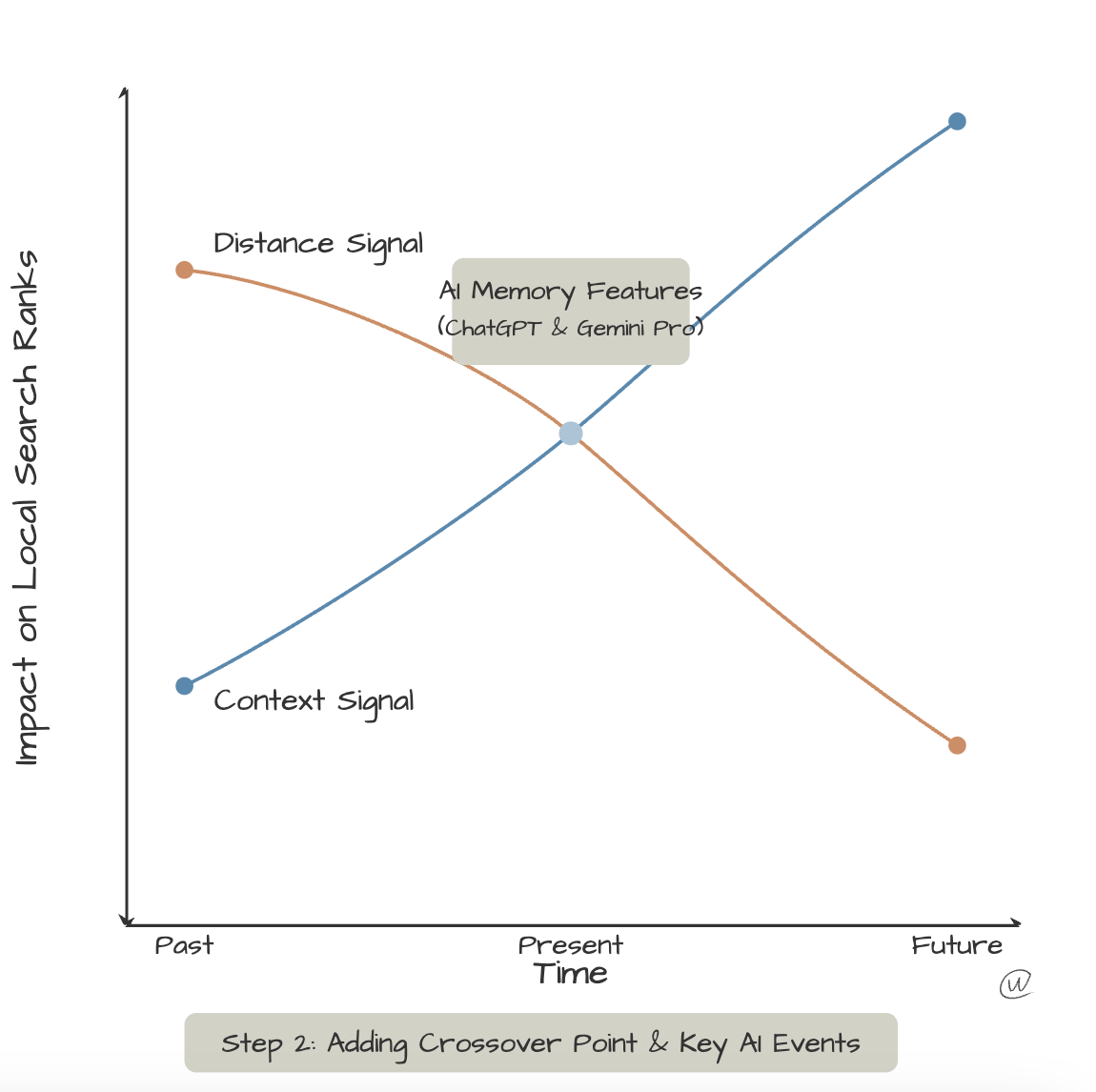
The diagram marks the point labeled "Signaling Shift," where context starts to outweigh distance as the dominant factor in local search rankings.
This is the information asymmetry that's developing in the market.
Economic Theory Explains The Transformation
This transition fits Spence's Signaling Theory from 1973 closely. Local businesses have long signaled quality through location and proximity, which created an information asymmetry that search engines reinforced.
AI breaks that pattern by giving weight to new signals. It looks at the context of your conversation and the expertise a business has shown, and it rewards structured data that's easy to access.
Businesses can no longer rely only on being the closest option. They have to become the most relevant option in the customer's ongoing dialogue with AI.
That flips the competitive advantage in local search. Quality signals will beat geographic signals.
Businesses that adapt quickly will gain market share. Those that don't will get harder and harder to find, even with a prime physical location.
How To Prepare Your Business For AI-Driven Local Search
The best strategy is to strengthen the signal for everything that provides context. In practice, that means more structured data.
Companies that structure their data for AI will dominate local search. Making complete information easy to find in machine-readable formats isn't optional anymore.
AI can only explain what it can find and read.
DIAGRAM STEP 3
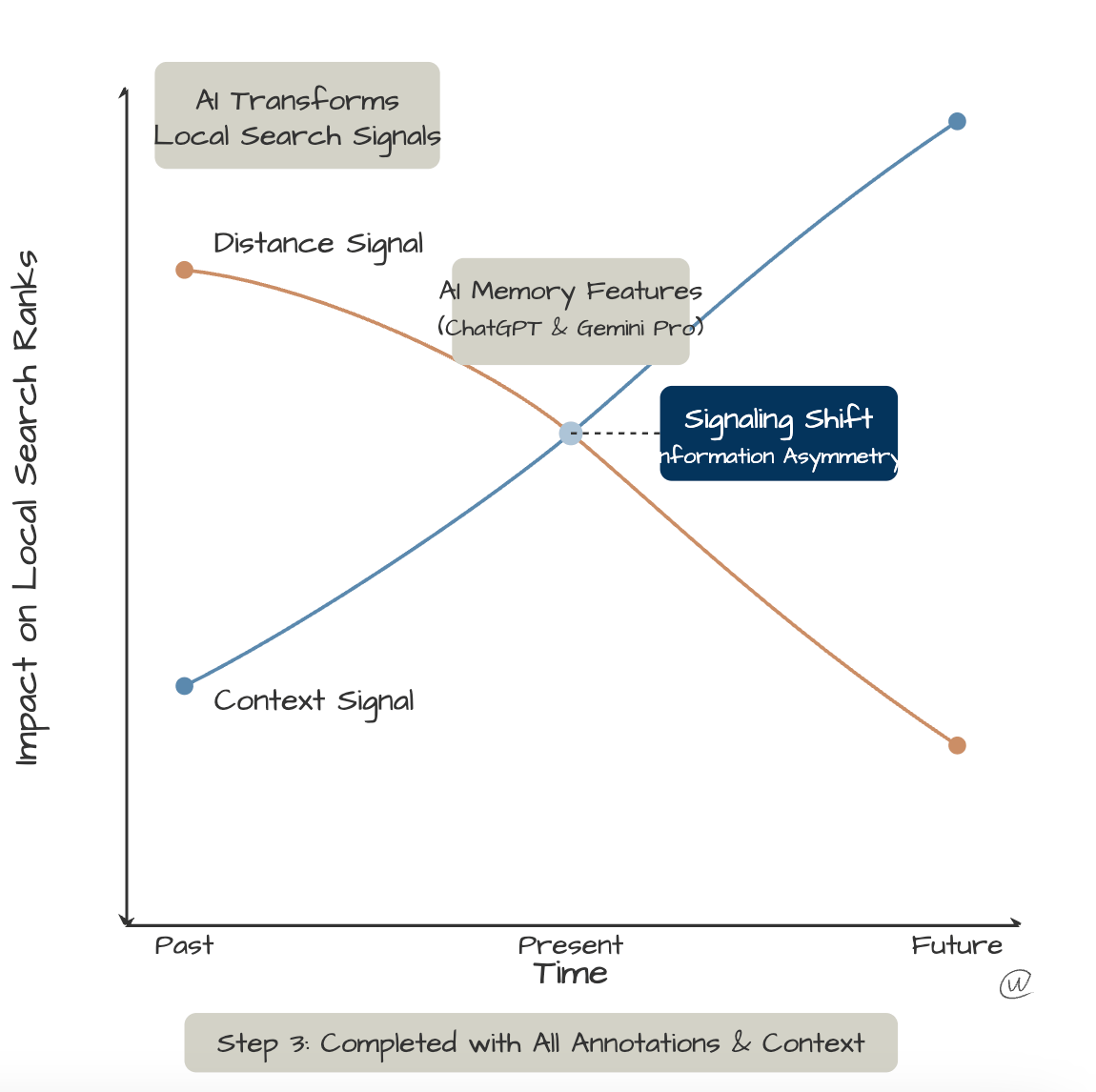
The right side of our diagram shows where this is heading. Context signals reach their maximum influence, and distance barely matters.
Here's what businesses should do now.
Audit your structured data. Make sure you're using Schema.org markup extensively.
Document customer journeys in detail. AI systems will increasingly value businesses that provide clear solutions to specific customer scenarios.
Create machine-readable content about your specialty areas. Help AI understand exactly what problems you solve and how you solve them.
Build detailed FAQ content structured for AI. This builds your context signals.
What matters most is whether your business looks like the logical answer to a customer's question, based on their ongoing conversations with AI.
Are you still relying on proximity when you should be building context signals?
Barriers To This Transformation
Some kinds of business will hold on to distance longer than others. Emergency services will keep treating it as a primary factor. So will businesses built on immediate need or convenience.
Search engines may also run hybrid systems during the transition. Expect proximity to stay relevant, especially for mobile searches with clear, urgent intent.
Local business directories built on traditional ranking factors may struggle to adapt at first. Their economic incentives often line up with the old proximity-based model.
User expectations will take time to adjust, too. People have been conditioned to get proximity-based results for local searches.
Regulatory concerns about information filtering and bias could also slow things down, especially where AI systems might favor certain businesses based on subjective factors.
The End Of Location Advantages
This change reorders competitive advantage in local search.
Where a business sits on the map will matter less than how well AI understands it. The winners will be the businesses whose information is structured for AI, whether or not they're the closest.
In competitive markets where location has created artificial monopolies, this opens things up. A business two miles away with better service can finally compete with the mediocre option next door.
The question businesses need to ask now is about relevance.
How do we make our relevance to customer needs unmistakably clear to AI systems?
A business that can't answer it may become invisible in search, even to customers down the street.
Prime real estate won't guarantee search visibility anymore.
Looking Back
Looking back from September 2026.
AI is gathering so much context, speed and memory that it's hard to compare it to 17 months ago. Here's what I would say. No matter where we're headed, I'm consulting ChatGPT or Grok about parking, traffic, nearby food, what to see and what's happening that weekend.
You name it, I ask it.
I also see a ton of retail use cases. The number of times I snap a photo of a product or shoes or a new tech gadget (like the XNote pen) and just let AI go research it and explain all of it to me is astounding.