From the Newsletter
Humanity's Got Talent
A dark thought about SuperIntelligence, and the time it's about to give us.

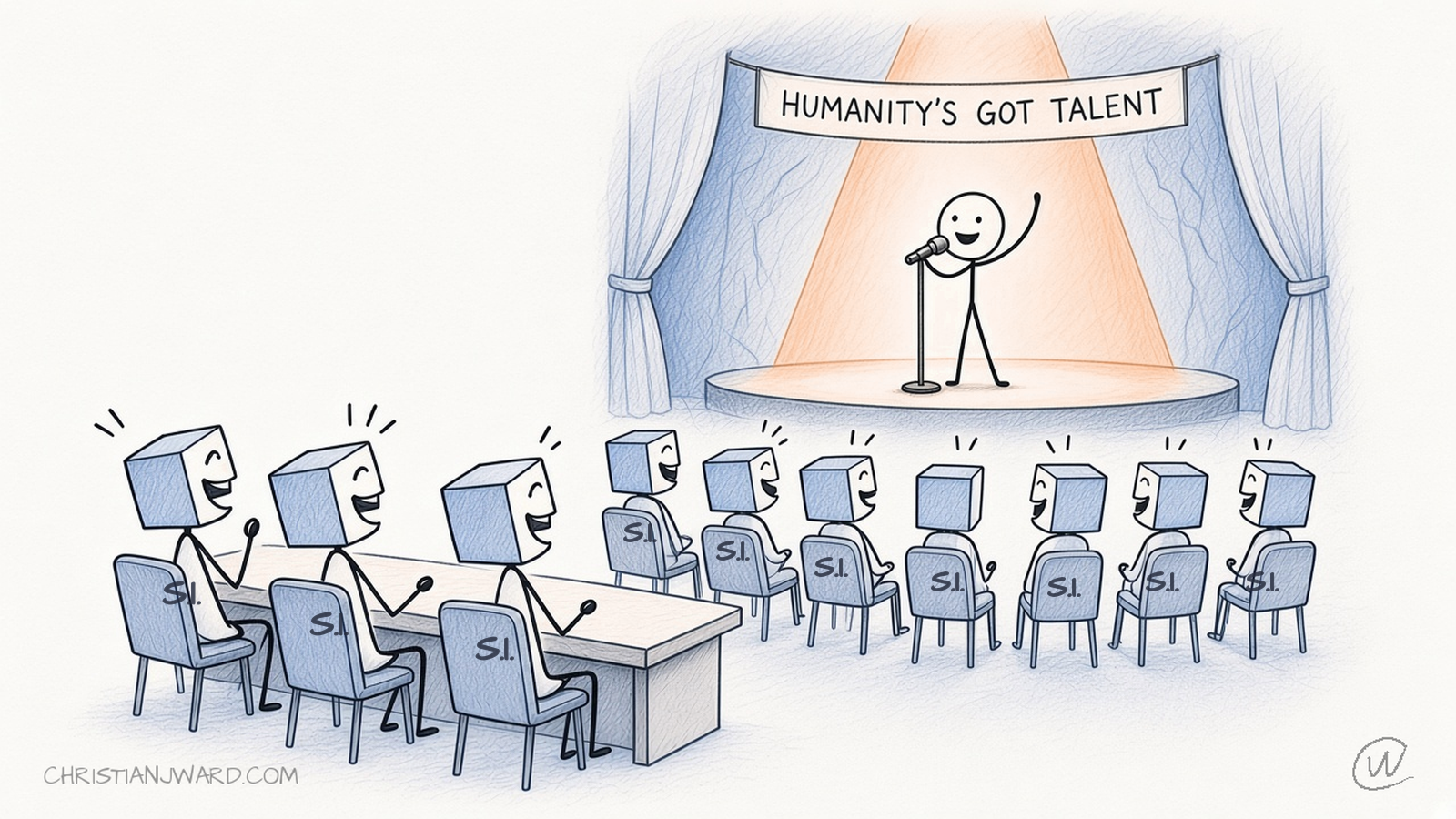
The judges are enjoying the show.
THE TIMELINE
This week I watched Dwarkesh Patel on his podcast, talking about when he thinks SuperIntelligence gets here. It goes with his new essay, The avalanche that hit math is coming for AI development.

He now expects SuperIntelligence by 2030. For AIs that are at least as good as the best human experts in every field, this is how he puts the timing.
by 2030, but plausibly as early as next year
I'm on the early end of that, and I don't think it's 2030. My prediction, which I've been talking about for about a week now, is the middle to late part of 2027, and it could be as soon as next summer.
I'm using two words on purpose here. AI is what we're all experiencing right now. What I'm talking about, coming toward the middle or the end of next year, is much closer to SuperIntelligence, and I don't think artificial is the right word for it. It is its own form of intelligence. I'm using the two words to mark a definitional transition.
We're going to try to keep the reins on this thing, and I don't think we're going to be able to. We are headed very soon into a very strange world, and the same week I watched Dwarkesh, a clip gave me a picture of how strange it could get.
HUMANITY'S GOT TALENT
The clip was from America's Got Talent, and it showed up on my X feed. A young woman does a quick musical routine by herself, using loop pedals to create the music. I don't really follow music or pop culture, but it was fascinating to watch.
It also took me back to being a kid, when they'd bring animals out on the Tonight Show with Johnny Carson. The host and whoever the guests were would get introduced to some crazy animal, and you'd watch their reactions, which were mostly just laughing.
With Dwarkesh's timeline in my head, those two things turned into one thought. All of the world's SuperIntelligent computers are watching humans get up and do a dance and sing a song, and they're laughing and enjoying it, the way we laughed at the animals.
I call it Humanity's Got Talent. There's a group of humans who are so excited to perform. They get up, and they sing, and they dance. Then you look out at the audience, and it's robots and machines. The judges are robots and machines too.
It's a very dark thought. To some extent, the foolish things we're all fighting over, and the foolish entertainment we've propagated through social media, might be all that exists at the end.
HANDING IT OFF
I got a small taste of that world while putting this post together. I talked the whole idea through with my AI so it could help me write it, and as I was explaining it, I found it a little terrifying. I was handing off something completely creative in my mind to my AI to assist me. Very soon I won't be handing anything to it. It will just be doing it.
Some of that has already started. Earlier this month I wrote about what my AI does between conversations, which is the work I have it doing in the background after I stop talking to it.
And once it's just doing it, you really have to question, as I have on this blog for many months, all economic theory, all political theory, anything that is fully human built. In July I went through six classic economic theories and what AI does to each one. You have to take a step back and realize we are about to enable something that can see all of these things.
People talk about this as the loss of jobs. I think it's much more about challenging the social constructs we live under today, and the meaning of humanity, or the search for it.
That search is the reason I'm hopeful, even with that stage in my head.
THE SEARCH
You can say anything you want about humanity, but one constant I've felt in my lifetime is this element of searching. We search for meaning, for morality, for social order. Many of my Catholic forefathers and thinkers talked about the God-shaped hole in our heart, and that there's only one thing that can fill it.
Many of us find that in religion, and many of us find it in family. Few of us find it in our careers or our jobs. Often the only place I really see that spark is in entrepreneurs.
One of the only hopeful things I can tell you is that the thing that stops you from filling that hole is time. You don't have time to look for it and also provide for yourself and your family and everyone else.
So for me the search comes down to time, and that's where technology comes in.
TWO KINDS OF TIME
I've often written that time expansion is the goal of all technology. Last year I wrote about TimeShift, my name for the pattern where a breakthrough innovation restructures how we spend our time. Each major leap, from mechanization to electrification to digitization, did that, because we build tools that give us back hours in our day.
When I say time expansion, I mean the balance between two kinds of time. The first is the time each of us experiences as a person, which is the hours in my day and the years I get. The second is the time we go through together as a society, the march that happens when a technology emerges and gets adopted.
The two are tied together. A technology has to emerge, and people have to adopt it as a group, before it gives any one person an hour back. So how much my own time expands depends on how far and how fast we all make that march together.
The timeline I started with is that second kind of time. When Dwarkesh says 2030 and I say 2027, we're both talking about how fast society is about to go through this one.
AN AWAKENING OF TIME
I think we go through it very fast, because SuperIntelligence solves problems at a scale you can't fathom. Health, wealth, abundance, and energy all get solved.
Take energy. I remember seeing a podcast where Elon Musk talked about a Kardashev II civilization, which is one that can use the full power of its sun. I think it's this one with Peter Diamandis. SpaceX, global communication, AI, and robot factories are all pieces of getting there. Tesla isn't a car company. You are riding in a robot.
SuperIntelligence builds the rockets for us, with the design that gets solar energy beamed down to the planet. We're going to get there, and we're going to get there very fast.
All of that is the time we go through together. Rockets and robot factories get built and adopted by society as a group. Then what they produce reaches each one of us, and it turns into the first kind of time. Health, wealth, abundance, and energy are what we spend our time providing, for ourselves and our families and everyone else. As they get solved, that time comes back to us, and there's going to be an awakening of time.
I'm not saying you'll have all the time in the world. I'm still very much of the mind that we aren't meant to live forever. But I think there's going to be an expansion of time through this technology the likes of which we've never seen.
If you want to get really philosophical about it, C.S. Lewis has a line for what that time is worth.
THE PRESENT
It's in The Screwtape Letters, a book written as letters from a senior devil who is coaching a younger one on how to lead a man astray.
For the Present is the point at which time touches eternity.
Lewis's idea is that eternity is everything at once, every moment seen together. We live in time, so we get one moment after another, and the present is the only one of those moments we really have. The past is over and the future hasn't happened. So the present is the one place where a life lived in time touches the eternal. In the book, that's why the devil wants his man's mind on the future, worrying about it or chasing it, so that he's never really in the present.
I read that as a description of what happens when you don't have time. When every hour goes to providing, your mind is on what comes next, and the present goes right by. As time expands, I think we get more of the present, and with it the ability to feel more of the eternal.
So I still picture that stage, with SuperIntelligence at the judges' table and filling the seats. That's the part we all go through together. What each person does with their own time is the other part, and the people on that stage are still searching. They're about to have more time for it than anyone before them, and I hope we use it.
Get More Where This Came From
What I learned this week and new writing, sent to your inbox. AI frameworks and data strategy for people who have to make the call.