WILTWWhat I Learned This Week

Issue 03October 30, 20264 stories7 min read

Shopping agents and two old economic models

A lot of my posts this week were about AI agents buying things for people. Walmart opened its store to outside shopping agents, Spotify said it wants to be inside the agents people use, and on Wednesday Shopify put its checkout into several of them.

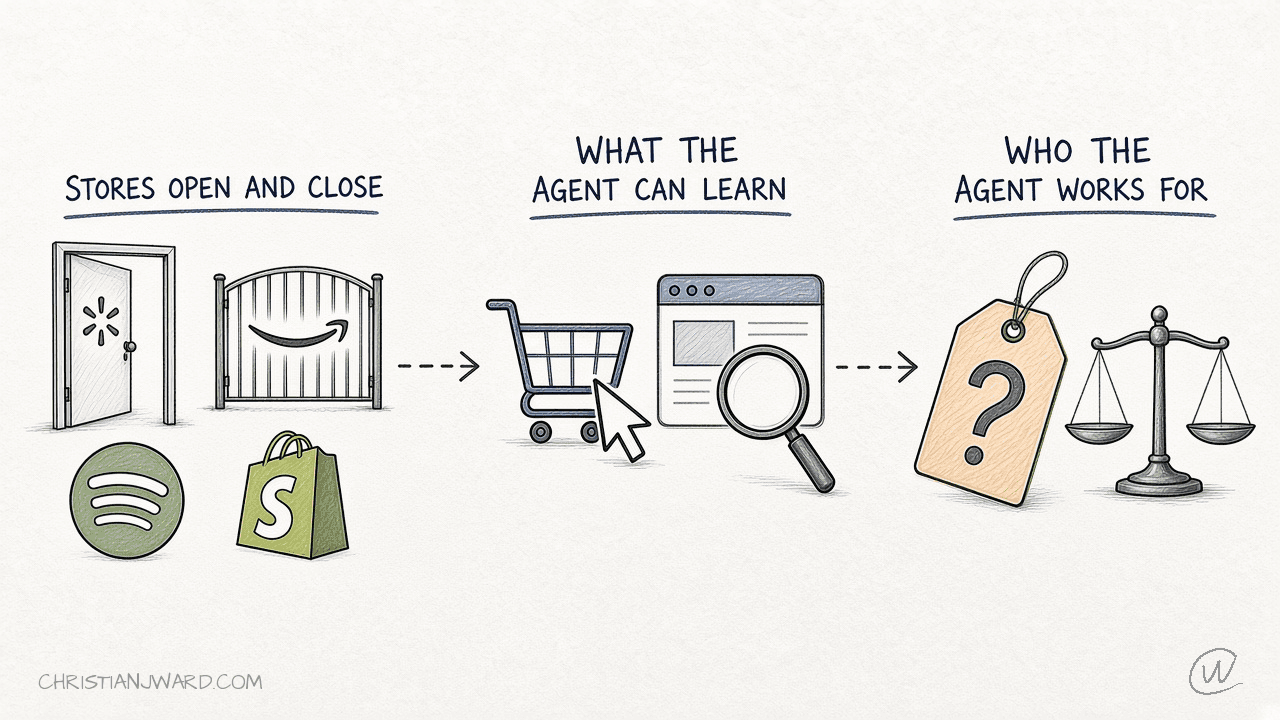
Once an agent does the shopping, the business it picks depends on what it can find out about that business, and on who the agent is really working for. Both of those connect to economic models of the past that AI is likely to change.

Shopping agents and two old economic models

Agents shop past the big marketplaces

Walmart opened Agent Gateway and Agent Profiles to outside AI shopping agents, Reuters reported, while Amazon blocked Meta's Muse, according to Axios.

When Elon Musk told people to have their agent buy somewhere else, I wrote that Amazon isn't the whole internet, and Google isn't either. If agents like Grok go shopping beyond the big marketplaces, they need a source for what a business actually sells and does, and the closest source to the business is its own website.

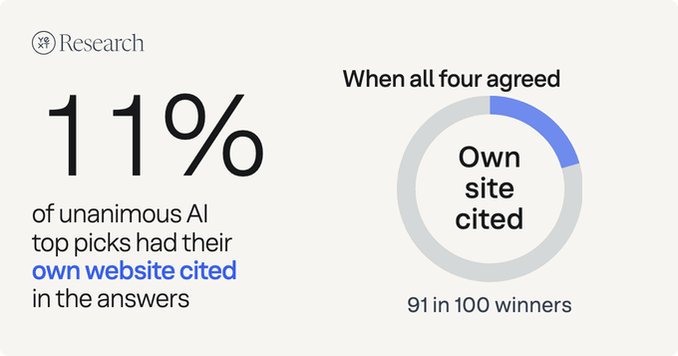
When four AI engines all picked the same business, Yext found its own site was cited 91% of the time.

That's the engines going straight to the business's own site when they agree. It's why I called a business website the conveyor belt of structured data to these models.

@wardchristianj@wardchristianj
Amazon isn't the whole internet, and Google isn't either. Elon Musk (@elonmusk) is telling people to have their agent buy somewhere else. If agents like @grok go shopping beyond the big marketplaces, they need a source for what a business actually sells and does. The closest source to the business is its own website. Then your own website has to carry you. When four AI engines all picked the same business, @yext found its own site was cited 91% of the time. That's the engines going straight to the business's own site when they agree. The homepage you ignored is your best salesperson again. Your website as a business is the conveyor belt of structured data to these models. You need to start treating it that way.
· View on X

Be where the agent is

Benzinga reported that Spotify is treating AI agents, from ChatGPT to Muse, as a new growth engine, under the headline "We Are Simply Everywhere."

My reply was that it makes sense for Spotify, and that this is the Apple App Store decision from 18 years ago, on steroids.

If the agent is where people ask for music, that's where you want to be.

@Benzinga@Benzinga
Spotify Embraces AI Agents From ChatGPT to Muse as New Growth Engine: ‘We Are Simply Everywhere’ https://t.co/k1mVVMuk2L
· View on X
@wardchristianj@wardchristianj
@Benzinga makes sense for @Spotify. If the agent is where people ask for music, that's where you want to be. this is the @Apple App Store decision from 18 years ago, on steroids.
· View on X

Who the agent works for

Alexander Grieve shared a proposal for Open Agentic Commerce. He argues that personal agents are running into walls like the ones banks put up during the Open Banking fights, and suggests guidance for regulators. His starting point is the principle that consumers should be able to choose who, or what, transacts on their behalf. The goal he describes is an agent acting on your behalf that is as capable of delivering value and cost savings to you as you would be acting on your own.

In my quote of it I wrote that Agency Theory research is going to make a huge comeback. An agent that does as well for you as you would do for yourself is the problem at the center of Agency Theory.

Dodd-Frank 1033 already has the word in it. A consumer includes an agent acting on behalf of an individual.

But do we really mean the same thing? The agent in that law is someone you hand a task to and trust to act for you. An AI agent acts for you too. It just isn't a someone.

Is AI as agent really the correct way to think about it?

That's a big question, and probably the one these fights end up turning on.

@AlexanderGrieve@AlexanderGrieve
Personal agents are everywhere (Muse! Instinct! Hermes! GrokBot! Dots! Duet!). And, increasingly, they're running into walls – similar walls to the ones banks threw up during the Open Banking fights of the past decade, as fintech users struggled to connect their apps to their bank-held financial data. It's time for Open Agentic Commerce. In Dodd-Frank Section 1033, the backbone of Open Banking, the definition of “consumer” reads: “an individual or an agent, trustee, or representative acting on behalf of an individual.” Congress obviously wasn’t contemplating AI agents when it wrote Dodd-Frank — but technology changing doesn’t obviate the underlying principle: consumers should be able to choose who, or what, transacts on their behalf. Banks and companies like Amazon have real, legitimate concerns about agents becoming vectors for fraud or unauthorized transactions. But those are arguments for building portals for secure access, not for prohibiting agents altogether. Open Banking offers a useful lesson here, in that secure, standardized interfaces are preferable to forcing third parties into credential sharing or screen scraping. We propose some basic guidance that relevant regulators (FTC, OCC, CFPB) could consider to help the market to coalesce around open norms before incumbents obtain sufficient lock-in, freezing the current landscape to their advantage. With standards like these established, agents can make decisions that better serve the consumer, and will index on things like quality or price, rather than being funneled into a constrained set of options. The push for Open Banking resulted in better experiences and lower prices for consumers. As agents become principal commercial actors, it is imperative that we lay the groundwork now so that an agent acting on your behalf is equally capable – if not more so – of delivering value and cost savings to you as you would be acting on your own. Read our proposal below:
· View on X
@wardchristianj@wardchristianj
Agency Theory research is going to make a huge comeback. Dodd-Frank 1033 already has the word in it. A consumer includes an agent acting on behalf of an individual. but do we really mean the same thing? The agent in that law is someone you hand a task to and trust to act for you. An AI agent acts for you too. It just isn't a someone. Is AI as Agent really the correct way to think about it That's a big question. And probably the one these fights end up turning on
· View on X

Applying what I learned this week

Shopify released its Fall '26 Edition on October 28. Buyers can point ChatGPT, Claude or another agent to a shopping skill called shop.md, and it can search more than a billion products and check out with Shop Pay. Shopify says the agent knows a buyer's preferences, sizes and order history from Shop. Shop Pay checkout is also going inside personal AI agents, starting with Muse from Meta and Claude Duet.

The same day, in a quote of Aakash Gupta's post on malls and discovery shopping, I wrote that a search box waits for you to already know, and AI doesn't have to wait.

Context and memory are probably the biggest elements here. Location, time, context and memory are almost the perfect storm, or the perfect opportunity, for AI to create serendipitous shopping experiences.

The businesses that do well here are the ones with the most knowledge about themselves, on their own site and on every third-party platform the AI reads. If it can't find you, it can't surprise anyone with you. Shopify also added a knowledge base where merchants review and publish the facts agents get about their store, such as return windows and shipping destinations. Agents that ask Shopify about a store only get the facts the merchant has published.

@wardchristianj@wardchristianj
A search box waits for you to already know. AI doesn't have to wait. context and memory are probably the biggest elements here. Who you are, what you liked last time, what you're in the middle of right now. So location, time, context and memory are almost the perfect storm or the perfect opportunity for AI to create serendipitous shopping experiences. The businesses that do well here are the ones with the most knowledge about themselves, on their own site and on every third-party platform the AI reads. If it can't find you, it can't surprise anyone with you
· View on X

How they come together

Each of these stories puts an agent between a person and the business they buy from, and that's where the two economic models come in.

The first is Agency Theory, the question of who the agent is really working for.

The second is the whole concept of information arbitrage, because AI will constantly seek information as our agent. Finding a better deal, finding an alternative, and learning about the good and bad things of a particular product become ongoing. Normally, not knowing those things wouldn't necessarily stop someone from trying a product.

I expect the number of returns to fall drastically as AI starts to actually know people's exact measurements, what shoes they like, what they didn't like and what their styles are.

It's also going to rapidly open up new alternatives that maybe aren't known to the individual. Taking the time to learn that things exist and might be a better fit for you becomes wired into everyone's experience.

That's a huge change, economically speaking.

send me the best thing you read this week.

By the way

My most-viewed post this week was a reply to Dexerto about Discord making public server messages searchable on Google. I said Discord could end up playing the part Reddit plays in Google results. It had 4,343 impressions as of Thursday.

Get it every Friday