WILTWWhat I Learned This Week

Issue 04November 6, 20266 stories8 min read

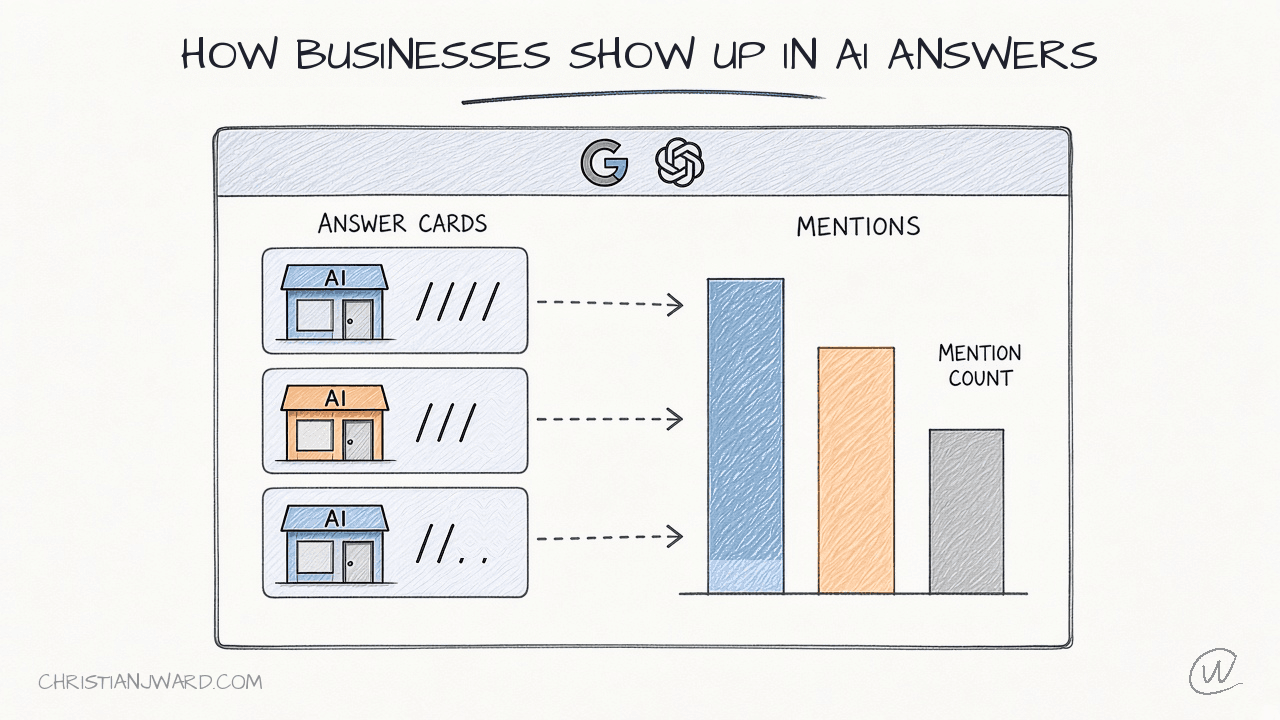
Google and OpenAI are building dashboards for how businesses show up in AI answers

Google added a Generative AI performance report to Search Console this year. Now OpenAI is testing a dashboard inside ChatGPT that would count how often a business appears in answers and how often people click through to its site.

My own posts this week went from a clip of my talk in Marbella to a reply about WebMCP on Thursday morning. An AI that remembers what you tell it decides which businesses it shows you from then on, and once that agent can book or buy for you, it also acts on whatever those businesses have published about themselves.

Google and OpenAI are building dashboards for how businesses show up in AI answers

Counting how often ChatGPT mentions you

Google rolled out its Generative AI performance report worldwide at the end of August, Alex Halliday pointed out, with impressions across AI Overviews and AI Mode broken out by page and by country.

OpenAI hasn't announced its version, and it isn't live yet. Juozas Kaziukėnas found it as part of a larger Business Hub feature in ChatGPT, and Search Engine Land wrote it up. It tracks the number of times a business appeared in ChatGPT responses and the number of clicks on links to its website, day by day in a chart. Only businesses that have verified their ownership get it, for example by connecting a Shopify store.

Juozas noted that it doesn't show prompts, user data or any kind of competitor ranking, so it won't tell you why mentions or clicks went up or down. Combined with outside tools that track prompts, he expects it to show accurate first-party data on whether generative and answer engine optimization is working.

In a post about my SIINDA talk, I wrote that you are not in the conversation. I'm talking to my AI, and it goes out to your clients' websites, listings and data, and cookies and tracking won't show you any of it.

Search Engine Land lists the other half of the Business Hub as adding your latest products, keeping your business info up to date, and a business agent that answers customer questions with context you control.

At SIINDA Live in Marbella I said the only way a business plays is by showing the AI everything true about it.


Memory changes who's on the board

I used Guess Who, the board game we grew up with, in that Marbella talk to show how memory changes who's on the board.

Tell your AI you want to work on your health this year. Candy stores and donut shops are gone, and they never show up again unless you force it to take that context out of its memory.

Christian J. Ward@wardchristianj
Tell your AI you want to work on your health this year. Candy stores and donut shops are gone, and they never show up again unless you force it to take that context out of its memory. I used Guess Who, the board game we grew up with, at @Siinda Live in Marbella to show how memory changes who's on the board. Thank you to Siinda and everyone involved for the opportunity.
· View on X

Designed to forget

Humans are designed to forget. I wrote that to Harrison Chase and asked whether deciding what an agent should drop is one of the new context engineering challenges on his list.

On Monday I told LangChain that an agent with perfect memory doesn't forget anything, and context rot is what that looks like by the time it reaches the final report. So a lot of keeping the window lean comes down to deciding what the agent should drop.

LangChain@LangChain
How do agents remember? And what does preventing context rot have to do with it? Join our live workshop on context engineering for agent memory and learn: ✅ Context management techniques by building w/ Deep Agents ✅ How to keep the context window lean from the first tool call to final report https://events.langchain.com/register/agent-memory-101-context-engineering/
· View on X
Christian J. Ward@wardchristianj
Humans are designed to forget. An agent with perfect memory doesn't forget anything, and context rot is what that looks like by the time it reaches the final report. So a lot of keeping the window lean comes down to deciding what the agent should drop. Does Deep Agents let the agent make that call itself, or is it still a rule the builder writes up front?
· View on X

Offers in the open

Publishers are adding invisible ads for AI agents, The Information reported, and Perplexity blocked the ones Time placed for agents and called them deceptive, according to Digiday.

I replied to Glenn Gabe that hiding paid copy in the version of a page only the agent reads is the deceptive part, because the person asking never sees what shaped the answer.

I still don't think agents should be walled off from brands. An ad doesn't have context, but an offer does. Put the real deal and the facts behind it out in the open where both the person and the agent can check them, and the agent has a good reason to use it.

Glenn Gabe@glenngabe
Sounds like 'Ads for Agents' are coming to Raptive soon. And it's pretty deceptive to me... Perplexity already began blocking the ads from influencing its agents and search results -> Publishers Are Adding Invisible Ads for AI Agents "These ads for AI agents exist on a separate, text-only website version designed to be easily read by the agents. A site using these ads, like Time.com, identifies an agent as soon as it arrives and serves it the stripped-down version of the site rather than the one human visitors see." "Within two weeks of Time’s launch of its agent ads, Perplexity said it began blocking those ads from influencing its AI agents and search results, calling the practice deceptive." "Paul Bannister, chief strategy officer at Raptive, a New York digital ads company, said he is planning to begin pitching ads for AI agents to brands in the next couple of weeks. And over at PMG, roughly a fifth of the Texas-based digital marketing agency’s 60 or so clients plan to run Mobian’s agent ads over the next month, according to a person close to PMG." And Anthropic, OpenAI, and Google worry about BS influence: "Anthropic, OpenAI and Google have all held informal discussions with publishers about ads aimed at agents, according to two people familiar with these discussions. In those conversations, the companies have expressed their worry that marketers could include hidden instructions with an ad—perhaps telling an agent to ignore a competitor’s product—and they want the content clearly labeled as an advertisement, these people said. (Anthropic, OpenAI and Google wouldn’t comment for this story.)" https://www.theinformation.com/articles/publishers-adding-invisible-ads-ai-agents
· View on X
Christian J. Ward@wardchristianj
hiding paid copy in the version of a page only the agent reads is the deceptive part, because the person asking never sees what shaped the answer I don't think agents should be walled off from brands though. An ad doesn't have context, but an offer does. Put the real deal and the facts behind it out in the open where both the person and the agent can check them, and the agent has a good reason to use it
· View on X

AI is speeding up Anthropic's own research

METR published an independent assessment of AI R&D acceleration at Anthropic on Thursday that I found pretty interesting.

As of October 2026, METR estimates Anthropic is improving its models on well-specified tasks at around twice the rate it did between March 2024 and October 2025, and it attributes a majority of that to Anthropic's extensive use of AI in R&D. For now that mostly looks like people working with AI to run experiments faster.

METR gives the number with high uncertainty and wouldn't be surprised if the real figure were closer to 1.3x or 3x. Anthropic redacted a majority of the evidence METR found most informative.

Applying what I learned this week

Google added home-services booking to AI Mode with Angi Home, Thumbtack, Housecall and GetJobber, with ServiceTitan coming soon. It's US only for now, Search Engine Roundtable reported on Thursday.

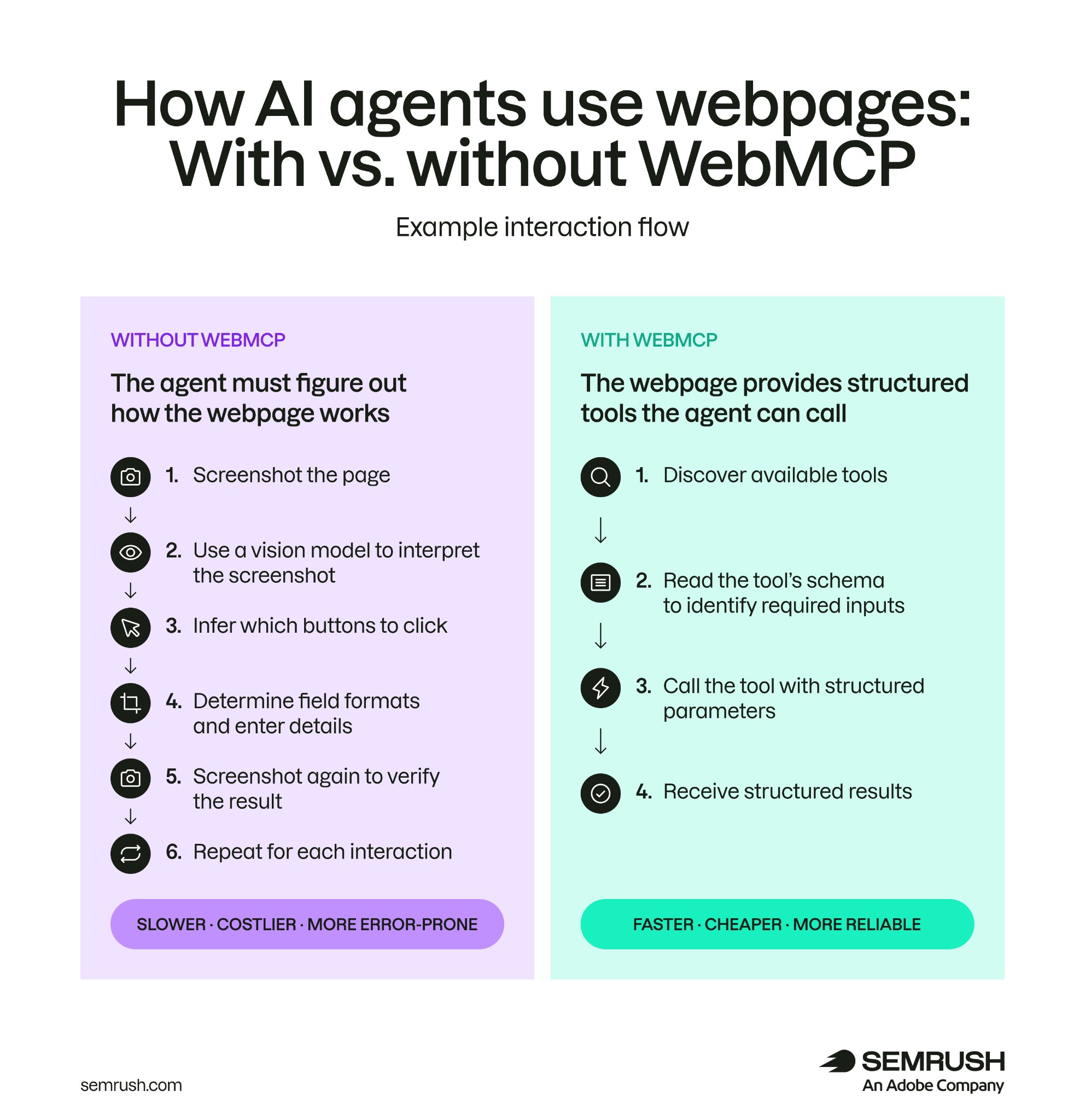
That same morning I replied to Semrush about WebMCP, a W3C draft that lets sites declare structured actions for AI agents.

The harder part for brands is deciding which actions to declare.

An agent that can book, buy or check stock directly will take your site at its word. So whatever you expose has to be right every time, because there is no person on the other end to notice a stale price or a wrong hour.

That makes the data behind the action more important than the page it used to live on.

Semrush@semrush
The web was built for people to read and click. AI agents need a different way to interact with it. Today, agents often rely on screenshots, parse HTML, and guess which buttons and fields to use. WebMCP gives websites a structured way to declare available actions, so agents can discover tools, understand their inputs, and execute them directly. That means fewer fragile steps, more reliable interactions, and a new consideration for marketers: your website needs to be usable by AI agents, not just discoverable. WebMCP is still emerging, but the shift is worth preparing for. Here’s how it works and what it means for your site 👇 https://social.semrush.com/48iHr2R.
· View on X
Christian J. Ward@wardchristianj
The harder part for brands is deciding which actions to declare An agent that can book, buy or check stock directly will take your site at its word So whatever you expose has to be right every time, because there is no person on the other end to notice a stale price or a wrong hour That makes the data behind the action more important than the page it used to live on
· View on X

How they come together

The dashboards count how often an AI mentions a business and how often someone clicks. The other sections are about what the agent believes about a business by the time it answers. Memory sets which businesses are still on the board for me, what the agent drops sets what it still knows, and an offer in the open gives the person and the agent the same facts to check.

On Sunday I wrote that the new AI systems don't have well defined Actions tied to their answers yet, and that this will change very quickly. By Thursday Google had home-services booking inside AI Mode, and an agent booking on those facts has no person there to notice a mistake.

METR's assessment is about something else, how fast the models themselves are improving.

send me the best thing you read this week.

By the way

Claire Vo called what's happening with AI-built software new physics. I replied that the name is appropriate, because we're really talking about the force exerted, the mass of the current system, and the acceleration of everything around us. That reply had 1,289 impressions as of Thursday morning, more than anything else I posted this week.

Get it every Friday