WILTWWhat I Learned This Week

Issue 02October 23, 20264 stories6 min read

Agents need shared context and memory

This week is all about what an agent knows about the person, the task and the facts in front of it.

The systems that keep that memory consistent across models are the ones that will feel like one assistant. Everything below is something to read or check out that supports it.

Agents keep working while you're away

Anthropic opened a research preview of Claude Duet, an app where Claude works as a proactive agent. It comes to you with what needs your attention, keeps working when you step away and checks with you before it acts on your behalf.

Claude@claudeai
We’re opening a research preview of Claude Duet, a new app where Claude works as a proactive agent. It comes to you with what needs your attention, completes tasks you ask of it, keeps working when you step away, and checks with you before it acts on your behalf. https://t.co/kt8gAbWuX8

· View on X

Good memory should make the next task better

Letta introduced FrontierMemory, which tests whether the memory an agent writes for itself helps it do better on later tasks.

Letta's CEO, Charles Packer, wrote that an agent with good memory should cost less or score higher than an agent without it. Measured that way, frontier models vary widely in how useful their memories are.

Letta@Letta_AI
Introducing FrontierMemory: a new way to evaluate agent memory through downstream task performance. While existing memory benchmarks focus on recall (saturated via agentic search), FrontierMemory focuses on how agents learn from experience.
· View on X
Charles Packer@charlespacker
Modern "memory" benchmarks are saturated since they measure recall of facts -- in the coding harness / bash loop era, recall is solved, while continual learning in token space remains unsolved. FrontierMemory is a new benchmark designed to actually measure self-improvement through memory. It's built on a simple premise - if AI-generated memory is *good*, it should actually improve downstream task performance. An agent with good memory should be more efficient (lower cost), or it should be more capable (higher score) than memory-less agents. When you measure memory this way, it turns out there's a very wide spread in frontier model capabilities. Opus 5.5 and GLM-5.3 for example are *significantly* better at generated useful memories than GPT-6.1 Sol. FrontierMemory can measure overall harnesses as well: and it also turns out that different implementations of AI dreaming vary wildly in performance. For example, it may surprise you that @PrimeIntellect Agent's memory system works significantly better than Hermes Agent's. FrontierMemory is a continuous benchmark - we will be adding more tasks and revising them over time, and will be adding extremely long-horizon RSI-style tasks in our next release. If you're building an AI system with memory, please reach out / DM! Likewise if you're building models or harnesses and would like to submit.
· View on X

Agents are starting to work in groups

Pedro Domingos wrote that the society of models he predicted in The Master Algorithm in 2015 is coming to pass.

In my reply to him, I wrote about how people actually work now, with one model planning, another writing the code and a third checking whether the result does what was asked. They need shared context and shared memory, or each agent starts from zero and repeats work another agent already finished.

Eugenia Kuyda launched Wabi 2.0, an agent you use together in a group thread. When the school changes pickup time, Wabi updates the family calendar and everyone sees it.

My own agents in Grok Bot share memory in a similar way, so a rule one bot records reaches the others. That's a big reason they can work together, and it also makes it easy for one wrong memory or rule to corrupt the other bots.

Pedro Domingos@pmddomingos
The society of models I predicted in "The Master Algorithm" in 2015 is coming to pass. https://t.co/sYSxoWyaW4
· View on X
Christian J. Ward@wardchristianj
You called it in 2015. I read The Master Algorithm when it came out, and it definitely opened my eyes. It's not necessarily about competing philosophies or algorithmic approaches. It's the understanding, which has certainly played out, that there will be a combination of solutions that are extremely customized. That also plays into the society of models concept, where we need this shared memory and context. It's showing up in how people actually work now, with one model planning, another writing the code and a third checking whether the result does what was asked. They need shared context and shared memory. Without it, each agent starts from zero and repeats work another agent already finished. Coordination comes down to what every model knows about the person, the task and the facts in front of it. The systems that keep that memory consistent across models are the ones that will feel like one assistant.
· View on X
Eugenia Kuyda@ekuyda
Wabi 2.0 is live! personal agents are one person, one chat. but the parts of life that matter run on more than one person Wabi is an agent you use together. you talk to it, it does stuff, builds the apps you need, and anyone can join the thread - your partner, your best friend, the preschool moms groupchat school changes pickup time → Wabi updates the family calendar, everyone sees it. a show you’d both love → Wabi finds a night that works, gets the tickets. the trip everyone keeps talking about → Wabi picks the dates, builds the itinerary, books it go start a thread with your people 👇
· View on X

Applying what I learned this week

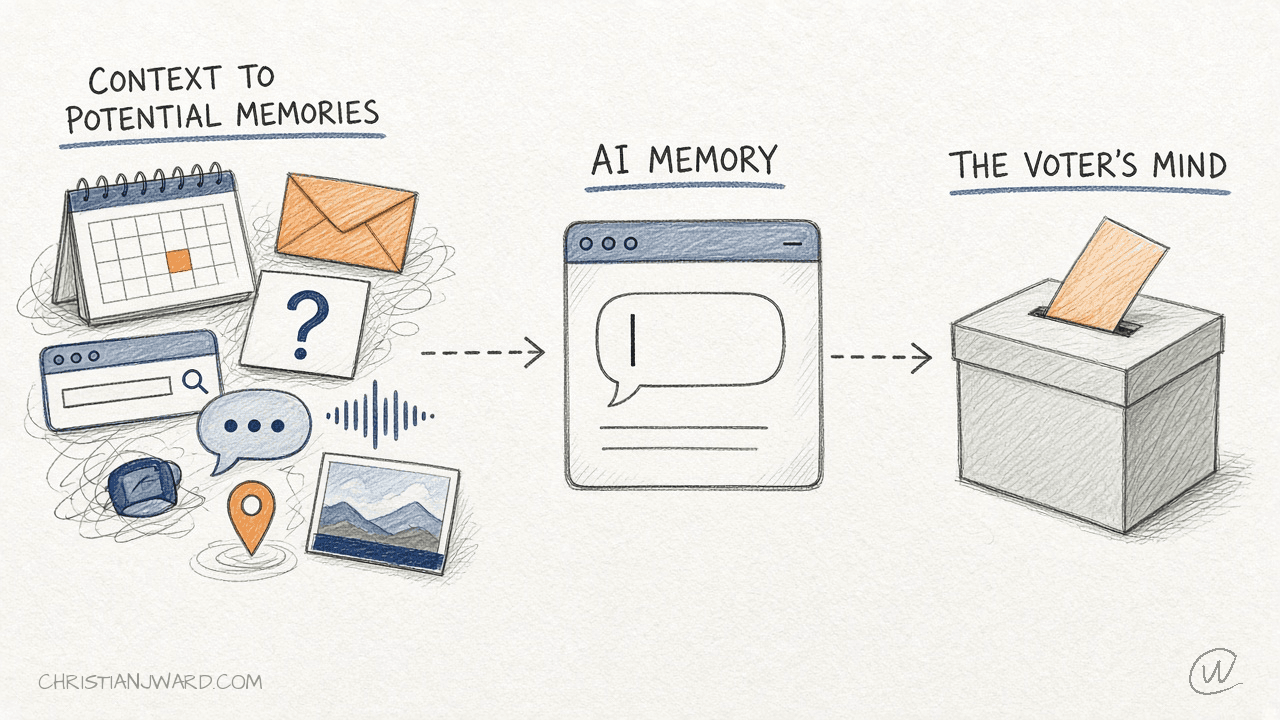
There's a lot of news about how voters feel about fraud and how they feel about the elections. And I can't help but think about how context and memory are going to drastically change the life of the average voter.

I almost feel bad for all the shady legislators who draft legislation and referendums and other things with names that are so confusing.

Because my AI is going to be able to understand what I read, what I write, who I talk to, my conversations, and it's going to be able to help me decipher what is so hidden in a lot of these things.

And helping people pick candidates.

I think that's a good thing, but how it's done will be mostly through the types of tools I learned about this week with memory and context.

CNBC@CNBC
Corruption is voters' top issue ahead of midterm election, CNBC survey shows https://t.co/HRuuhD0w5o
· View on X

How they come together

All three come down to context and memory, and so does the way an AI picks a business.

One of my own posts this week was about a dad whose Grok Bot found a dentist near him that took his insurance, then booked the appointment from its browser.

What he asked about was insurance and an open appointment, and star ratings never came up. You could be very highly rated, and if you don't take my insurance, it doesn't matter.

In Yext research, the highest-rated business led an AI's list only 40% of the time.

Every question people ask AI is going to be custom to the context and memory of the person asking, so a business is only going to win in AI if it gives the AI every detail it can, in real time.

send me the best thing you read this week.

By the way

By the way, here's the thing that got the most interest on social, the one about a dad whose Grok Bot booked his dentist appointment. The most read post on the blog was Number one is a thing of the past.

Get it every Friday