From the Newsletter
The AI Prosthetic: How Invisible Tech Will Scale Every Human
How multimodal AI with persistent memory will create enhanced humans within two years

A lot just happened in a single week. Claude Sonnet 4 dropped (Anthropic, 2025). Google I/O happened (Google, 2025). Jony Ive and Sam Altman announced their new venture (TechCrunch, 2025).
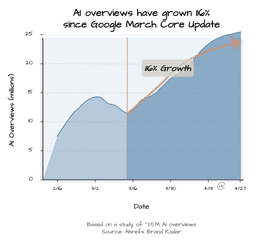
The SEO community is trying to understand what AI overviews mean for search (Search Engine Land, 2025). They're working through the context changes and what they mean for rankings.
But these changes point to something much larger, which is AI scaling human capability at the individual level.
It's all moving so fast that it's hard to take in. Still, you need to skate where the puck is going. Right now the puck is headed toward full modality AI, with memory, vision, and reasoning that expand what each person can accomplish.
The Emergence of Personal Capability Scaling
Full modality AI changes how people interact with computers. These systems can see, hear, remember, and process information across several channels at once.
Google's glasses demonstration at I/O showcased this direction (Google, 2025). The device takes ongoing snapshots of your environment, remembering where you left your keys and conversations from weeks ago.
The glasses are a first step. The real target is something far more integrated.
Now imagine a wearable device small enough to disappear and connected enough to link you to AI that scales you as an individual throughout an entire day, week, month, year, and life.
The current Meta offerings are bulky glasses, and most wearable hardware still screams "tech user." The device I'm describing would fade from view while it expands your cognitive reach.
We're talking about adding an AI prosthetic to the human experience. Each person's available knowledge graph gets much larger as a result.

If you wear Meta glasses, that’s you on the left.
At my age, it's a very human experience to walk into a room and forget why I went there.
That may never happen again once this kind of scaling arrives, because the AI will remember what I walked in there to do.
Claude Sonnet 4 and similar models now process visual, audio, and text inputs while maintaining conversation context across sessions. They remember what you're working on and how you like to think.
The Jony Ive and Sam Altman collaboration points in exactly this direction. When Apple's former design genius teams up with OpenAI, they're building the infrastructure for invisible human augmentation.
Memory Plus Modality Equals Individual Expansion
The technical breakthrough comes from combining persistent memory with multimodal processing and contextual reasoning.
Earlier AI forgot each conversation as soon as it ended. Newer systems keep memory across interactions, so over time they come to understand your patterns and your projects.
Multimodal processing means handling images, audio, text, and video at the same time. The AI that reads your email can also see your screen and hear the room around you.

AI will develop much faster than you realize.
Contextual reasoning is what ties it together. The system stores what it takes in and then connects the dots, across different kinds of input and across time.
Say you're reading a book on a flight. You talk through the ideas with your AI companion using an invisible interface, and from that conversation it suggests blog post angles and adapts the content for different audiences.
Your wearable captures the whole exchange, including the book, what you said about it, and how you reacted. Weeks later, when a related topic comes up, it can bring that moment back.
It changes learning, too. Education can happen anywhere when you have a trusted guide who knows how you learn and where your gaps are.
The classroom becomes wherever you are.
Preparing for Personal Scaling
Start experimenting with multimodal AI tools now. Upload images to Claude, try talking to it by voice, and build habits around working with AI.
Document how you think. These systems learn from what you give them, so better input means they can scale you further.
Look at your own information architecture.
How do you capture, process, and retrieve what you know right now?
AI will amplify whatever system you already have.
Practice prompting across modalities, so you get comfortable working with AI through text, voice, and images. My latest hack is using Apple Voice Memos on my watch, which creates full transcripts for a recording or conversation. I then take the transcript that Apple Voice Memos generates and feed it into an AI to help organize my thoughts.
Think about what you uniquely bring.
What makes your thinking distinctive?
AI will scale your strengths and help cover your weaknesses.
Ask yourself this.
What would you attempt if you had perfect memory and unlimited processing power accessible through an invisible interface?
Start moving toward those goals now.
Then picture your daily routine once AI becomes invisible and constant, and how you'd approach learning a new skill with a trusted AI guide available anywhere.
The Ethical and Moral Questions
This raises big ethical and moral questions that we're not prepared to answer.
When AI becomes a prosthetic extension of human capability, I wonder what happens to authentic human experience.
Do we lose something about being human when we never forget, never lose focus, and never lack information?
Privacy concerns multiply when a wearable is always connected and the AI keeps a persistent memory of your days and your conversations.
Who owns this data, and who can access it?
The inequality problem worries me too. If some people have access to capability scaling and others don't, we end up with a new class system of enhanced and unenhanced humans.

I don’t want to become an orange statistic.
Then there's dependency, as we lean on AI for memory, decisions, and problem solving.
What happens when the system fails, and will we still have those skills ourselves?
Authentication becomes impossible.
How do we verify that a human is really on the other end if AI can perfectly mimic the way people think and respond?
The social fabric changes too. Relationships, work, creativity, and achievement all shift when AI scales what a person can do, and we don't know yet what that means for society.
Individual Capability Expansion at Scale
What happens when every person has cognitive tools that go far past what one person could do alone?
Start with the economics. When one person can do work that used to take a team, entire business models shift.
Educational systems will need restructuring. Learning objectives change when AI gives instant access to information and analysis through invisible interfaces, and the idea of expertise will change along with them.
Creative industries get new forms of expression, and their traditional creative processes get challenged at the same time.
At work, people collaborating with AI will open up entirely new categories of individual achievement.
We're scaling us.
The Timeline is Now
None of this is far off.
Google's glasses already demonstrate environmental memory and visual processing. Claude Sonnet 4 handles complex multimodal tasks today.
The Ive and Altman partnership suggests that invisible scaling devices will be ready for consumers within the next two years, and other companies are racing toward the same thing.
Adoption will follow the smartphone pattern. It will start slowly, then speed up fast, until nearly everyone has one.
Early adopters get a real head start. There's a learning curve now, and it will get steeper as the capabilities grow.
Human capability scaling has begun.
We're still not prepared for the ethical, moral, and social questions that come with it.
Looking Back
Looking back from September 2026.
To a large degree, AI is already "seeing" my screen and my phone more than I am. AI with the camera always on keeps developing, with Meta launching their glasses, and every other device out there is contemplating more "ambient" AI.
Apple just announced Siri Recap for Apple Watch, which can create summaries of your conversations for you to review later. It arrives in beta later this year.
This will evolve very quickly. And yes, I think it has lots of privacy concerns, but it will not slow down.
Anyone who uses AI note takers knows they seem amazing. Then you have to do something with what they capture, and that's the next step.